Algeria
 Egypt
 Libya
 Morocco
 Sudan
 Tunisia
 Benin
 Burkina Faso
 Cabo Verde
 Côte d'Ivoire
 Ghana
 Guinea
 Guinea-Bissau
 Liberia
 Mali
 Mauritania
 Niger
 Nigeria
 Senegal
 Sierra Leone
 The Gambia
 Togo
 Cameroon
 Central African Republic
 Chad
 DR Congo
 Equatorial Guinea
 Gabon
 Republic of the Congo
 São Tomé and Príncipe
 Burundi
 Comoros
 Djibouti
 Eritrea
 Ethiopia
 Kenya
 Malawi
 Mauritius
 Mozambique
 Rwanda
 Seychelles
 Somalia
 South Sudan
 Tanzania
 Uganda
 Angola
 Botswana
 Eswatini
 Lesotho
 Namibia
 South Africa
 Zambia
 Zimbabwe
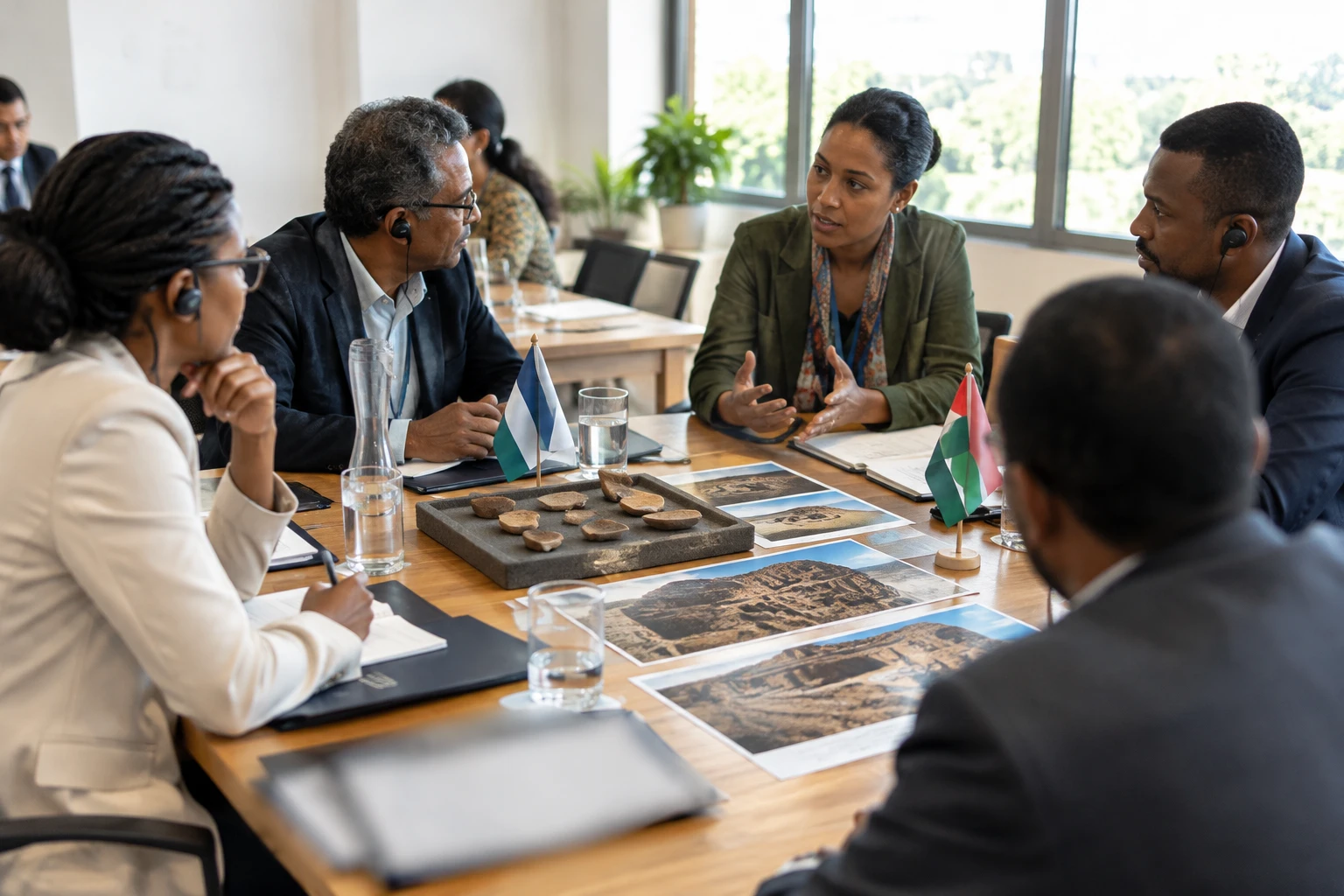
More than 200 kilometres from the coast, in the Isalo massif, a complex of terraces and structures cut into rock tells the story of a Madagascar connected to the Indian Ocean. Teniky is prompting researchers to look beyond the coast to understand the first centuries of settlement and the movements that crossed Madagascar.
A landscape shaped in the heart of Isalo
The site lies in a rocky cirque in southern Madagascar, within Isalo National Park. Cliffs enclose several developed spaces: terraces, sandstone walls, basins and niches cut into the rock. Some cavities contain sculpted features. The complex differs from known archaeological sites elsewhere on the island and along the East African coast.
Research carried out since 2021 by a Malagasy-Swiss team has revealed that Teniky is larger than initial observations suggested. Researchers have identified structures spread across several areas, including beyond the main cirque. A study published in the journal Azania: Archaeological Research in Africa describes these features and the results of the surveys.
Radiocarbon dating of charcoal associated with the structures places some of the construction between the end of the first millennium and the beginning of the second. Researchers put the period more specifically around the 11th and 12th centuries. Imported ceramics, dated between the 11th and 14th centuries, support this broad chronology. They cannot, on their own, date each wall or terrace: their interpretation must be considered alongside other archaeological evidence.
Distant trade, but origins still unknown
Since work began, the team has collected about 3,000 pottery fragments, according to the researchers’ account. Some came from Chinese and Southeast Asian wares. These objects attest to long-distance trade across the Indian Ocean. However, they cannot by themselves identify the people who transported them or those who lived at Teniky.
Malagasy researcher Chantal Radimilahy points out that Madagascar took part in these medieval trading networks. Goods may have passed through several ports and intermediaries before reaching the interior of the Great Island. The presence of imported objects therefore does not mean that Teniky’s inhabitants necessarily came from the regions where those objects were made. Rather, it sheds light on links between inland communities, coastal settlements and maritime routes.
This distinction matters. Archaeology can establish dates, materials and similarities, but precise routes and identities remain to be documented. The study of Teniky thus shows that trade can connect distant places without those contacts being reduced to a single migration or a simple origin.
Architectural similarities do not prove origins
The niches and some features at Teniky resemble rock-cut structures found in Iran, particularly in the Fars region. This comparison has prompted several hypotheses about possible practices and influences. It does not prove that a community from present-day Iran built the site, or that a particular religion was practised there.
The study’s authors cautiously suggest that some structures may have had a ritual or funerary purpose. They stress that formal similarities are not enough to establish cultural descent. Further research, particularly into how the spaces were used, the objects found there and relations with local populations, is needed before conclusions can be drawn.
The dating also challenges an earlier interpretation that attributed some of the constructions to the Portuguese, several centuries later. The available evidence places the site’s main period of activity well before their arrival in the region. Teniky has yet to reveal the names of its builders, but it places their presence in an important period of Madagascar’s early history.
Linking the interior to the coast
To better understand how people and goods moved, other research is focusing on river mouths and coastal sites. These places may help trace the stages between maritime routes and the interior. At Teniky, questions remain about who lived there, how the community obtained imported objects, and why the site was occupied and later abandoned.
This investigation is part of a history of Malagasy settlement built from several disciplines and sites across the island. Archaeological evidence complements research on languages, trade and environments. It does not tell a story of a single origin; rather, it makes it possible to study encounters, movements and forms of organisation over time.
At the regional level, Teniky is a reminder that Madagascar has long been part of a network linking the African coast, Asia and the islands of the Indian Ocean. The country is now a member of the Southern African Development Community, SADC, a framework for regional cooperation. But the medieval networks highlighted by the ceramics extended beyond present-day political borders and were part of much older maritime exchanges.
Further progress will depend on new excavations, comparative analyses of the ceramics and research at coastal sites. This work may clarify Teniky’s role in links between the coast and the interior, without making assumptions about the identity of its builders. For now, the findings establish one essential point: in the Middle Ages, communities lived in this isolated area while remaining connected to far-reaching trade networks.