Algeria
 Egypt
 Libya
 Morocco
 Sudan
 Tunisia
 Benin
 Burkina Faso
 Cabo Verde
 Côte d'Ivoire
 Ghana
 Guinea
 Guinea-Bissau
 Liberia
 Mali
 Mauritania
 Niger
 Nigeria
 Senegal
 Sierra Leone
 The Gambia
 Togo
 Cameroon
 Central African Republic
 Chad
 DR Congo
 Equatorial Guinea
 Republic of the Congo
 São Tomé and Príncipe
 Burundi
 Comoros
 Djibouti
 Eritrea
 Ethiopia
 Kenya
 Madagascar
 Malawi
 Mauritius
 Mozambique
 Rwanda
 Seychelles
 Somalia
 South Sudan
 Tanzania
 Uganda
 Angola
 Botswana
 Eswatini
 Lesotho
 Namibia
 South Africa
 Zambia
 Zimbabwe
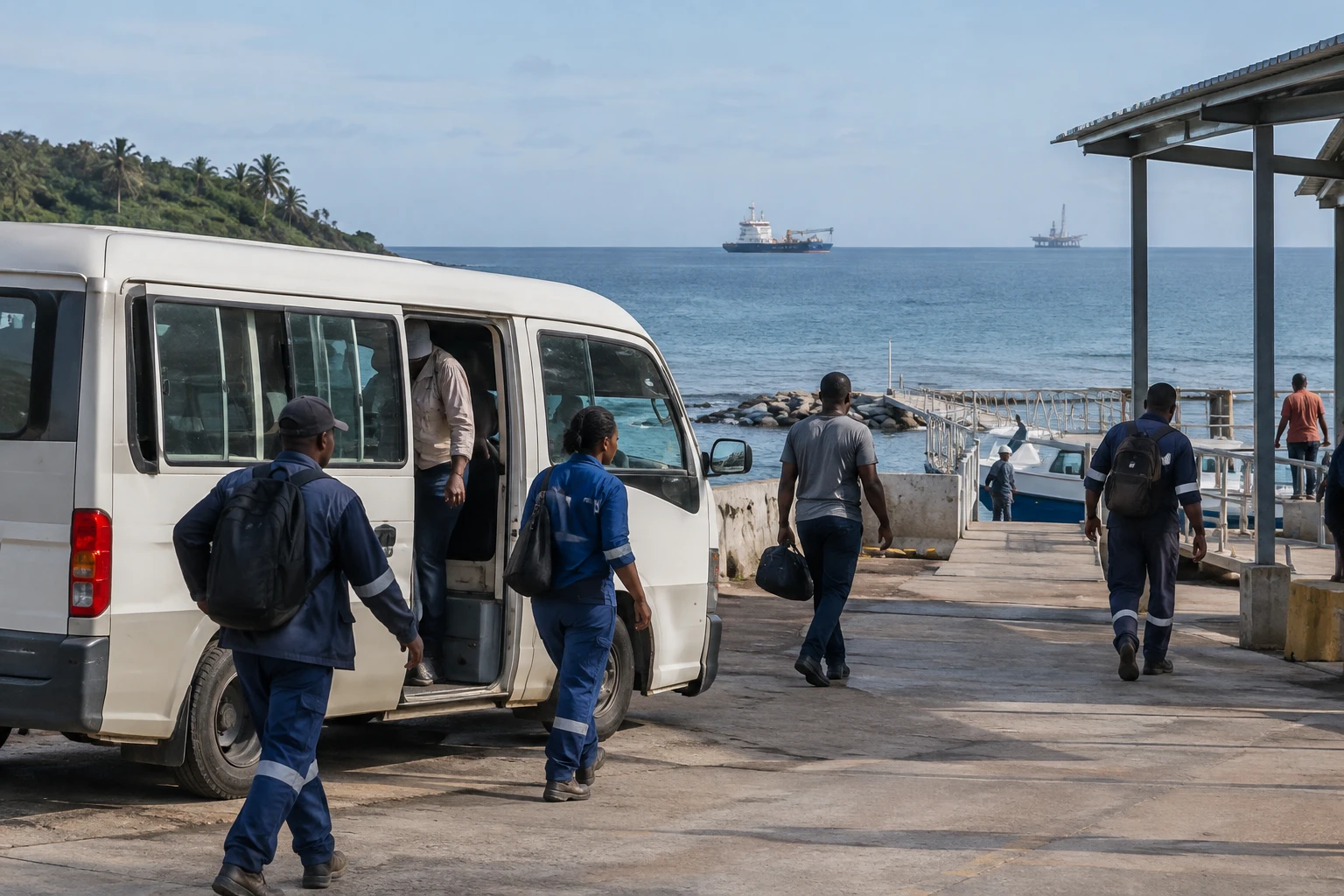
Off Mayumba, the immediate priority remains the human toll. The sinking of the Prospector 5 disrupted an offshore oil operation and mobilised Gabonese rescue services. It also raises a practical question: how can the causes of an accident during a technical manoeuvre be established, and what assurances can be given to workers and their families?
An accident during positioning
The Prospector 5 sank on Saturday 24 October 2026, at around 20:37, at the Dussafu Marin offshore oil licence, off Mayumba in Nyanga province. The jack-up unit, owned and operationally run by Borr Drilling, was preparing for a drilling campaign for BW Energy.
There were 115 people on board. In its initial report, the company said 110 had been brought to safety and five were unaccounted for. During the day on 25 October, one death was subsequently announced: at that point, four people remained missing. The figures may still change as search operations continue. Borr Drilling confirmed the time, the number of people on board and the initial figures. The Gabonese News Agency also reported the first information gathered in Gabon.
The platform was being jacked up and preloaded, a step before it is installed for drilling. Borr Drilling has cited, as a preliminary explanation, the seabed subsiding beneath a support, followed by a loss of stability. This describes the company’s initial hypothesis; it is not yet an investigative finding. The precise causes and any potential responsibility remain to be established.
Investigation expected, rescue efforts a priority
Gabon’s Ministry of Petroleum has announced an investigation to determine the circumstances of the accident and any potential responsibility. The authorities and companies say they are co-ordinating the search. President Brice Clotaire Oligui Nguema said state resources had been mobilised. Families are waiting for verified information about their loved ones, while survivors need medical follow-up and support after their evacuation.
A credible investigation will need to draw on technical evidence: data from the unit, seabed conditions, preloading procedures, how the manoeuvre was organised and emergency arrangements. It will also need to clarify the chain of decision-making between the licence operator, BW Energy, and the contractor that owns and operates the platform, Borr Drilling. The involvement of several companies must not make responsibilities unclear.
The ministry also said that production at the nearby MaBoMo facility had been halted in line with safety procedures applied during preparations for drilling. No damage to that facility or release of harmful substances from it had been reported at the time of its statement. This is not enough to draw conclusions about all the risks associated with the sinking: the wreck’s condition and any potential environmental impact will need to be assessed and documented.
A national issue in an oil-based economy
The oil sector is important to Gabon’s economic activity and public revenues. But the industry’s importance does not reduce the accident to a production issue. For workers, safety comes first; for their families, transparency and support; and for the authorities, the ability to enforce the rules and report the findings. Coastal residents, particularly in the south of the country, also have an interest in seeing risks to the marine environment examined publicly.
The sinking comes amid previous scrutiny of the safety of offshore operations in Gabon. In March 2024, a fire on the Becuna platform, operated by Perenco, led to the deaths of workers. This earlier incident does not mean the two accidents should be treated as equivalent: the circumstances and operators differ. It does, however, serve as a reminder that investigations and follow-up on recommendations must go beyond immediate crisis communications.
Oil production depends on facilities far from cities and land-based services. Operations involve employees, subcontractors and rescue teams, while technical decisions are taken by companies and authorities with distinct roles. This makes tested evacuation protocols, clear contractual responsibilities and information accessible to families and the public essential.
The regional dimension and next steps
Gabon is a member of the Economic and Monetary Community of Central Africa (CEMAC), which brings six states together in economic and monetary co-operation. The accident is not a CEMAC matter as such, but it concerns issues shared across the Gulf of Guinea: maritime safety, rescue preparedness and pollution prevention. Risks at sea do not stop at administrative borders, making the sharing of expertise among coastal states useful.
At continental level, the incident highlights the importance of governing natural resources in a way that protects people and the environment as well as organising their exploitation. For Gabon, the immediate test will be to find the missing people, support survivors and make the investigation’s findings public. The next significant information will concern the human toll, the wreck’s condition, the environmental assessment and corrective measures before any resumption of the operations concerned.
For now, established facts must be kept distinct from technical hypotheses. A provisional tally puts the death toll at one, with four people still missing, after 110 of the 115 people on board were brought to safety. The search is continuing, and the investigation will need to establish how a preparatory manoeuvre led to the loss of the platform.