Algeria
 Egypt
 Libya
 Morocco
 Sudan
 Tunisia
 Benin
 Burkina Faso
 Cabo Verde
 Ghana
 Guinea
 Guinea-Bissau
 Liberia
 Mali
 Mauritania
 Niger
 Nigeria
 Senegal
 Sierra Leone
 The Gambia
 Togo
 Cameroon
 Central African Republic
 Chad
 DR Congo
 Equatorial Guinea
 Gabon
 Republic of the Congo
 São Tomé and Príncipe
 Burundi
 Comoros
 Djibouti
 Eritrea
 Ethiopia
 Kenya
 Madagascar
 Malawi
 Mauritius
 Mozambique
 Rwanda
 Seychelles
 Somalia
 South Sudan
 Tanzania
 Uganda
 Angola
 Botswana
 Eswatini
 Lesotho
 Namibia
 South Africa
 Zambia
 Zimbabwe
An international agreement can recognise cocoa producers’ right to a living income. But it cannot, on its own, guarantee that money from bean sales reaches the households that grow them. For Ivory Coast, the world’s largest producer, the stakes are therefore as much political as commercial.
A new framework, with no mandated price
Adopted in Geneva on 13 February 2026, the International Cocoa Agreement 2026 entered into force on 1 October. The decision was formalised after a meeting of the Council of the International Cocoa Organization (ICCO) in Abidjan, from 14 to 18 September. The agreement succeeds the 2010 deal and broadens shared priorities: a living income for producers, processing in countries of origin, and economic, social and environmental sustainability. The ICCO confirmed the date it entered into force; reports published in Abidjan also cited it.
The text defines a living income as a household’s net income sufficient to provide a decent standard of living for all its members, according to national criteria. It calls on member countries to develop policies to that end. But it sets neither a global floor price nor an automatic penalty mechanism to compel industry players to pay farmers a specified income.
This distinction is central. The agreement establishes a shared ambition and a framework for co-operation. Concrete measures remain, for the most part, in the hands of governments and industry players. Recognition of a social objective therefore does not mean that producers’ incomes will rise as soon as the text enters into force.
From stock regulation to co-operation
Founded in 1973, the ICCO was initially associated with a more direct attempt to stabilise the market. The first international agreements provided for export quotas and a buffer stock: buying beans when prices fell, then releasing them onto the market when supply tightened. The aim was to limit sharp fluctuations in a crop whose trees take several years to yield after planting.
The system ran into practical and political difficulties. Building and maintaining stocks required financing and infrastructure. Producer countries needed export revenues, while farmers needed to sell their harvests. In addition, private stocks and the volumes actually available were difficult to measure. The 1993 agreement marked a change of course: quotas and the buffer stock gave way to co-operation, market analysis and a balance between production and consumption.
The 2026 text extends this evolution. It does not reinstate a public body tasked with buying beans to support prices. Instead, it relies on shared objectives, information-sharing and government action. This approach leaves room for national policies, but does not directly correct the imbalance of power between producers, traders, grinders and brands.
In Ivory Coast, added value is created at several levels
The Ivorian market already has its own mechanisms. The Coffee-Cocoa Council organises marketing and sets a guaranteed price for farmers for each season. This system can shield producers from some global market fluctuations. However, it is not enough to resolve questions around costs, yields, quality, orchard diseases or how value is shared along the supply chain.
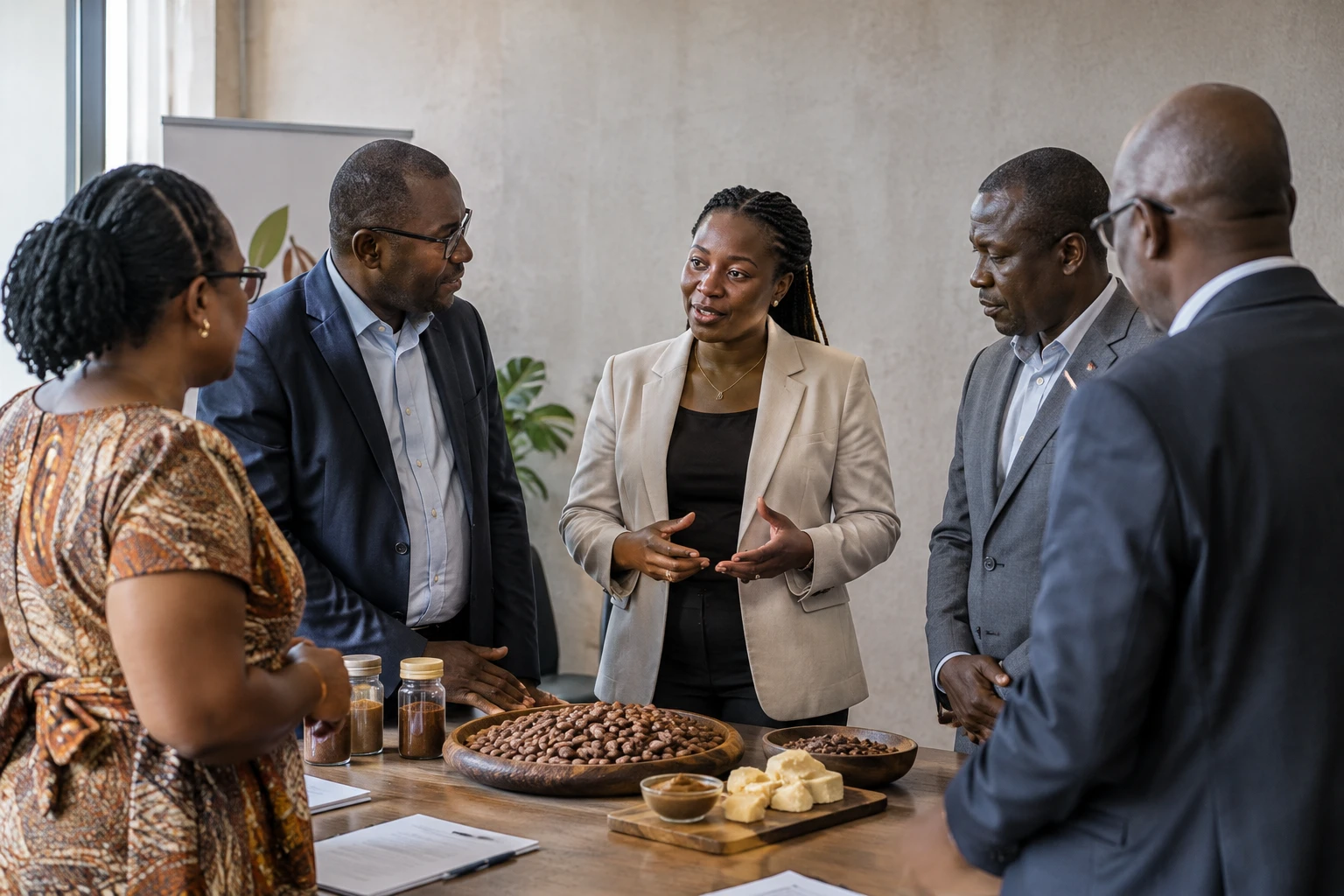
Local processing is one of the new agreement’s priorities. Grinding beans in Ivory Coast to produce cocoa liquor, butter or powder can support jobs and industrial activity. But the location of a factory does not, by itself, show who owns the assets, controls purchasing, organises transport or sets prices. The question also concerns the role of Ivorian companies, co-operatives and workers in these activities.
Tensions over incomes are a reminder that international objectives meet different realities across seasons and households. In January 2026, the Associated Press reported that Ivorian authorities planned to buy unsold stocks, as producers reported beans for which they had not been paid. This latest episode shows that an official price alone does not guarantee that the entire crop will actually be bought. The announced price, the volumes collected and the net income left to the household must be distinguished.
A benchmark published by Fairtrade for 2026 puts the reference price needed for a living income in Ivory Coast at 1,758 CFA francs per kilogram. This figure is an indicator developed by the organisation, not a mandatory price set by the international agreement. It also highlights why household income depends on several factors: the quantity produced, farming costs, the size of the holding and cocoa’s share of family resources. Fairtrade sets out its reference price for the 2026 season.
Implementation will be the test
Across West Africa, Ivory Coast and Ghana account for a major share of global production. Their choices on prices, marketing and traceability therefore carry weight far beyond their borders. ECOWAS, the regional organisation for West Africa, provides a forum for dialogue between neighbouring states, but the ICCO agreement is part of broader international co-operation between producing and consuming countries.
For producers, the priorities remain concrete: sell the harvest, cover household expenses and renew orchards without expanding cultivation into forests. For the state, the challenge also includes developing industrial capacity, improving stock transparency and maintaining export competitiveness. Industry players, meanwhile, must contend with price, supply and compliance risks.
The agreement can facilitate the exchange of data on production, stocks, grinding and prices. But the quality of this information will depend on how it is collected and shared. Monitoring national policies, the remuneration households actually receive and the share of value retained in producer countries will show in the coming years whether the new objectives go beyond commitments on paper.