
 Algeria
 Egypt
 Libya
 Morocco
 Sudan
 Tunisia
 Benin
 Cabo Verde
 Côte d'Ivoire
 Ghana
 Guinea
 Guinea-Bissau
 Liberia
 Mali
 Mauritania
 Niger
 Nigeria
 Senegal
 Sierra Leone
 The Gambia
 Togo
 Cameroon
 Central African Republic
 Chad
 DR Congo
 Equatorial Guinea
 Gabon
 Republic of the Congo
 São Tomé and Príncipe
 Burundi
 Comoros
 Djibouti
 Eritrea
 Ethiopia
 Kenya
 Madagascar
 Malawi
 Mauritius
 Mozambique
 Rwanda
 Seychelles
 Somalia
 South Sudan
 Tanzania
 Uganda
 Angola
 Botswana
 Eswatini
 Lesotho
 Namibia
 South Africa
 Zambia
 Zimbabwe
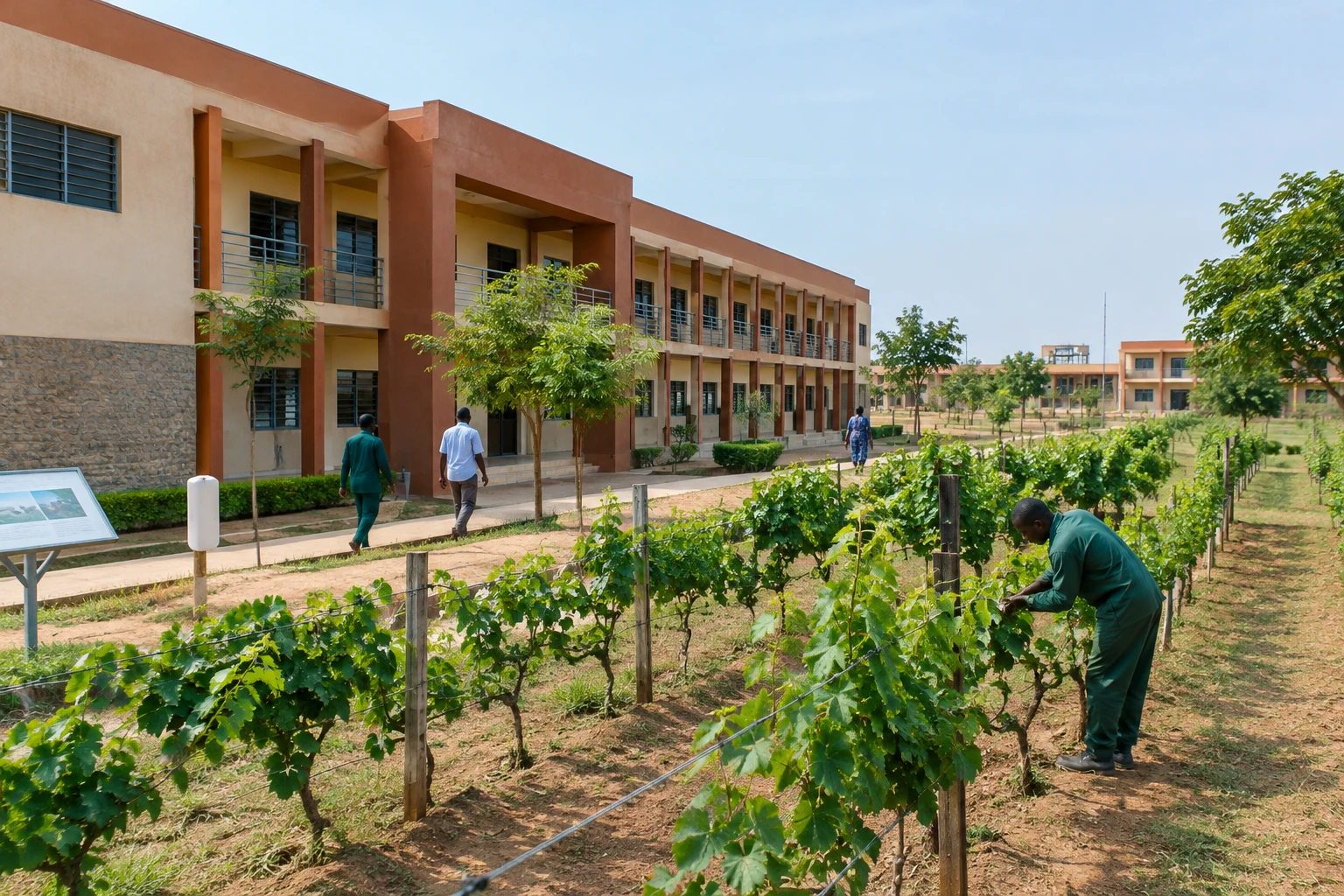
Processing grapes into wine in Burkina Faso for sale on the regional market: this ambition is now being pursued by a public-private company. But between a plant announced in Bobo-Dioulasso and a handful of experimental plots, the future sector must still demonstrate that it can secure a regular supply and produce at a competitive cost.
A mixed-ownership company, an investment to be delivered
On 22 October 2026 in Ouagadougou, the Council of Ministers adopted a decree creating the Société viticole du Burkina (SOVIB). The government report, carried by the public agency Sidwaya and the African Press Agency, confirms the creation of a mixed-economy company, jointly owned by public and private actors. The official announcement of SOVIB’s creation provides for initial capital of one billion CFA francs.
The state is to hold 45%, the Burkinabè private sector 45%, and BRAFASO, the national brewery, 10%. The company is to process grapes grown in the country. An industrial plant is planned for Bobo-Dioulasso, at an estimated cost of 9.8 billion CFA francs, or about $16.75 million.
The announced cost of the plant should not be confused with the company’s share capital. At this stage, the public information consulted provides no details of the full financing plan, production capacity, or construction and commissioning timetable. These are decisive steps: the announcement sets a direction, but does not yet amount to an operational plant.
Experimental vineyards, the first agricultural test
Industrial processing will depend first on the availability of grapes. Yet viticulture in Burkina Faso remains at the experimental stage. On 2 March 2026, Agriculture Minister Ismaël Sombié visited Bèga, in the commune of Bagré. The site covers four hectares and has 17,496 vines across 12 varieties, according to the ministry and Burkinabè media. An expansion to 10 hectares is being considered. The report on the agricultural visit to Bagré says the first fruit is appearing.
Another 0.5-hectare vineyard is at the National Agricultural Training School in Matourkou, near Bobo-Dioulasso. These trials are intended to help assess how varieties and farming practices adapt to local conditions. However, the areas recorded are not yet enough to establish harvest volumes, yields or the quantity of grapes that could be sold to a plant.
Moving from experimentation to commercial production takes time and investment: vines, irrigation, agronomic monitoring, storage and transport. It will also be necessary to determine whether growers will work directly with SOVIB, at what prices and with what purchase guarantees. Without a reliable market for farms, an industrial plant risks running short of raw materials. Conversely, steady demand could give growers an economic incentive to expand their vineyards.
Cutting imports without confusing volume and value
The project forms part of Burkina Faso’s policy of local processing and food sovereignty. It targets a market currently supplied largely by imports. Trade data cited in the source material and attributed to Trade Map show average annual imports of 13,780 tonnes of wine and grape must between 2021 and 2025, worth $4.32 million. They show a peak of 16,000 tonnes and $6.1 million in 2022.
These figures describe customs categories and overseas purchases; on their own, they do not show what share of the market Burkinabè production could capture. In 2025, according to the same data, France was the leading supplier by value, ahead of Togo and Spain. Local production could curb some foreign-exchange outflows. It does not, however, automatically guarantee lower prices: the cost of grapes, equipment, energy, packaging and distribution will all affect the final price.
The project will also need to specify what it intends to produce. Grape processing can supply different categories of beverages, with distinct production and market requirements. Published information has yet to establish SOVIB’s product range, quality standards, target markets or commercial strategy. These choices will affect agricultural requirements and the company’s ability to compete with imported products.
A national issue that goes beyond wine
Any benefits for the local economy will not be spread evenly. The planned plant could concentrate jobs and investment in Bobo-Dioulasso, while growers in farming areas will depend on access to water, technical advice and purchasing channels. Traders and distributors, particularly in the informal sector, will also play a role in selling the products. Value creation will therefore depend as much on links between the plant and local communities as on processing capacity itself.
Regionally, Burkina Faso belongs to the West African Economic and Monetary Union (UEMOA), which shares the CFA franc and a common market, among other things, and the Economic Community of West African States (ECOWAS), a framework for economic co-operation in West Africa. A local industry could target markets beyond the country, but that prospect will depend on quality, price and the trade rules applicable in the region. SOVIB will also have to contend with imported beverages and established supply chains.
The practical test now will be to link industrial announcements to agricultural results: financing for the plant, a verifiable timetable, vineyard yields and supply commitments. Until these elements are specified, the project remains an industrial-policy direction, not yet proof that a Burkinabè wine sector can operate on a large scale.



