
 Algeria
 Egypt
 Libya
 Morocco
 Sudan
 Tunisia
 Benin
 Burkina Faso
 Cabo Verde
 Côte d'Ivoire
 Ghana
 Guinea
 Guinea-Bissau
 Liberia
 Mali
 Mauritania
 Niger
 Senegal
 Sierra Leone
 The Gambia
 Togo
 Cameroon
 Central African Republic
 Chad
 DR Congo
 Equatorial Guinea
 Gabon
 Republic of the Congo
 São Tomé and Príncipe
 Burundi
 Comoros
 Djibouti
 Eritrea
 Ethiopia
 Kenya
 Madagascar
 Malawi
 Mauritius
 Mozambique
 Rwanda
 Seychelles
 Somalia
 South Sudan
 Tanzania
 Uganda
 Angola
 Botswana
 Eswatini
 Lesotho
 Namibia
 South Africa
 Zambia
 Zimbabwe
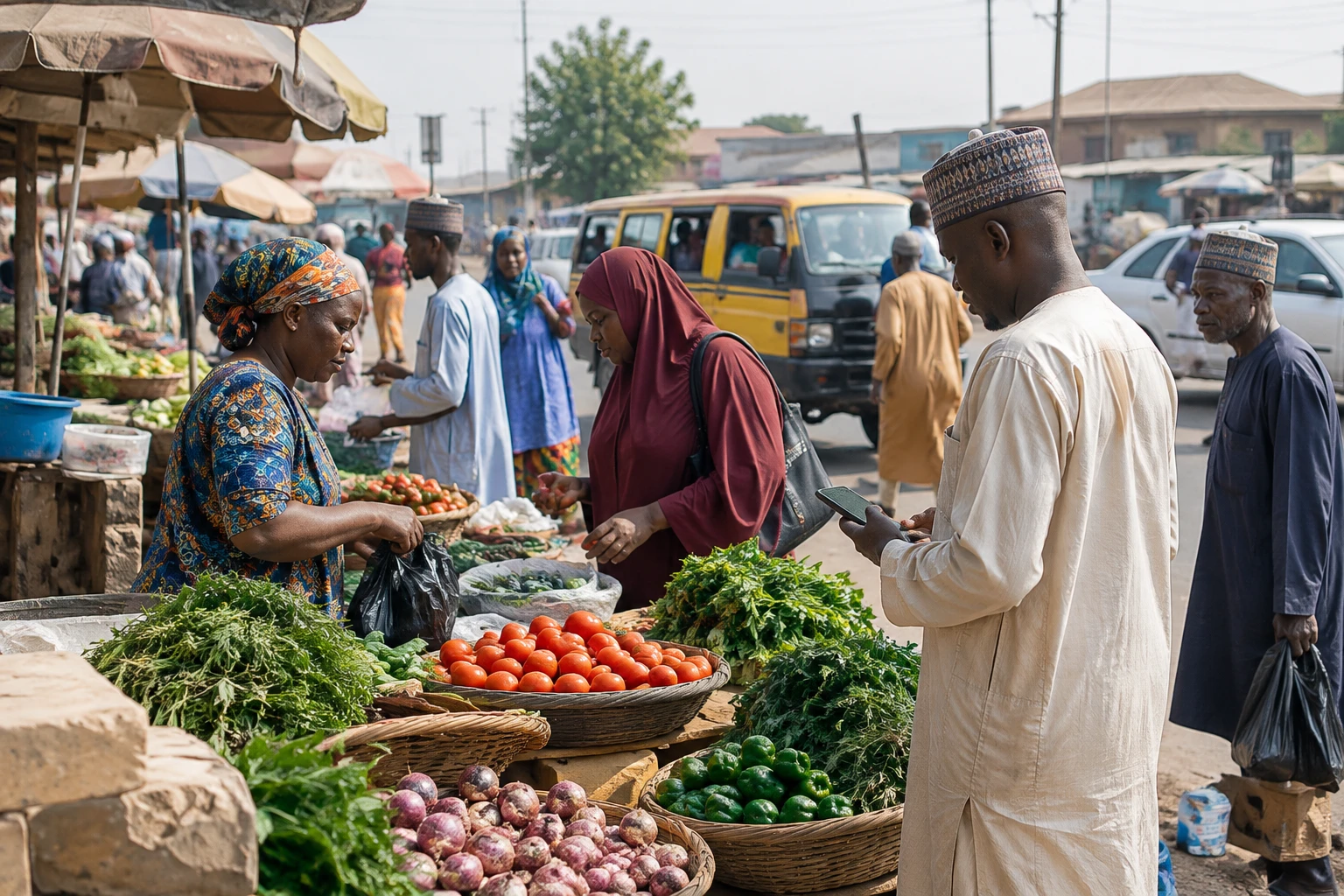
Falling inflation does not automatically fill households’ shopping baskets. In Nigeria, prices are rising more slowly than a year ago, but food remains expensive. The government’s challenge is now to translate economic reforms from national figures into everyday spending, from markets to transport.
Prices are slowing, but not all households feel relief
Nigeria’s National Bureau of Statistics (NBS) puts annual inflation at 14.63% in September 2026. The figure was 15.39% in August and 20.98% a year earlier. But this decline does not mean prices are falling: it means they are rising less quickly. Food inflation, at 19.59% according to the data released, continues to weigh on household budgets.
This distinction matters particularly for households that spend a large share of their income on basic goods. Falling overall inflation can coexist with persistent hardship in markets, especially when food prices rise faster than the overall index. The National Bureau of Statistics of Nigeria publishes indicators that make it possible to track this trend.
The situation is part of the economic transformation launched by President Bola Tinubu since 2023. The removal of fuel subsidies and liberalisation of the foreign exchange market were intended in particular to reduce public spending and restore economic balances. But these decisions have also made fuel more expensive and contributed to higher transport costs and the price of many goods. The government must therefore show that macroeconomic stabilisation can deliver tangible benefits.
Federal programme will also depend on states
On 22 October, the National Economic Council (NEC) approved a 90-day action plan presented by the Federal Ministry of Finance. The council brings together federal officials and state governors and is chaired by Vice-President Kashim Shettima. Its five stated priorities are access to food, tax harmonisation, completion of strategic projects, removal of barriers to investment and targeted support for households.
The plan therefore covers several levers at once. Tax harmonisation is intended to limit divergent rules across administrations. Completing projects and reducing barriers to investment, meanwhile, aim to improve infrastructure and economic activity. But the announcement alone does not establish which projects will be selected, which households will receive assistance or which indicators will be used to measure progress over the 90 days.
This uncertainty over the details matters. Nigerian accounts of the meeting also report approval of a national dashboard to track projects and strengthen transparency over the use of resources linked to the removal of subsidies. However, this tool will replace neither precise public targets nor regular publication of results. Implementation will also depend on the states, which provide some essential services and infrastructure.
Transport is a direct test of purchasing power
The NEC also backed a joint funding scheme between the federal government and state governments to accelerate the deployment of compressed natural gas (CNG) and electric vehicles. The stated aim is to make travel more affordable. The council stressed one decisive point: the savings made possible by these vehicles must translate into lower fares for passengers.
CNG is a gaseous fuel used in adapted vehicles, notably as an alternative to petrol. Its economic benefit for users, however, depends on access to vehicles, conversion workshops and refuelling stations. Nigerian authorities have already presented the national CNG transport programme as a way to reduce costs. In September, the presidency cited examples of cheaper journeys in some states; these local results alone do not establish that fares have fallen across the board.
The issue is a practical one for workers who rely on public transport and for operators, whose fuel costs influence fares. Rollout will therefore have to take regional differences into account: urban corridors, secondary cities and less well-equipped areas do not have the same infrastructure. The presidential update on the CNG transport programme sets out federal ambitions, while the outcome for passengers will have to be verified on routes and against fares actually charged.
From one-off aid to more lasting protection
Since the start of the reforms, Abuja has announced several support measures, including cash transfers, agricultural assistance and tax relief on certain food products. The Renewed Hope programme, in particular, envisaged payments of 25,000 naira a month for three months to 15 million households. These announcements alone do not establish how many beneficiaries actually received the aid or its lasting effect on their purchasing power.
More recently, the government launched HOPE-SP, a social protection project worth $1bn, according to the relevant federal ministry. It is intended to strengthen systems for identifying and supporting vulnerable households, as well as responses to shocks. The challenge is to move from one-off assistance to schemes capable of responding to food and economic crises. Their reach will depend on the quality of beneficiary lists, co-ordination between levels of government and monitoring of funds.
In an economy where informal activity plays a major role, targeting presents a particular challenge: households with irregular incomes are not always easy to identify using administrative systems alone. Officials will therefore have to balance speed of assistance, spending controls and actual coverage of the people concerned. The Nigerian Ministry of Humanitarian Affairs sets out HOPE-SP’s stated objectives.
Credibility will hinge on results
Vice-President Shettima has urged governors to translate the reforms into jobs, accessible health services and affordable transport. The appeal highlights the division of responsibilities: the federal government sets direction, but the states play a decisive role in implementation. For residents, success will be measured less by the number of decisions announced than by changes in prices, fares and access to services.
Nigeria, West Africa’s largest economy by population, is a member of ECOWAS, the Economic Community of West African States. How Abuja combines reforms, social support and infrastructure is therefore also of interest to its neighbours, which face their own pressures on prices and employment. The plan’s regional significance remains to be established, however: it will depend on national implementation and documented results, not merely its 90-day timetable.
The next steps to watch are the publication of detailed targets, the operation of the dashboard and an actual reduction in transport fares. Monitoring transfers and completed projects will also help distinguish announcements from benefits genuinely received by Nigerian households.



