Algeria
 Egypt
 Libya
 Morocco
 Sudan
 Tunisia
 Benin
 Burkina Faso
 Cabo Verde
 Côte d'Ivoire
 Ghana
 Guinea
 Guinea-Bissau
 Liberia
 Mali
 Niger
 Nigeria
 Senegal
 Sierra Leone
 The Gambia
 Togo
 Cameroon
 Central African Republic
 Chad
 DR Congo
 Equatorial Guinea
 Gabon
 Republic of the Congo
 São Tomé and Príncipe
 Burundi
 Comoros
 Djibouti
 Eritrea
 Ethiopia
 Kenya
 Madagascar
 Malawi
 Mauritius
 Mozambique
 Rwanda
 Seychelles
 Somalia
 South Sudan
 Tanzania
 Uganda
 Angola
 Botswana
 Eswatini
 Lesotho
 Namibia
 South Africa
 Zambia
 Zimbabwe
In Nouakchott, an institutional question has entered discussions about the cost of living and public services: who can govern, and for how long? On 21 October 2026, opposition party Tawassoul placed these concerns at the heart of rallies organised in the capital’s three regions.
A constitutional debate that goes beyond the presidency
President Mohamed Ould Cheikh El Ghazouani was re-elected in June 2024 for a second five-year term. Mauritania’s Constitution limits the head of state to two terms. Article 28 provides that he is “eligible for re-election only once”. A position taken by the Constitutional Council at his inauguration in August 2024 also described this as his final term under the rules in force.
Mauritania lies at the crossroads of the Maghreb and West Africa. It is not a member of the Economic Community of West African States (ECOWAS), which it left in 2000. Instead, it participates in the Arab Maghreb Union, whose regional activity remains limited, and maintains close relations with its Sahelian neighbours. In this context, respect for the rules governing presidential succession also matters for the credibility of institutions in a region marked by contrasting political trajectories.
The country saw a transfer of power between two elected presidents in 2019, when Mohamed Ould Abdel Aziz handed over power to Mohamed Ould Cheikh El Ghazouani. This constitutional continuity gives particular weight to the current debate: calls by some supporters of the authorities for a third term remain reported political initiatives, not the announcement of a candidacy or an adopted reform.
Tawassoul’s “three noes”
On 21 October, Tawassoul organised sit-ins in Nouakchott’s three regions. The party revived the slogans put forward for the start of its political year: no to a third term, no to restrictions on freedoms and no to corruption. Mauritanian media also reported rallies in other regions of the country. The available information does not provide an independent count of participants.
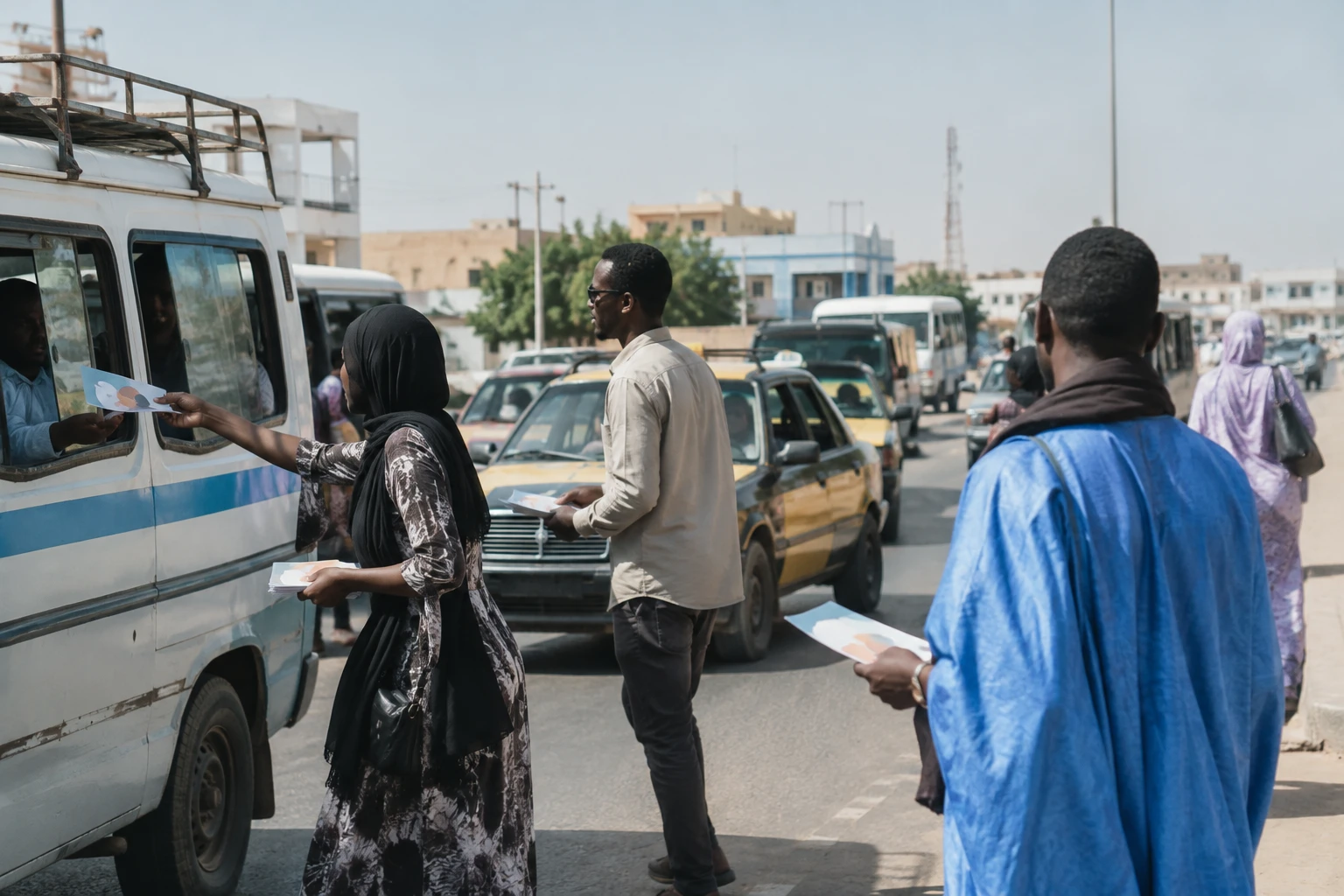
In the Arafat neighbourhood, south of the capital, activists lined a road and handed out leaflets to motorists, according to accounts gathered at the scene. The party’s vice-president, Mohamed Houd Mbareck, defended respect for the constitutional limit. He also said Mauritanians were waiting for answers on water, electricity and the price of essential goods, rather than a debate about extending a term in power.
Tawassoul’s secretary-general, Aminata Niang, meanwhile denounced what she considers failings in the oversight of public contracts and state-owned companies. She cited Somelec, the national electricity company, and accused the authorities of failing to ensure accountability. These allegations are part of the party’s political criticism; in themselves, they do not constitute audit or judicial findings.
The slogan thus brings together issues that do not affect the same groups in the same way. For institutions, the issue is the strength of the constitutional rule. For households, rising expenses and reliable access to services are immediate concerns. In Nouakchott, where government bodies and a significant share of economic activity are concentrated, these issues are particularly visible. However, the concerns of people in the regions, particularly over access to services, cannot be reduced to those of the capital.
An opposition seeking to broaden the debate
Tawassoul does not frame its opposition to a third term solely as a legal battle. By linking this demand to freedom of expression and the management of public funds, the party is trying to connect political rules with living conditions. This approach could broaden its appeal, but it also exposes the party to a demand: to substantiate its governance allegations and set out the solutions it advocates.
The rallies give the opposition a way to keep the issue in the public sphere between electoral contests. On their own, they cannot measure the views of all Mauritanians. It is important to distinguish between activist mobilisation, calls by figures close to the authorities and official decisions: at this stage, these three elements are not equivalent.
The issue is all the more sensitive because the Constitution does not only limit the number of terms in Article 28. The presidential oath also includes a commitment not to undertake or support any initiative aimed at revising the provisions on the duration and renewal of the term. The official text is available in the consolidated Mauritanian Constitution.
The next test will be institutional
At the regional level, Mauritania operates in a Sahelian space where military transitions and constitutional ruptures have weakened several frameworks for cooperation. It has left ECOWAS but remains directly affected by the political, security and economic balances of its neighbours. A debate about the limits of presidential power is therefore being watched beyond its borders, without the situation in Mauritania being equated with that of other countries.
What happens next will depend less on slogans than on actions: will officials advocating a third term spell out their proposal? Will the institutions reaffirm their interpretation of the text? And will the debate on governance lead to verifiable answers concerning public contracts and essential services? For now, the rallies of 21 October show that the opposition is seeking to prevent the constitutional question from being treated separately from everyday concerns.