Algeria
 Egypt
 Libya
 Morocco
 Sudan
 Tunisia
 Benin
 Cabo Verde
 Côte d'Ivoire
 Ghana
 Guinea
 Guinea-Bissau
 Liberia
 Mali
 Mauritania
 Niger
 Nigeria
 Senegal
 Sierra Leone
 The Gambia
 Togo
 Cameroon
 Central African Republic
 Chad
 DR Congo
 Equatorial Guinea
 Gabon
 Republic of the Congo
 São Tomé and Príncipe
 Burundi
 Comoros
 Djibouti
 Eritrea
 Ethiopia
 Kenya
 Madagascar
 Malawi
 Mauritius
 Mozambique
 Rwanda
 Seychelles
 Somalia
 South Sudan
 Tanzania
 Uganda
 Angola
 Botswana
 Eswatini
 Lesotho
 Namibia
 South Africa
 Zambia
 Zimbabwe

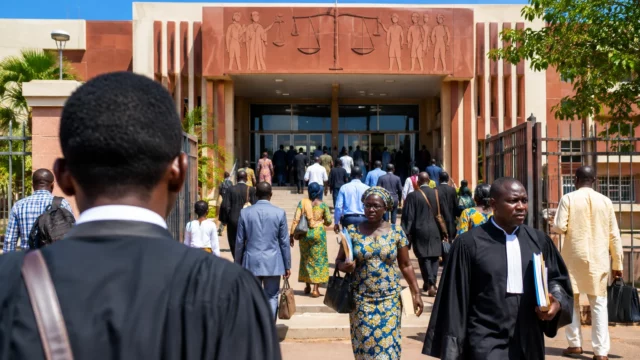
In Ouagadougou, the reform of the penal code does more than toughen penalties: it raises questions about the role of justice in a country confronted with armed violence and governed by transitional authorities. Among its most severe measures, the text reinstates the death penalty for certain offences.
A far-reaching penal reform
On 20 October 2026, all 71 voting members of the People’s Legislative Assembly unanimously adopted the new penal code. The session was held in Ouagadougou in the presence of the Minister of Justice, Edasso Rodrigue Bayala. The text contains more than 900 articles and underwent more than 700 amendments during its examination, according to the parliamentary institution.
Capital punishment is provided for certain offences, notably those linked to terrorism, espionage and treason. The text also covers the import of expired or prohibited products when it results in death. The authorities say these penalties may apply to perpetrators as well as their accomplices. The details of the provisions and their implementation will need to be assessed in light of the final text and the legal steps that follow its adoption.
The vote marks a break with the 2018 penal code, which removed the death penalty from the sanctions applicable to ordinary crimes. However, Burkina Faso had not executed any condemned prisoners since 1988, according to a study on the history of abolition in the country. The return of the death penalty to written law does not in itself mean that an execution will take place: it opens a new legal and political chapter.
Security, justice and state powers
The government presents the reform as a way to better protect people and property, respond to new forms of crime and strengthen public security. In a country where armed groups remain a major concern, the security argument is central. But the effectiveness of an extreme penalty is not measured by its severity alone: it also depends on the quality of investigations, the independence of the courts and the safeguards afforded to those on trial.
The reform goes far beyond capital punishment. It reinstates criminal penalties for press offences, toughens some traffic penalties and provides for fines linked to the amount of public funds embezzled. It also creates new offences, notably for repeated malicious messages. Finally, the penal code criminalises homosexual and related practices. These provisions directly affect individual freedoms, the media and the conduct of public debate.
The effects will not be the same for everyone. People prosecuted for offences affecting national security will face exceptionally severe penalties. Journalists and media outlets will have to contend with the return of press offences. Traders, transport operators and businesses will be affected by changes to the rules on dangerous products, road traffic and financial penalties. For residents, the practical question will be how the new rules are applied in the courts, in Ouagadougou and across the regions.
A political transition under scrutiny
The decision is part of the trajectory of the transitional authorities led by Captain Ibrahim Traoré, who came to power in 2022 after two changes of regime within a few months. The overhaul of criminal law accompanies an assertion of state authority and its security priorities. It also comes amid national debate over institutions and civil liberties.
At regional level, Burkina Faso is a member of the Economic Community of West African States (ECOWAS), an organisation bringing together West African countries. The country has moved closer to Mali and Niger through the Alliance of Sahel States. These choices have altered its relations with ECOWAS and revived discussions on regional cooperation in security and governance. The penal reform thus comes amid a period of institutional realignment, although its adoption alone does not make it possible to assess its diplomatic consequences.
The next stage will be decisive: publication of the final text, its entry into force and court rulings on its application. The procedural safeguards for defendants and the balance between security, fundamental rights and press freedom will also need to be observed. For Burkinabè people, as for regional partners, it is in these practices that the reform’s real impact will be determined.