
 Algeria
 Egypt
 Libya
 Morocco
 Sudan
 Tunisia
 Benin
 Burkina Faso
 Cabo Verde
 Côte d'Ivoire
 Ghana
 Guinea
 Guinea-Bissau
 Liberia
 Mali
 Mauritania
 Niger
 Senegal
 Sierra Leone
 The Gambia
 Togo
 Cameroon
 Central African Republic
 Chad
 DR Congo
 Equatorial Guinea
 Gabon
 Republic of the Congo
 São Tomé and Príncipe
 Burundi
 Comoros
 Djibouti
 Eritrea
 Ethiopia
 Kenya
 Madagascar
 Malawi
 Mauritius
 Mozambique
 Rwanda
 Seychelles
 Somalia
 South Sudan
 Tanzania
 Uganda
 Angola
 Botswana
 Eswatini
 Lesotho
 Namibia
 South Africa
 Zambia
 Zimbabwe
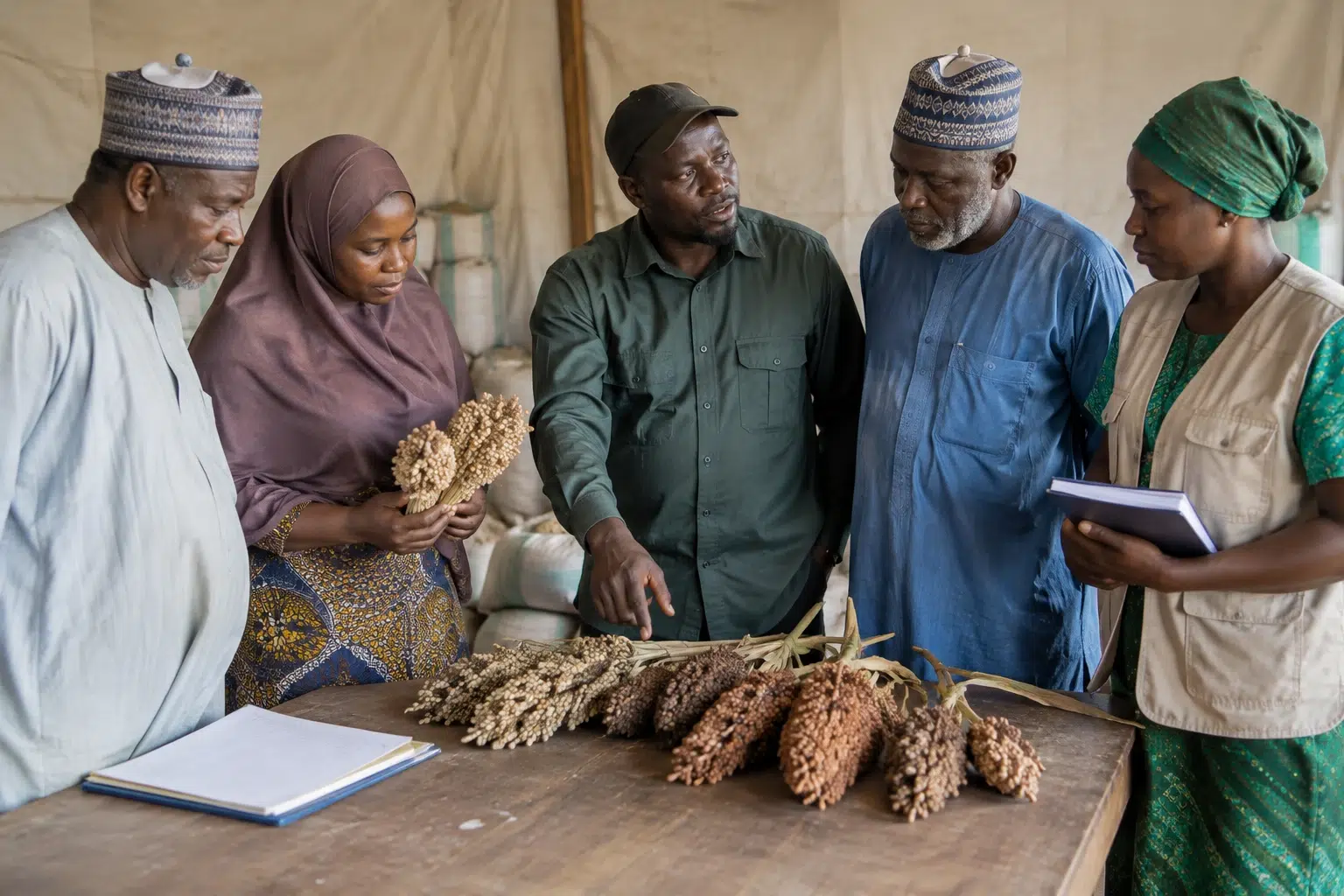
A larger harvest is not enough to make an agricultural sector more competitive. In Nigeria, sorghum feeds households and supplies several industries. But yields remain low, while Brazil is gaining access to markets in China. The gap between the two models raises a practical question: how can production increase without relying solely on expanding cultivated land?
Two agricultural trajectories intersect
The available figures first call for caution. For the 2025/2026 season, the United States Department of Agriculture’s (USDA) Foreign Agricultural Service estimates Brazilian production at 7 million tonnes, compared with 6.5 million in Nigeria. These figures put Brazil ahead of the West African country. The USDA’s published sorghum production estimates therefore do not, at this stage, confirm Nigeria’s return to second place globally in 2026/2027.
A separate forecast, attributed to the USDA in the available estimates, puts Nigeria at 7 million tonnes and Brazil at 6.5 million in 2026/2027. These are projections that may change, not harvests already recorded. The difference from public data for the previous season is a reminder of how much rankings depend on the period considered and statistical revisions.
For Nigeria, sorghum production is as much a matter of domestic supply as of global standing. The cereal is grown in several northern states, including Kano, Kebbi, Jigawa and Sokoto. It is consumed by households and processed by flour mills, breweries and animal-feed manufacturers. ICRISAT’s guide to sorghum cultivation in Nigeria identifies these major production areas.
In Nigeria, growth depends mainly on land area
Forecasts reported for 2026/2027 put Nigeria’s harvest at 7 million tonnes, 500,000 tonnes more than the previous year. But this increase would largely depend on a rise in harvested area, from 5.32 million to 5.7 million hectares. Average yield would remain close to 1.23 tonnes per hectare.
The contrast with Brazil is marked in the same estimates. A harvest of 6.5 million tonnes there would be grown on about 2 million hectares, or nearly 3.25 tonnes per hectare. Conditions are not directly comparable: climates, growing seasons, varieties and production systems differ. But the yield figures highlight a challenge for Nigerian farmers: sustainable growth also depends on the amount harvested from each plot.
In Brazil, sorghum can be planted after the soybean harvest. This second season makes use of land when the window for sowing maize is narrowing. Sorghum, which is more resistant to water stress than some crops, can then appeal to farmers. The sector estimates cited in the available data also indicate lower production costs than for second-season maize, despite a lower selling price.
For Nigerian farmers, raising yields requires suitable seeds, accessible agronomic advice and sufficiently predictable markets. The solutions extend beyond farms: storage, transport and buyers’ capacity to absorb regular volumes also matter. Research and extension programmes run by ICRISAT and its partners cover the Kano-Jigawa and Kebbi-Sokoto areas, among others. The agricultural programme supported by the African Development Bank and implemented with ICRISAT illustrates this production-area approach.
China opens a market for Brazilian sorghum
Brazil’s advance is not only about its fields. Access to the Chinese market gives the crop a new commercial dimension. A phytosanitary protocol between the two countries, concluded in November 2024, set out the conditions for Brazilian sorghum to enter the market. In November 2025, Brazilian establishments were then authorised to export. Brazil’s agriculture ministry publishes the export protocol for China.
According to Brazilian foreign trade data cited by Forum Macao, China bought 196,050 tonnes of sorghum between January and August 2026, out of 231,200 tonnes exported by Brazil during that period. These figures place the Chinese market at the heart of Brazil’s export trade. They do not mean that Nigerian sorghum is being directly displaced: Nigeria’s sector primarily serves domestic and regional demand. The report on Brazilian sorghum exports to China details these volumes.
In China, sorghum can be used in animal feed when its price makes it competitive with maize. It is also used to produce baijiu, a traditional spirit. For buyers, having several suppliers can diversify supply. For Brazil, the challenge is to maintain volumes and quality in line with market requirements.
An issue that goes beyond global rankings
Nigeria does not need to become a major exporter to China to benefit from its production. Higher yields and more regular deliveries could already boost farm incomes and secure supplies for processors. Agreements between producers and industry can help identify the varieties sought, aggregate harvests and make purchasing more predictable. However, they must leave room for small-scale farmers, particularly in rural areas where access to inputs, credit and infrastructure remains unequal.
The regional dimension also matters. Nigeria is an agricultural heavyweight in ECOWAS, the Economic Community of West African States. Its grain production can support trade and regional food security mechanisms. ECOWAS has a food reserve designed to supplement national stocks in times of strain. The ECOWAS regional reserve has already supplied grain to Nigeria.
In Abuja, the debate over sorghum is therefore tied to agricultural productivity, local processing and the movement of food across West Africa. The next step will be to see whether harvests confirm the 2026/2027 forecasts and whether production gains come from higher yields rather than further expansion of cultivated area. For farmers and industry alike, that is where the resilience of the sector will be determined.



