Algeria
 Egypt
 Libya
 Morocco
 Sudan
 Tunisia
 Benin
 Burkina Faso
 Cabo Verde
 Ghana
 Guinea
 Guinea-Bissau
 Liberia
 Mali
 Mauritania
 Niger
 Nigeria
 Senegal
 Sierra Leone
 The Gambia
 Togo
 Cameroon
 Central African Republic
 Chad
 DR Congo
 Equatorial Guinea
 Gabon
 Republic of the Congo
 São Tomé and Príncipe
 Burundi
 Comoros
 Djibouti
 Eritrea
 Ethiopia
 Kenya
 Madagascar
 Malawi
 Mauritius
 Mozambique
 Rwanda
 Seychelles
 Somalia
 South Sudan
 Tanzania
 Uganda
 Angola
 Botswana
 Eswatini
 Lesotho
 Namibia
 South Africa
 Zambia
 Zimbabwe
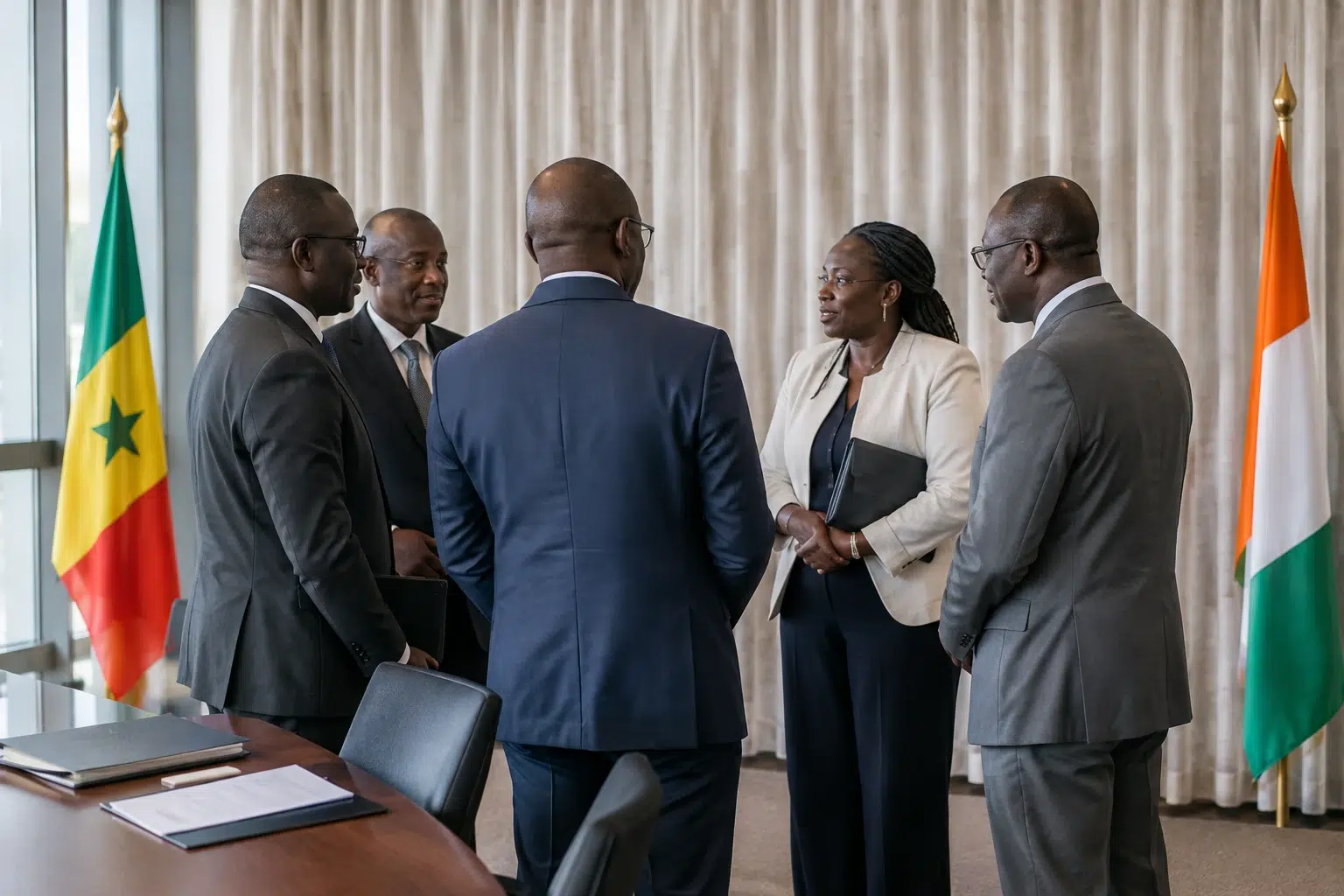
Around 50 agreements, but trade still considered too modest: relations between Senegal and Côte d’Ivoire are now measured by the gap between diplomatic commitments and projects actually delivered. In Abidjan, the two governments put this issue back at the centre of their agenda.
Two partners at the heart of West Africa
Senegal and Côte d’Ivoire are members of the West African Economic and Monetary Union (UEMOA), which shares a common currency, the CFA franc, and the Economic Community of West African States (ECOWAS), a regional framework for economic and political cooperation. Their closer ties therefore concern both bilateral relations and the integration of the sub-region.
The two economies are among the main drivers of trade within UEMOA. The Central Bank of West African States notes that Côte d’Ivoire and Senegal were the two leading intra-community suppliers in 2023. This gives their cooperation tangible weight, without meaning that trade between them is already reaching its full potential. The BCEAO report on regional trade sets out their role in the common currency area.
The meeting comes as both countries seek to turn their development priorities into investment, jobs and infrastructure. Côte d’Ivoire is preparing its 2026-2030 National Development Plan, while Senegal is implementing its 2025-2029 National Development Strategy, according to information presented by the Ivorian government.
Agreements must deliver results
Senegalese Prime Minister Ahmadou Al Aminou Lô visited Côte d’Ivoire on 18 and 19 October 2026 for a working and friendship visit. On 19 October, he met his Ivorian counterpart, Robert Beugré Mambé, and then President Alassane Ouattara. The talks took place in Abidjan, Côte d’Ivoire’s economic capital. The country’s political and administrative capital is Yamoussoukro.
The discussions focused in particular on agreements concluded since the 1970s. Lô referred to around 50 commitments and said few were being implemented satisfactorily. He called for specific targets, deadlines and regular monitoring, as well as for the joint committee responsible for following up decisions by the Joint Commission for Cooperation to become operational before the end of the year.
The two governments put the volume of trade at about 250 billion CFA francs. Cited by officials during the visit, the figure is presented as a cumulative value and as an estimate. On its own, it does not indicate how trade is distributed between the countries, which sectors are involved or how it changes annually. The authorities nevertheless consider it lower than the scope for investment and trade between the two economies. The Senegalese Press Agency and Ivorian government services also reported the figure and the call to strengthen private investment. The APS report details proposals for monitoring the agreements.
Trade, security and practical cooperation
Robert Beugré Mambé highlighted agriculture, energy and public policy. He also wants businesses from both countries to play a greater role. For economic stakeholders, the challenge is not limited to signing agreements: projects must be identified, their financing facilitated and implementation responsibilities clarified.
The priorities discussed cover sectors where cooperation could have different effects on different communities. Agricultural projects could affect producers and supply chains; energy investments, businesses and households. But the benefits will depend on the projects selected, where they are located and the role given to local businesses. Announcements made during the visit do not yet specify a sector-by-sector timetable or detailed financing.
Regional security was also on the agenda. The prime ministers discussed the fight against terrorism, violent extremism and transnational crime, as well as training and information-sharing. These issues extend beyond national borders: they call for coordination between services and cooperation with ECOWAS mechanisms. Public statements do not, however, detail the operational arrangements agreed.
Relations between Dakar and Abidjan are thus part of a regional balance of power in which both countries seek to consolidate their economic influence while maintaining common frameworks. UEMOA’s monetary and trade cooperation facilitates exchanges, while ECOWAS provides a broader forum for discussing security and integration.
Implementation will be the next test
The visit brought a familiar problem in regional diplomacy back to the table: the distance between signed agreements and their implementation. The announced joint committee could provide a monitoring tool, provided it sets deadlines, publishes progress on commitments and involves the relevant administrations. For now, these details remain to be clarified.
The two governments also discussed the Dakar 2026 Youth Olympic Games, scheduled to take place in Senegal from 31 October to 13 November. The event is a near-term opportunity for cooperation and regional mobilisation, but the main measure of closer bilateral ties will remain the delivery of announced projects.
For UEMOA and ECOWAS, the stakes extend beyond relations between two capitals. If the Union’s leading trading partners can make their agreements more operational, this could strengthen intra-regional trade. The next step to watch is therefore less another statement than a verifiable implementation timetable.