Algeria
 Egypt
 Libya
 Morocco
 Sudan
 Tunisia
 Benin
 Burkina Faso
 Cabo Verde
 Ghana
 Guinea
 Guinea-Bissau
 Liberia
 Mali
 Mauritania
 Niger
 Nigeria
 Senegal
 Sierra Leone
 The Gambia
 Togo
 Cameroon
 Central African Republic
 Chad
 DR Congo
 Equatorial Guinea
 Gabon
 Republic of the Congo
 São Tomé and Príncipe
 Burundi
 Comoros
 Djibouti
 Eritrea
 Ethiopia
 Kenya
 Madagascar
 Malawi
 Mauritius
 Mozambique
 Rwanda
 Seychelles
 Somalia
 South Sudan
 Tanzania
 Uganda
 Angola
 Botswana
 Eswatini
 Lesotho
 Namibia
 South Africa
 Zambia
 Zimbabwe
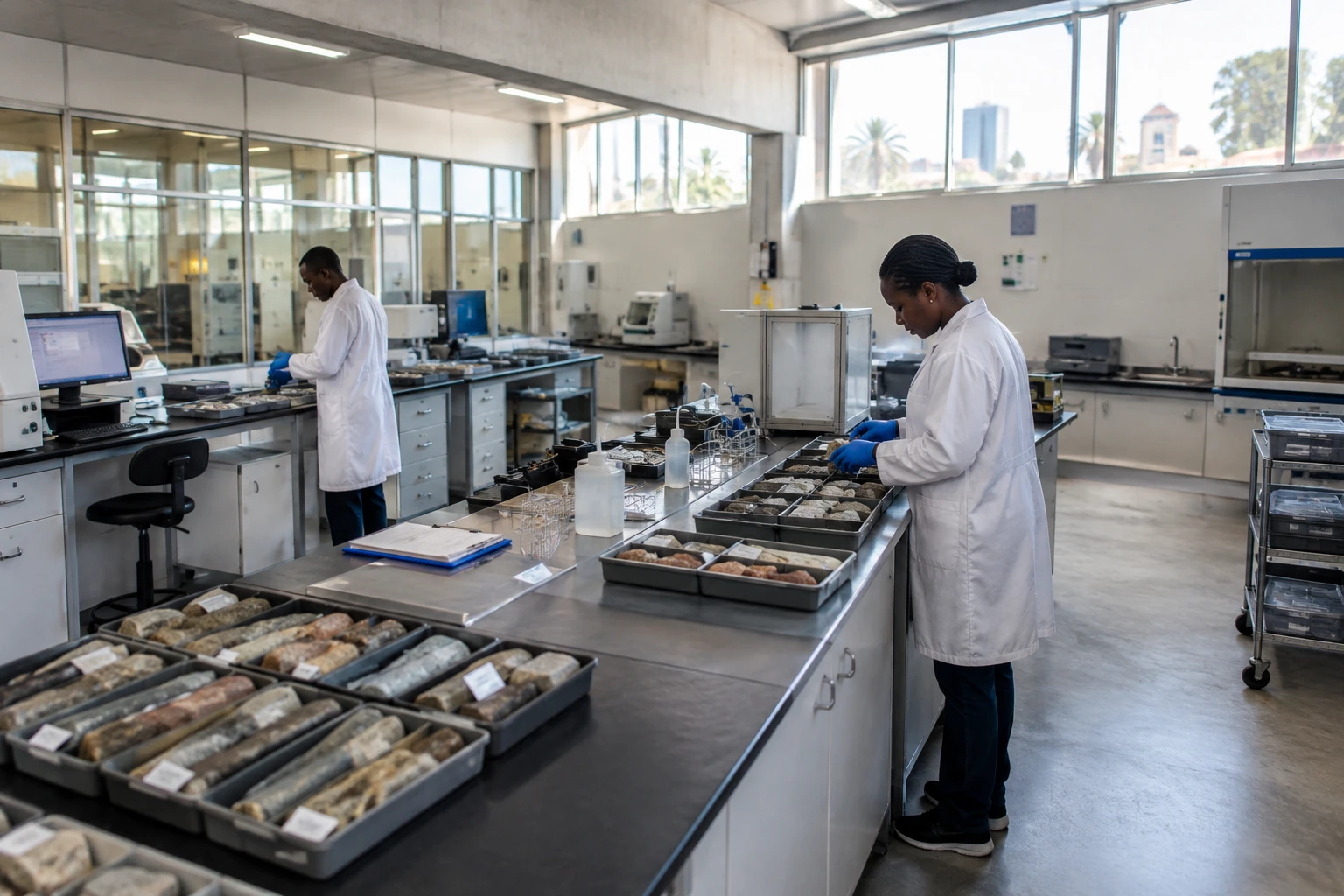
In a mine, decisions about drilling or processing also depend on laboratory results. As gold projects advance in Côte d’Ivoire, the ability to analyse rocks locally is becoming an economic, technical and industrial-sovereignty issue.
The country produced 59.124 tonnes of gold in 2024, compared with 23.54 tonnes in 2015, according to figures from the Ministry of Mines cited by the Ivorian economic portal. This growth has accompanied the opening of new mines and a rise in exploration campaigns. It is creating steady demand for services that are less visible than extraction but essential at every stage of the mining cycle.
From samples to mine decisions
On 15 October, Capital Limited announced that its subsidiary MSALABS had begun operations on the Koné gold project. The company is to build and operate a laboratory under a five-year contract with Montage Gold. A facility is also planned in Korhogo, with sample intake expected before the end of the year. These details are based on the company’s announcement and could not all be independently verified.
The principle is simple: teams collect samples from different locations and depths, then measure their gold content. The results help geologists refine their understanding of the deposit’s shape and decide where to continue drilling. They also inform decisions about which ore to send to the plant. The presence of gold alone is not enough to justify mining: its concentration, distribution and recovery costs also matter.
Koné illustrates the scale of the work under way. Montage Gold is developing a project where the first gold pour has been announced for the final quarter of 2026. In June, the company also reported an increase in measured resources at satellite deposits, meaning mineralised zones near the main deposit. These estimates and timelines are the company’s own and remain dependent on the progress of construction.
For laboratories, proximity cuts transport times and makes it easier to monitor campaigns. It does not, however, guarantee enough orders or make equipment profitable. In 2025, MSALABS generated $73.5m in revenue worldwide, up 68.2% year on year, according to Capital Limited’s annual report. This figure covers all its operations, not just the Ivorian market.
Established competition and local-content stakes
The market is not starting from scratch. SGS opened a commercial laboratory in Yamoussoukro in 2022, focusing in particular on the preparation and analysis of gold samples. The company says it can support exploration projects in the country. In Abidjan, Bureau Veritas also provides mining analysis services. A single campaign may use several providers, including to verify some results at an independent laboratory.
This verification, often called check assaying, helps ensure the quality of the data. In a technical update published in March 2026, Montage Gold said that selected samples are sent to external laboratories, including MSALABS and Bureau Veritas. For mining companies, the reliability of results has direct implications for resource estimates and investment choices. For laboratories, these checks are also a source of business.
The Société pour le développement minier de la Côte d’Ivoire (SODEMI), a state-owned company, is also seeking to establish its position. Its laboratory received ISO/IEC 17025 accreditation in May 2023 from the West African Accreditation System (SOAC). The standard recognises a laboratory’s technical competence for a defined scope of tests; it does not mean that all its activities are automatically covered. The government has encouraged mining companies to use this national expertise.
The challenge, then, is less about opening facilities than ensuring a steady flow of samples to them. Private operators are seeking contracts with exploration companies and mines. SODEMI, for its part, must turn its accreditation into orders and sustainable activity. Artisanal miners could also benefit from more accessible analysis to better understand their ores and organise their operations, provided costs and turnaround times are appropriate.
Keeping more value in the region
Samples do not always stay in the country where they are collected. In 2025, Awalé Resources described a route in which samples were prepared in Yamoussoukro, then sent to Ghana for gold analysis and Ireland for analysis of other elements. This arrangement shows that expertise and capacity are spread across several countries. It also underlines that laboratory competition takes place at regional and international level, not only among Ivorian providers.
For Côte d’Ivoire, developing these services locally could keep a larger share of technical activity in the national economy. This does not replace foreign expertise or cross-checks. But it could strengthen local skills, shorten some supply chains and increase the ability of Ivorian institutions to monitor data produced about the country’s subsoil.
This development is part of a region where mineral exploration and new mines are expanding beyond national borders. ECOWAS, the Economic Community of West African States, is a relevant space for the movement of expertise and the comparison of services. The next step will be to see whether announced investments translate into steady orders, competitive turnaround times and lasting recognition of results. Only then can the gold boom also help build a scientific services chain in Côte d’Ivoire.
Background sources: Ivorian gold production data, SGS information on its Yamoussoukro laboratory, SODEMI accreditation certificate, Montage Gold news on the Koné project and Capital Limited’s 2025 annual report.