
 Algeria
 Egypt
 Libya
 Morocco
 Sudan
 Tunisia
 Benin
 Burkina Faso
 Cabo Verde
 Côte d'Ivoire
 Ghana
 Guinea
 Guinea-Bissau
 Liberia
 Mali
 Mauritania
 Niger
 Nigeria
 Senegal
 Sierra Leone
 The Gambia
 Togo
 Cameroon
 Central African Republic
 Chad
 DR Congo
 Equatorial Guinea
 Gabon
 Republic of the Congo
 São Tomé and Príncipe
 Burundi
 Comoros
 Djibouti
 Eritrea
 Ethiopia
 Kenya
 Madagascar
 Malawi
 Mauritius
 Mozambique
 Rwanda
 Seychelles
 Somalia
 South Sudan
 Tanzania
 Uganda
 Angola
 Botswana
 Eswatini
 Lesotho
 Namibia
 Zambia
 Zimbabwe
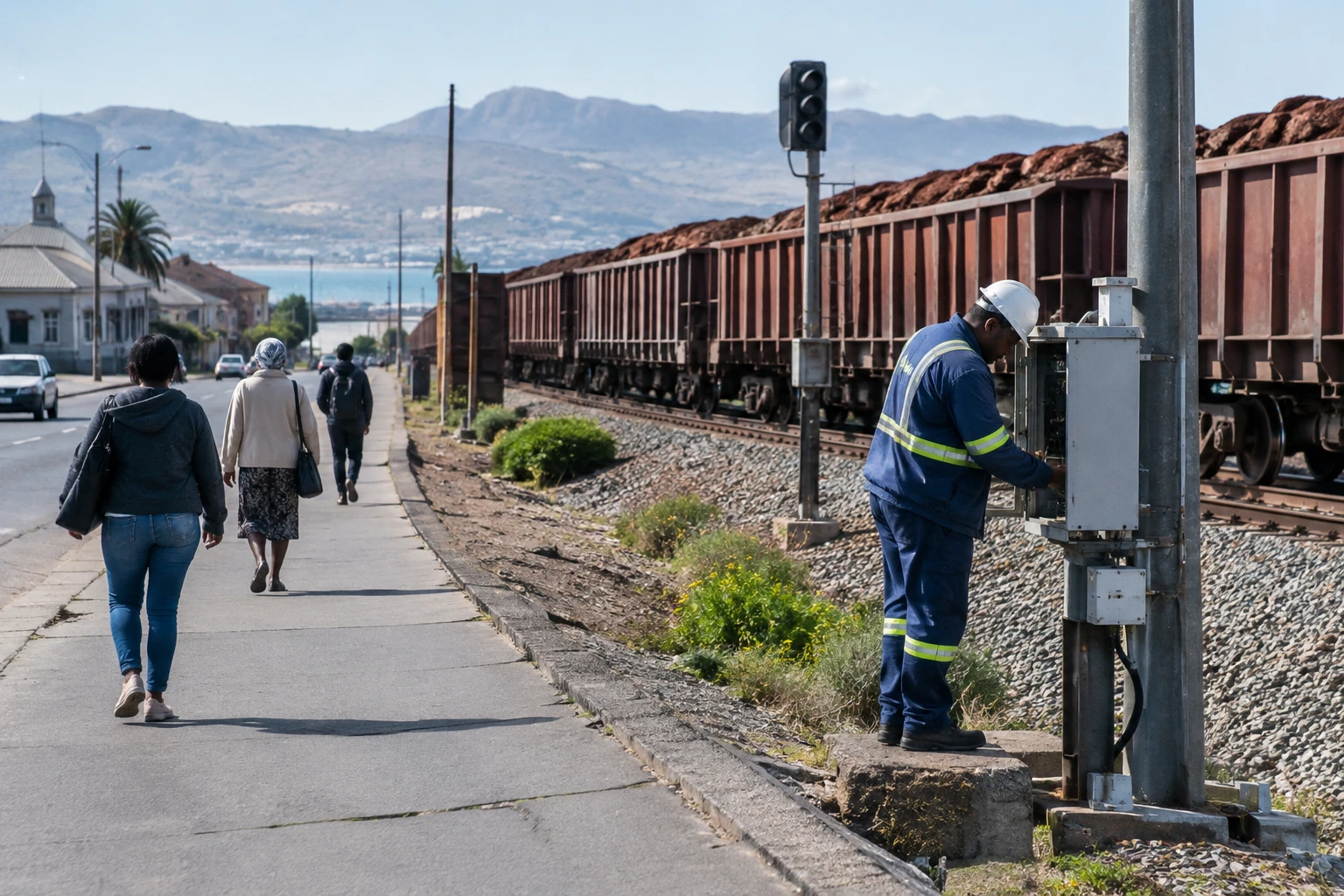
A train stalled or delayed on the route between Sishen and Saldanha is not just a problem for a mining company. It also means a cargo arriving later at port, export revenue being deferred and a supply chain becoming less reliable. In South Africa, the restoration of this strategic corridor is intended to address that vulnerability.
A vital corridor, from the Northern Cape to the Atlantic
The railway links the mining areas of Sishen, in the Northern Cape province, to the port of Saldanha, in the Western Cape. Stretching 861 kilometres, it carries iron ore to one of the country’s main maritime export gateways. The route is known as the Ore Export Line, or OREX.
South African ore goes mainly to Asian markets, but also to buyers in Europe and Africa. According to the Minerals Council South Africa, customs data available for the first 11 months of 2025 indicated that around 64.4 million tonnes were exported during the year. The port of Saldanha then handled nearly 80% of national iron ore shipments. These figures show why the line’s performance matters beyond the interests of a single operator. The Minerals Council South Africa’s industry data also gives a measure of the country’s logistical dependence on this port.
The corridor forms part of a wider regional network. South Africa is a member of the Southern African Development Community (SADC), which brings together countries seeking, among other things, to strengthen trade and transport infrastructure. South African rail and port links also provide an outlet for neighbouring economies, some of which have no direct access to the sea. A more reliable line could therefore have effects beyond the provinces it crosses, although the benefits will depend on available capacity and the rules governing network access.
Restoration programme running to 2030
On 12 October 2026, South Africa’s Transport Minister, Barbara Creecy, inspected maintenance work on the line and presented a restoration programme valued at about 8.9 billion rand. The sum equates to around $541 million, according to the estimate given in the announcement. Work is due to continue until 2030.
The programme includes track renewal, upgrades to electrical and signalling systems, and repairs to rolling stock. Its stated aim is to restore the corridor’s reliability and safety while improving its capacity to carry freight. On 12 October, intensive maintenance was under way as part of a planned line closure from 6 to 16 October. The minister described the corridor as an economic artery supporting exports, industrial activity and employment. The South African government’s announcement sets out the amount, the expected duration and the role assigned to the programme.
The lengthy timetable underscores the scale of the needs. Replacing ageing components will not be enough if trains, control systems and port equipment do not keep pace. Actual capacity depends on the entire chain, from the mines to the loading of ships. A rail upgrade not accompanied by coordination with the port could shift the bottleneck rather than remove it.
Rail reform put to the test
The upgrade is taking place as Transnet, the state-owned transport and logistics company, reorganises its rail business. Since April 2025, infrastructure management has been separated from train operations. The separation is intended to allow other operators to access the network, which was previously dominated by Transnet Freight Rail, the state-owned company’s freight division.
In May 2026, the infrastructure manager announced that train slots had been allocated to 11 private companies. The government estimates that these operators could add 24 million tonnes of freight capacity, with the potential to expand this to 52 million over five years. These are projected capacities, not volumes already transported. New entrants will need, among other things, locomotives, wagons and operating contracts to turn these slots into actual services. SAnews sets out the allocation of these slots and the stated targets.
For mining groups, a more predictable service could reduce delays and make sales planning easier. For workers and businesses in the regions concerned, continuity of operations also matters for employment and transport-related activity. But the benefits are not automatic: they will depend on the work being completed, infrastructure being shared fairly and Transnet’s ability to coordinate several operators on a common network.
Rural mining areas and port towns will not experience the same effects. In the Northern Cape, the line connects mining production to a distant export market. In Saldanha, ore traffic supports port and logistics activity. Nationally, improved reliability could also ease pressure on road transport. The issue, however, is not simply a matter of setting rail against road: the two modes need to work together, particularly for goods that cannot be transported directly by train.
A test for regional logistics ambitions
The OREX programme will be assessed on two fronts. First, it will be necessary to check that the announced work is progressing to schedule and genuinely improving the regularity of train services. Second, opening the network to private operators will need to deliver measurable results without compromising maintenance or producers’ access to infrastructure.
The implications are continental too. For SADC countries, the reliability of South African corridors can affect the cost and predictability of regional trade. For South Africa, it will determine the ability to move its resources to ports and maintain the competitiveness of its exports. The Sishen–Saldanha project will not, on its own, resolve the difficulties facing the national network. It is nevertheless a practical test of the ability to bring investment, maintenance and operational reform together around a corridor on which producers, employees, transport operators and trading partners depend.



