Algeria
 Egypt
 Libya
 Morocco
 Sudan
 Tunisia
 Benin
 Burkina Faso
 Cabo Verde
 Ghana
 Guinea
 Guinea-Bissau
 Liberia
 Mali
 Mauritania
 Niger
 Nigeria
 Senegal
 Sierra Leone
 The Gambia
 Togo
 Cameroon
 Central African Republic
 Chad
 DR Congo
 Equatorial Guinea
 Gabon
 Republic of the Congo
 São Tomé and Príncipe
 Burundi
 Comoros
 Djibouti
 Eritrea
 Ethiopia
 Kenya
 Madagascar
 Malawi
 Mauritius
 Mozambique
 Rwanda
 Seychelles
 Somalia
 South Sudan
 Tanzania
 Uganda
 Angola
 Botswana
 Eswatini
 Lesotho
 Namibia
 South Africa
 Zambia
 Zimbabwe
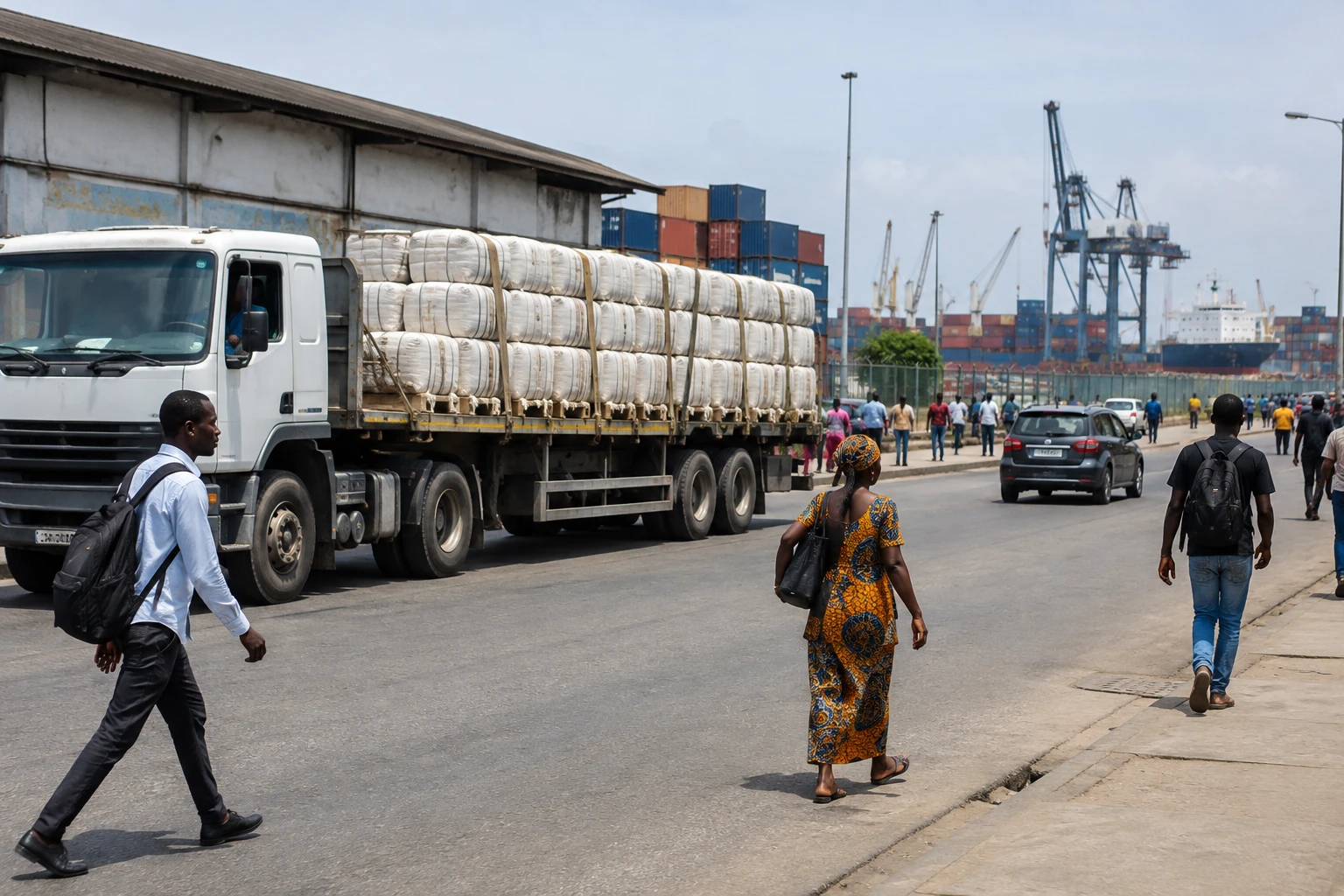
For cotton, selling a harvest is not enough. Until the bales have left the port, exporters await payment, producers may run short of cash and buyers have doubts about delivery times. In 2025, reported delays in Abidjan exposed this vulnerability at the heart of a sector linking Ivorian and Sahelian fields to global markets.
A strategic port under pressure
The port of Abidjan is an important maritime gateway for Côte d’Ivoire. It also serves landlocked economies in the West African hinterland, notably Burkina Faso and Mali. The smooth running of operations therefore matters to Ivorian businesses, as well as to transporters and traders beyond the country’s borders.
This regional role is part of an economic area in which goods move between member states of ECOWAS, the Economic Community of West African States. Road and rail corridors linking the port to landlocked countries extend its reach far beyond the Ivorian coastline.
Logistical difficulties, however, are not confined to ships. In July 2025, the Port of Abidjan Authority, Customs and the Ivorian Shippers’ Council discussed truck congestion in the port area. The causes identified included a shortage of parking areas, insufficient coordination and vehicles being immobilised for extended periods. The authorities then raised the possibility of a dedicated area for waiting trucks. The Port of Abidjan Authority’s account of the measures under consideration confirms that congestion affected several links in the logistics chain.
Delays hold up payments
At the end of May 2025, sector participants reported delayed ships, postponed port calls and a shortage of available containers. Johanna Adotevi, commercial director of Ivoire Coton and Faso Coton, said waiting times could reach three months, compared with about three weeks under normal conditions. These delays and the company-specific figures are reported by the executives concerned; they are not a consolidated assessment of the entire port.
According to Adotevi, about 3,000 tonnes destined for Ivoire Coton were then held up, with an estimated value of nearly 30bn CFA francs, or about €45.7mn. The mechanism is direct: if the goods are not loaded, payment by the buyer may be delayed. The company then has less cash available to meet its commitments and finance the next stages of its operations.
The pressure reaches producers. Kassoum Koné, head of the Compagnie ivoirienne de coton and president of the African Cotton Association at the time, explained that export delays could postpone payments due to cotton growers. For rural farms, late payment can complicate the purchase of inputs or preparations for the next season. The available source does not, however, provide an independent count of the producers affected or the amount of their outstanding payments.
Traders and transporters are also exposed. A container held up incurs storage charges and can make it harder to meet the dates agreed with the buyer. In the event of late delivery, the exporter risks contractual penalties or losing a client’s trust. Small-scale producers, who generally have less financial leeway than commercial operators, may feel the effects of such delays sooner.
Commercial risks beyond the port
The problem is not limited to the immediate cost of storage. A buyer may choose an origin able to deliver faster. Adotevi compared the situation with competition from Brazilian cotton, available on the market while African cotton remains held up. If delays recur, buyers could factor this risk into their prices or diversify their suppliers. This is a risk described by industry professionals, not a price decline already demonstrated by market data.
The Indian timetable mentioned in 2025 reports requires clarification. At the time, industry participants feared the imminent reinstatement of customs duties on cotton imports. But the Indian government later extended the exemption until 31 December 2025. The Indian parliament states that the standard 11% duty was reinstated on 1er January 2026. The Indian parliamentary response on the duty timetable therefore corrects the 1er November deadline mentioned in the initial context. This tax measure may have influenced the timing of purchases, but on its own it does not prove that delays in Abidjan caused a loss of market outlets.
A regional test of reliability
In 2025, port authorities acknowledged difficulties with truck movements and began consultations with the relevant services. This official finding corroborates the existence of logistical strain, but does not in itself confirm the specific delays reported by cotton companies or their financial estimates. Nor does the available information establish how long the congestion lasted for each operator.
For the sector, the issue extends beyond the season in question. The competitiveness of West African cotton depends on quality and price, but also on the ability to transport cargoes on time. In a region where several producer countries depend on corridors to the sea, a slowdown at a port can weigh on the entire chain, from rural farms to international buyers.
The point to watch, then, is the regularity of operations, not just the annual volume handled. The parking and coordination measures announced in Abidjan will need to translate into more predictable delays. For Ivorian producers and their neighbours in the hinterland, the port’s reliability determines access to payments and the ability to prepare for the next season.