Algeria
 Egypt
 Libya
 Morocco
 Sudan
 Tunisia
 Benin
 Burkina Faso
 Cabo Verde
 Côte d'Ivoire
 Ghana
 Guinea
 Guinea-Bissau
 Liberia
 Mali
 Mauritania
 Niger
 Nigeria
 Senegal
 Sierra Leone
 The Gambia
 Togo
 Cameroon
 Central African Republic
 Chad
 DR Congo
 Equatorial Guinea
 Gabon
 Republic of the Congo
 São Tomé and Príncipe
 Burundi
 Comoros
 Djibouti
 Eritrea
 Ethiopia
 Kenya
 Madagascar
 Malawi
 Mauritius
 Mozambique
 Rwanda
 Seychelles
 Somalia
 South Sudan
 Uganda
 Angola
 Botswana
 Eswatini
 Lesotho
 Namibia
 South Africa
 Zambia
 Zimbabwe
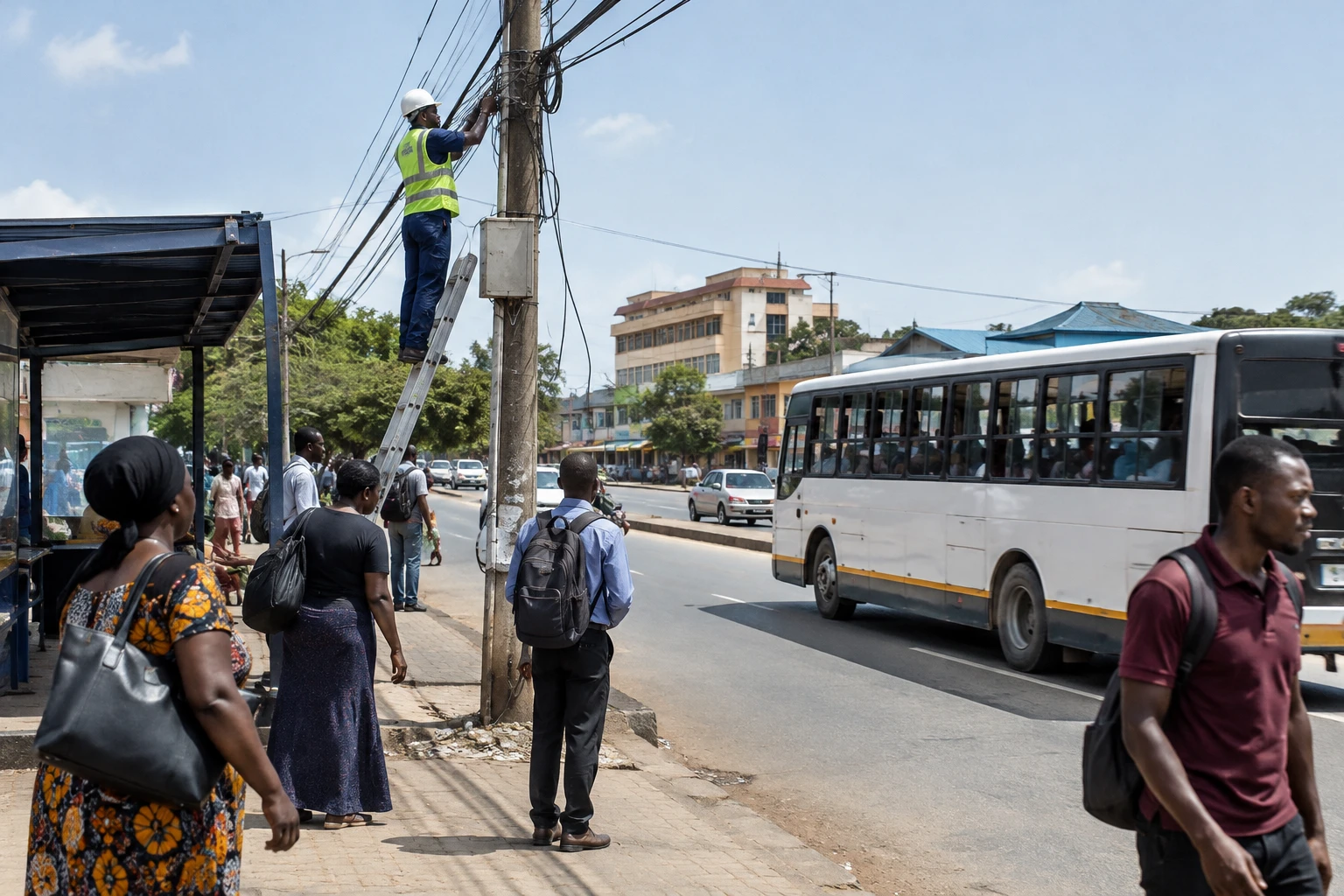
As fibre gains ground in Tanzania, the quality of its installation is becoming as tangible an issue as connection speeds. Cables hung too low or weakened poles can threaten passers-by, disrupt service and make network maintenance more difficult.
The regulator’s response comes amid a rapid expansion of digital infrastructure. It raises a central question for Tanzanians: how can more homes and businesses be connected without multiplying poorly coordinated installations?
Deadline to fix installations deemed risky
The Tanzania Communications Regulatory Authority (TCRA) is reported to have given internet service providers 30 days to fix several defects identified during field inspections. The notice, reported on 13 October, mentions leaning poles, cables hanging too low and a lack of markings to identify equipment owners.
As of publication, the deadline and specific findings could not be corroborated by a second independent report. They are therefore reported with attribution. The TCRA did, however, publish rules in 2026 governing the deployment of fibre-optic cables. These cover overhead and underground installations, the sharing of poles and ducts, maintenance and fault management. The TCRA’s official rules on fibre deployment thus provide a regulatory framework for the sector’s growth.
A cable hung too low can be caught by a vehicle or construction equipment. An unstable pole can fall and damage several connections at once. Beyond the risk of physical damage, a break can cut off access to services used by households, businesses and public authorities.
Fibre is spreading but remains a minority of fixed connections
Operators are stepping up investment as demand for more reliable connections grows. Yas Tanzania launched its fibre service in Dodoma after an initial rollout in Dar es Salaam. Tanzanian media have confirmed the expansion into the country’s political capital. The launch of Yas Fiber in Dodoma illustrates the competition to serve new neighbourhoods and businesses.
In Zanzibar, an agreement with the authorities provides for an investment of 300 billion shillings over 20 years, according to Tanzanian daily The Citizen. The project targets the islands of Unguja and Pemba and aims to connect about 100,000 homes in its first three years. The report on the agreement between Yas Fibre and Zanzibar specifies that it is a partnership with the local agency responsible for information and communications technology infrastructure.
State-owned operator TTCL is also continuing to expand its network. Figures cited in available reports point to a new phase intended to make fibre available to a further 400,000 homes, with coverage targets of 750,000 homes by June 2027 and then one million by June 2028. These deadlines have not been independently corroborated here.
Data attributed to the TCRA for the end of March 2026 offer a still-contrasting picture of the market: about 590,000 fixed internet subscriptions, of which nearly 391,500 were wireless and 198,700 wired. Fibre accounts for only part of the latter category. In other words, network expansion is evident, but wired connections do not yet dominate fixed access.
Sharing infrastructure to limit duplication
Sharing poles and ducts is among the tools provided for under the TCRA’s rules. Infrastructure sharing allows several operators to use the same infrastructure rather than adding equipment along a given street or route. It can reduce clutter and make inspections easier, provided maintenance responsibilities are clearly established.
This coordination is particularly important in growing cities, where telecoms networks coexist with electricity infrastructure, street lighting and roadworks. It also matters beyond major centres: installation and maintenance costs can make less densely populated areas less attractive to operators. Announcements of nationwide coverage therefore do not mean that every home will be connectable at the same time.
For households, the arrival of fibre can provide a more reliable connection, useful for work, education or administrative services. But the presence of a cable in a neighbourhood guarantees neither an immediate connection nor an affordable price. For businesses, public authorities and operators, continuity of service also depends on equipment quality, maintenance and clear rules for sharing.
A Tanzanian issue with implications beyond its borders
Tanzania is a member of the East African Community (EAC), a regional organisation that brings neighbouring countries together around economic integration goals. Reliable networks matter for trade, digital services and businesses operating across borders. Coordinating national infrastructure is therefore a practical element of this integration, although the reported measure concerns installations in Tanzanian territory first and foremost.
The next step will be to establish whether providers fix the reported defects and whether the TCRA reports on the follow-up. The rules adopted in 2026 show that the regulator intends to oversee deployment beyond investment announcements alone. For Tanzania, the challenge is now twofold: to extend fibre from Dodoma and Dar es Salaam to more towns, while ensuring network safety, maintenance and continuity.