Algeria
 Egypt
 Libya
 Morocco
 Sudan
 Tunisia
 Benin
 Burkina Faso
 Cabo Verde
 Ghana
 Guinea
 Guinea-Bissau
 Liberia
 Mali
 Mauritania
 Niger
 Nigeria
 Senegal
 Sierra Leone
 The Gambia
 Togo
 Cameroon
 Central African Republic
 Chad
 DR Congo
 Equatorial Guinea
 Gabon
 Republic of the Congo
 São Tomé and Príncipe
 Burundi
 Comoros
 Djibouti
 Eritrea
 Ethiopia
 Kenya
 Madagascar
 Malawi
 Mauritius
 Mozambique
 Rwanda
 Seychelles
 Somalia
 South Sudan
 Tanzania
 Uganda
 Angola
 Botswana
 Eswatini
 Lesotho
 Namibia
 South Africa
 Zambia
 Zimbabwe
When a harvest leaves the fields, its value also depends on what happens next: storage, processing, packaging and access to markets. In Côte d’Ivoire, these stages are becoming an industrial as well as an agricultural issue. A trade fair in Abidjan recently brought Italian equipment manufacturers together with West African businesses seeking solutions.
Processing locally and preserving better
The event took place from 8 to 10 October 2026 at the Abidjan Exhibition Centre. Plastprintpack and Agrofood West Africa ran alongside Afrik’Embal, the trade fair organised by the Association of Packaging Professionals of Côte d’Ivoire, as well as Food Expo and HoReCa Expo. The organisers report 180 exhibitors from 25 countries and more than 4,000 trade visitors. These figures indicate the event’s reported scale, but do not in themselves measure the contracts signed or its industrial impact. The event organisers’ published report also confirms that this edition was held in Abidjan.
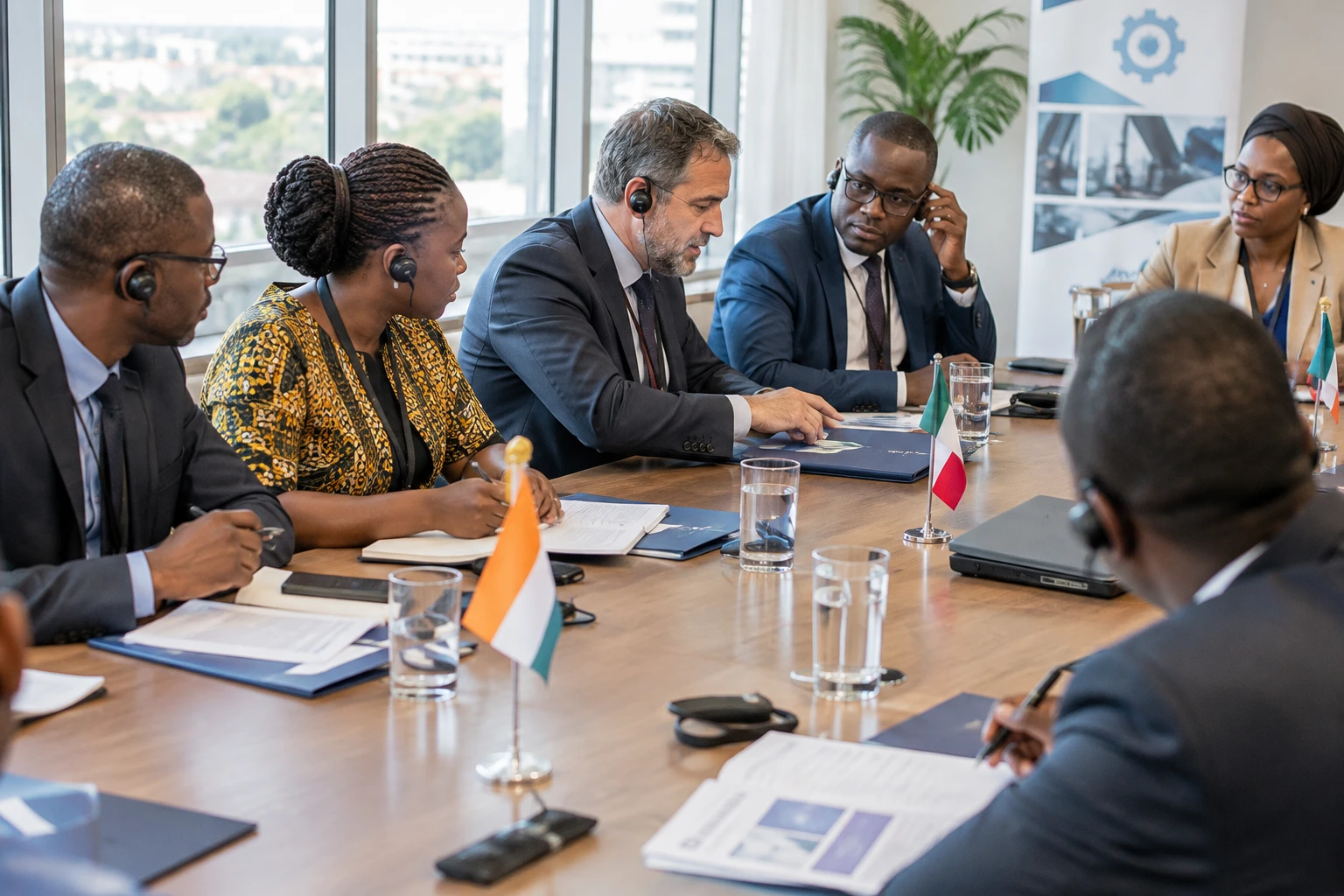
The Italian delegation comprised more than twenty companies, according to information provided at the trade fair. Eighteen were supported by the Italian Trade Agency, alongside businesses already established in Côte d’Ivoire. The equipment on display is aimed in particular at the food, cosmetics and pharmaceutical industries. It addresses several needs: packaging products, protecting them during transport and adapting their presentation to market requirements.
Italy’s participation is part of a commercial effort, but also reflects a search for technical partnerships. The Italian Trade Agency had announced a national pavilion in Abidjan from 8 to 10 October. The Italian agency’s announcement confirms the organised presence of Italian companies. Statements made during the trade fair point to an ambition that goes beyond selling machinery: supporting manufacturers in designing their projects.
This distinction matters. A packaging line alone cannot create a strong local industry. Technicians are also needed to install and maintain it, along with accessible spare parts, appropriate training and affordable financing. Without these conditions, a factory may remain dependent on foreign suppliers even if it processes more raw materials locally.
A market to build beyond equipment
Côte d’Ivoire is seeking to increase the processing of its agricultural produce, particularly cocoa and cashew nuts. The Ministry of Agriculture recently described cocoa processing as close to half of production, while highlighting the work still needed in other sectors and the persistence of post-harvest losses. The priorities set out by the ministry are a reminder that packaging is part of a much wider chain: collection, storage, processing and distribution.
Needs vary across this chain. Large export-oriented plants may seek high-throughput machinery and packaging that meets international standards. Small businesses, cooperatives and local processors often have different priorities: modular equipment, controlled costs, nearby maintenance and formats suited to local sales channels. Relevant technology must therefore meet the needs of producers at several scales.
Economic geography also matters. Industrial and logistics activities are largely concentrated around Abidjan and its port access. Yet producers are spread across different regions of the country. Better packaging will reduce losses only if storage infrastructure, transport and market access keep pace, including far from the political capital, Yamoussoukro. The challenge is to connect production areas to processing plants without reserving the gains for large operators alone.
Finally, materials cannot be considered separately from costs and the environment. Packaging protects food and helps it reach the market, but its production uses raw materials and creates waste. The choice between plastic, cardboard or reusable solutions depends on the product, storage conditions and local collection and recycling capacity. Investments must therefore be assessed for their industrial usefulness, their long-term cost and their end-of-life impact.
An Ivorian challenge with West African markets in view
Côte d’Ivoire is a member of ECOWAS, the Economic Community of West African States. For manufacturers, this regional framework offers prospects beyond the domestic market: equipment and processed products could serve several neighbouring countries. But this depends on trade rules, standards, infrastructure and companies’ ability to supply their customers consistently.
The Abidjan trade fair has brought together two interests that do not automatically align. Italian companies are seeking markets for their technologies. Ivorian stakeholders have an interest in turning imported equipment into skills, skilled jobs and lasting local capacity. The outcome will depend on the agreements reached after the trade fair: training, after-sales service, knowledge transfer and integration of domestic suppliers.
The signal is tangible: the packaging industry is attracting international suppliers and has a regional trade fair in Abidjan. The next stage will be less visible than an exhibition. It will be measured by the commissioning of equipment, its accessibility to businesses of different sizes and the share of added value that remains in the country. That is where the contribution of these partnerships to Côte d’Ivoire’s industrial transformation will be put to the test.