Algeria
 Egypt
 Libya
 Morocco
 Sudan
 Tunisia
 Benin
 Burkina Faso
 Cabo Verde
 Côte d'Ivoire
 Ghana
 Guinea
 Guinea-Bissau
 Liberia
 Mali
 Mauritania
 Niger
 Nigeria
 Senegal
 Sierra Leone
 The Gambia
 Togo
 Cameroon
 Central African Republic
 Chad
 DR Congo
 Equatorial Guinea
 Gabon
 Republic of the Congo
 São Tomé and Príncipe
 Burundi
 Comoros
 Djibouti
 Eritrea
 Ethiopia
 Madagascar
 Malawi
 Mauritius
 Mozambique
 Rwanda
 Seychelles
 Somalia
 South Sudan
 Tanzania
 Uganda
 Angola
 Botswana
 Eswatini
 Lesotho
 Namibia
 South Africa
 Zambia
 Zimbabwe
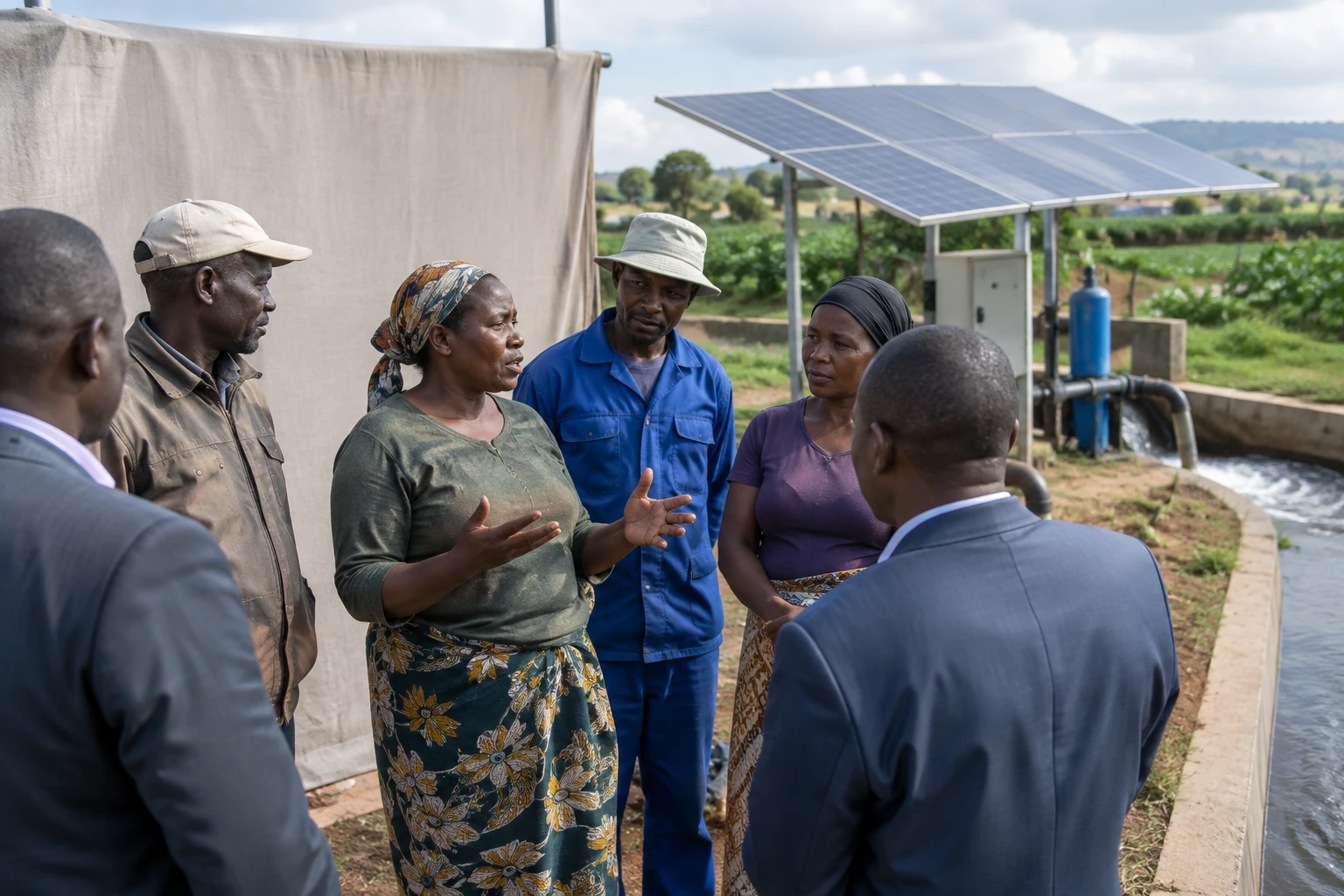
In Sirikwa, in Kenya’s Uasin Gishu County, a rehabilitated water reservoir is expected to help farmers grow crops even when rainfall is insufficient. But irrigation alone does not guarantee profitable harvests: access to markets, water management and how supplies are shared will also affect the results.
A water reserve for two growing seasons
President William Ruto inaugurated the Ziwa 2 irrigation project on 12 October 2026 in the Soy constituency, in western Kenya. The first phase is set to deliver water to 500 acres, or about 202 hectares, and serve 1,000 farming households. Work on the project, launched in June 2025, is largely complete. The connection of the remaining beneficiaries and the installation of a fence around the dam are expected by the end of November 2026, according to the Kenyan authorities and national media outlet Citizen Digital.
The work involved removing sediment accumulated in the dam and rebuilding its embankment. Its storage capacity has now reached one million cubic metres. Two solar-powered pumps, each rated at 50 cubic metres per hour, are then expected to carry water to the plots.
The households concerned will be able to grow maize and beans, as well as vegetables and higher-value crops such as tomatoes, onions, spinach, kale, passion fruit and coffee. The authorities are counting on two growing seasons a year. Their projection — not an income already recorded — is 200,000 Kenyan shillings per acre per household each year.
The project is valued at 147 million Kenyan shillings, according to information released at its inauguration. These projections will depend in particular on the volumes of water actually distributed, production costs and the prices at which crops can be sold.
Collective management will matter as much as the pumps
Ziwa 2 is part of a national strategy to reduce agriculture’s dependence on rainfall. According to the National Irrigation Sector Investment Plan, Kenya had about 711,933 acres of equipped land in 2023, or nearly 284,773 hectares. This represented less than 5% of arable land and 21% of the irrigation potential estimated in the plan. This potential does not mean that all this land can be developed without taking water resources and environmental constraints into account.
The same strategy sets a target of developing 1.5 million acres for irrigation by 2030. The national irrigation expansion programme is progressing through projects of various sizes, including community schemes. Ziwa 2 illustrates this approach: a local reservoir, solar-powered equipment and plots farmed by households rather than one large, unified agricultural scheme.
The next step will be as much institutional as technical. Kenya’s Department of Irrigation and the National Irrigation Authority plan to support the formation and registration of a water users’ association. They also say they will provide agricultural management training and links to markets. These arrangements will need to specify who receives water, according to what schedule, and how the equipment will be maintained.
The effects will not be the same for everyone. Connected households will be better able to plan their crops; agricultural workers and local sellers could benefit from more regular activity. Farmers not served by the scheme, however, will not benefit directly from the infrastructure. And if access to buyers, storage or transport remains difficult, producing more will not necessarily be enough to increase incomes.
Expansion announced, results still to be established
A second phase is under consideration to bring an additional 2,000 acres under irrigation and serve 4,000 more households. This is an announced project, separate from the 500 acres in the first phase; the available information does not yet give a completion timetable for this expansion. At national level, the government has also referred to building dams of various sizes, but this ambition does not in itself amount to a record of completed projects.
For farmers in Uasin Gishu, the immediate challenge will therefore be to turn stored water into regular production, and then into income, without putting the resource under strain. The figures announced — the dam’s capacity, the area equipped and projected incomes — describe targets and resources. Actual yields, sales and the distribution of benefits will make it possible to assess the results later.
The issue extends beyond the county. Kenya is a member of the East African Community (EAC), which coordinates agricultural policies and food security initiatives among its partner countries. More predictable production can contribute to regional markets, but it cannot replace cross-border trade or cooperation on food systems. At Ziwa 2, the next concrete indicator will be the completion of connections announced for November 2026; after that, it will be necessary to see whether the water users’ associations and commercial outlets keep pace with the infrastructure.
Background sources: Citizen Digital’s report on the inauguration of Ziwa 2, Kenya’s National Irrigation Sector Investment Plan, the national irrigation expansion programme and an overview of the EAC’s agricultural policy.