Algeria
 Egypt
 Libya
 Morocco
 Sudan
 Tunisia
 Benin
 Burkina Faso
 Cabo Verde
 Côte d'Ivoire
 Ghana
 Guinea
 Guinea-Bissau
 Liberia
 Mali
 Mauritania
 Niger
 Nigeria
 Senegal
 Sierra Leone
 The Gambia
 Togo
 Cameroon
 Central African Republic
 Chad
 DR Congo
 Equatorial Guinea
 Republic of the Congo
 São Tomé and Príncipe
 Burundi
 Comoros
 Djibouti
 Eritrea
 Ethiopia
 Kenya
 Madagascar
 Malawi
 Mauritius
 Mozambique
 Rwanda
 Seychelles
 Somalia
 South Sudan
 Tanzania
 Uganda
 Angola
 Botswana
 Eswatini
 Lesotho
 Namibia
 South Africa
 Zambia
 Zimbabwe

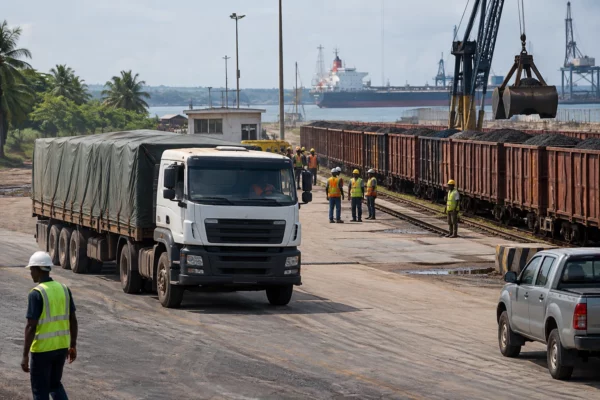
In Moanda, the value of a mine is measured not only in tonnes of manganese extracted. It also depends on access to water, jobs created by Gabonese suppliers and activities that can continue when mining slows. This question is gaining importance as Gabon seeks to process more ore on its own territory.
Processing ore means building an entire ecosystem
Gabon, in central Africa, has set a precise timetable for this ambition: the government has announced that exports of raw manganese will end from 1 January 2029. The target poses a major industrial challenge for operators. Processing ore requires plants, but also a reliable electricity supply, infrastructure, technical skills and commercial outlets.
The Ministry of Mines brought together industry stakeholders in 2025 to prepare for this change. The Compagnie minière de l’Ogooué (Comilog), Nouvelle Gabon Mining and other operators are taking part in discussions. The Gabonese Press Agency has also reported that the state aims to increase local processing, while the ministry has spoken of a goal to process all manganese extracted in the country by 2029. The government timetable for raw manganese and the Gabonese Press Agency’s report shed light on the two strands of this policy.
Some processing is already taking place in Moanda. The Moanda Industrial Complex produces sintered manganese; the Moanda Metallurgical Complex makes alloys, among other products. These facilities show that local industrial activity is possible. However, they are not, on their own, enough to guarantee that the benefits will be widely shared by local communities and Gabonese businesses.
Funding for local services and projects
Since 2020, the Gabonese state and Eramet Comilog have had financial mechanisms in place to support local development and social initiatives. The framework is based in particular on a Gabonese decree dated 22 January 2021, which stipulates that funded projects must take local content into account—that is, the participation of the country’s businesses and skilled workers. The text published in the Gabonese Official Journal sets out the applicable rules.
For 2025, Eramet says it allocated €13.1 million to these funds, including €5.9 million to the Local Communities Development Fund and €7.4 million to the CSR Fund. The company says the funding supported infrastructure, education, water access and health projects, particularly in Moanda, Bakoumba and Mounana. These figures and achievements come from the company’s own communications; they describe the amounts allocated, not the long-term results for residents. Eramet’s 2025 universal registration document details the funds and reported projects.
Among the needs identified is Moanda’s water supply. Material presented by the company estimates the shortfall at about 300 cubic metres per hour and announces an initial phase of 11 boreholes, designed to add 110 cubic metres per hour. These are stated production targets: their delivery and impact on everyday access to water will need to be monitored over time.
The future Lycée de l’Excellence de Moanda highlights another issue: training. According to figures provided by Comilog, construction employs more than 350 people, most of them local, and the contract has been awarded to a Gabonese company. The value of such projects will also depend on their ability to impart skills and create lasting opportunities beyond the duration of the construction work.
The decisive test: income that does not depend on the mine
A mine has a limited lifespan. For mining municipalities, economic diversification is therefore a practical concern: agriculture, food processing, crafts, transport, trade and services can provide households and small businesses with other sources of income.
Comilog describes its Seed Fund as a way to support very small businesses through guarantees that make it easier to obtain credit from microfinance institutions. The company says 197 projects have received funding since the launch of the second phase, amounting to about CFAF 1.17 billion. It also says it supported 44 projects in 2025, worth CFAF 260 million. These figures, published by the operator, would benefit from being supplemented with data on business survival, lasting jobs and the distribution of beneficiaries among municipalities. Comilog’s presentation of the Seed Fund sets out the scheme.
Local content also applies to contracts awarded by industry. Comilog says it awards 42% of its service contracts to local SMEs and reports that more than 3,000 jobs have been created in this way. For these contracts to genuinely strengthen the economic fabric, small businesses must be able to meet requirements for quality, safety and reliability without remaining permanently dependent on a single major client.
A Gabonese issue with regional implications
The debate extends beyond the mining sites of Haut-Ogooué. Gabon belongs to CEMAC, the Central African Economic and Monetary Community, which brings together six countries that share, among other things, a common monetary framework. A more developed Gabonese processing industry could strengthen industrial trade and demand for skills within the bloc. But electricity, infrastructure and financing remain decisive conditions for making investments viable. CEMAC and its regional framework place this ambition in its economic context.
The 2029 deadline will test whether the political timetable matches industrial capacity. For leaders, the challenge is to turn a strategic resource into productive activity at home. For the people of Moanda and neighbouring communities, success will be measured more directly by access to services, stable jobs and businesses able to survive beyond mining contracts. Local processing will therefore be about more than plants: it will also depend on how much value remains sustainably in the Gabonese economy.