Algeria
 Libya
 Morocco
 Sudan
 Tunisia
 Benin
 Burkina Faso
 Cabo Verde
 Côte d'Ivoire
 Ghana
 Guinea
 Guinea-Bissau
 Liberia
 Mali
 Mauritania
 Niger
 Nigeria
 Senegal
 Sierra Leone
 The Gambia
 Togo
 Cameroon
 Central African Republic
 Chad
 DR Congo
 Equatorial Guinea
 Gabon
 Republic of the Congo
 São Tomé and Príncipe
 Burundi
 Comoros
 Djibouti
 Eritrea
 Ethiopia
 Kenya
 Madagascar
 Malawi
 Mauritius
 Mozambique
 Rwanda
 Seychelles
 Somalia
 South Sudan
 Tanzania
 Uganda
 Angola
 Botswana
 Eswatini
 Lesotho
 Namibia
 South Africa
 Zambia
 Zimbabwe
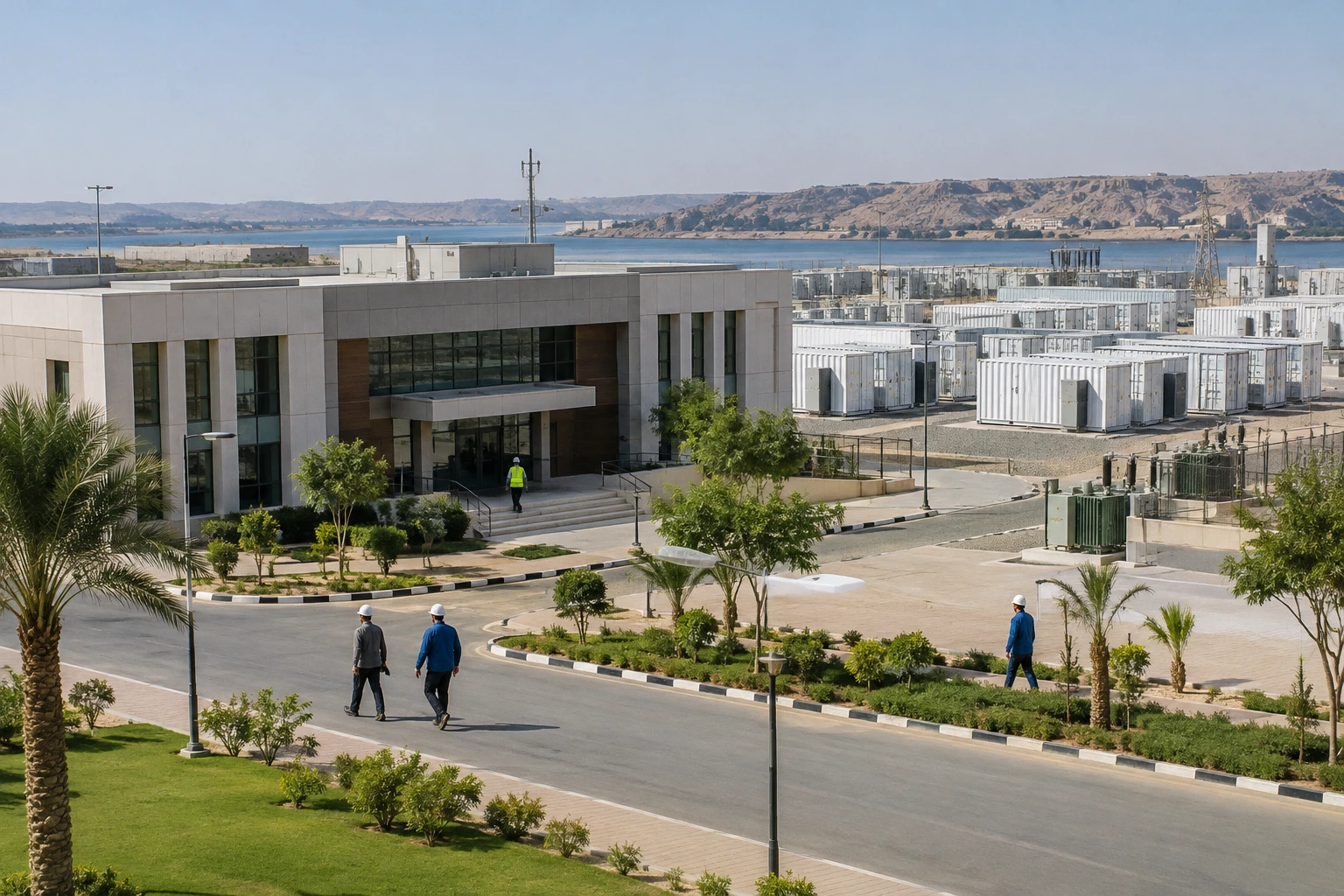
When the sun sets over power plants in southern Egypt, the grid must still meet high demand. Battery storage can shift some of the electricity generated during the day to peak hours. That is the purpose of two new projects led by AMEA Power.
A grid adapting to the rise of solar and wind power
Egypt is investing in renewable energy while seeking to make its electricity system more flexible. A solar or wind power plant does not generate electricity continuously at the same level. A large-capacity battery can store available electricity and then release it when generation falls or consumption rises.
The country has already taken a first step: a 300 MWh storage system, paired with the Abydos solar power plant in Aswan Governorate, was commissioned in 2025. Nefertiti and Horus would mark a step change in scale, as they are standalone storage facilities rather than batteries added to a single solar power plant.
This development forms part of an ambitious national trajectory. In July 2026, Egypt’s Ministry of Electricity set a target of 27,705 MW of renewable capacity and 14,320 MWh of battery storage by the end of 2028. Egypt, in North Africa, is not part of a regional economic community comparable to ECOWAS or SADC. Its regional role is shaped in particular by electricity interconnections and exchanges with neighbouring countries.
Two sites, 1,500 MWh of planned storage
On 12 October 2026, Chinese manufacturer Sineng Electric announced the start of equipment deliveries for the Nefertiti and Horus projects. The company said an initial tranche representing 1.1 GW of equipment is due to be shipped by the end of the year. This figure refers to the power of the announced conversion equipment, not the amount of energy the batteries will be able to store.
Nefertiti is to be built at Benban, in Aswan Governorate. The European Bank for Reconstruction and Development (EBRD) describes it as a system with 500 MW of power and 1,000 MWh of capacity. Horus, planned for Zafarana in Suez Governorate, is to reach 250 MW and 500 MWh. Together, the two facilities would therefore total 750 MW of power and 1,500 MWh of storage.
The EBRD has approved up to $162.5 million in financing for Nefertiti and up to $61 million for Horus. It estimates the costs of the two projects at about $297 million and $145 million respectively. Commercial operations are expected to begin in 2027. The facilities are to provide services to the national grid under long-term capacity agreements.
To clarify these units, power, expressed in megawatts (MW), indicates how quickly electricity can be delivered. Capacity, measured in megawatt-hours (MWh), indicates how much energy can be stored. Nefertiti could thus, in theory, supply 500 MW for two hours if fully charged.
Grid stability goes beyond storage
The converters announced by Sineng do more than move electricity between batteries and the grid. The manufacturer says its equipment will help regulate frequency and voltage. It is also intended to help manage consumption peaks and integrate variable renewable generation. These functions will be crucial in assessing the projects’ actual usefulness once they are connected.
The expected benefit is primarily in grid operations: storing some of the solar or wind surplus can limit generation losses and ease pressure during peak demand. For households and businesses, however, the impact will depend on the facilities’ actual availability, their grid connections and the overall management of electricity supply. Batteries do not generate energy; they shift it over time, with losses during charging and discharging.
The selected sites bring the projects close to areas already associated with energy production. Benban is home to a large solar complex, while Zafarana is also known for its wind farm. This location may make it easier to manage renewable generation, but it also makes investment in transmission lines and substations essential. Efficient storage is not enough if electricity cannot flow to areas of consumption.
A test of Egypt’s energy ambitions
Nefertiti’s size has led Sineng to describe it as the largest standalone battery storage project under construction in Africa. That claim should be distinguished from the storage capacity already in operation on the continent: this is a project under construction, with the announced schedule targeting 2027. Its ranking will therefore depend on the completion and commissioning of comparable facilities.
For Egypt, the challenge goes beyond the volume of batteries installed. The question is whether the grid can absorb more solar and wind power while ensuring a reliable supply. At regional level, the expansion of interconnections with neighbouring countries also raises questions about electricity exchanges and cross-border stability. The next steps to watch are the full delivery of equipment by the end of 2026, followed by commissioning in 2027.
Sineng Electric announcement on deliveries · EBRD project summary for Nefertiti · EBRD project summary for Horus · Egyptian renewable capacity and storage targets · Commissioning of the Abydos storage system