
 Algeria
 Egypt
 Libya
 Morocco
 Sudan
 Tunisia
 Benin
 Burkina Faso
 Cabo Verde
 Côte d'Ivoire
 Ghana
 Guinea
 Guinea-Bissau
 Liberia
 Mali
 Mauritania
 Niger
 Nigeria
 Senegal
 Sierra Leone
 The Gambia
 Togo
 Cameroon
 Central African Republic
 Chad
 DR Congo
 Equatorial Guinea
 Gabon
 Republic of the Congo
 São Tomé and Príncipe
 Burundi
 Comoros
 Djibouti
 Eritrea
 Kenya
 Madagascar
 Malawi
 Mauritius
 Mozambique
 Rwanda
 Seychelles
 Somalia
 South Sudan
 Tanzania
 Uganda
 Angola
 Botswana
 Eswatini
 Lesotho
 Namibia
 South Africa
 Zambia
 Zimbabwe
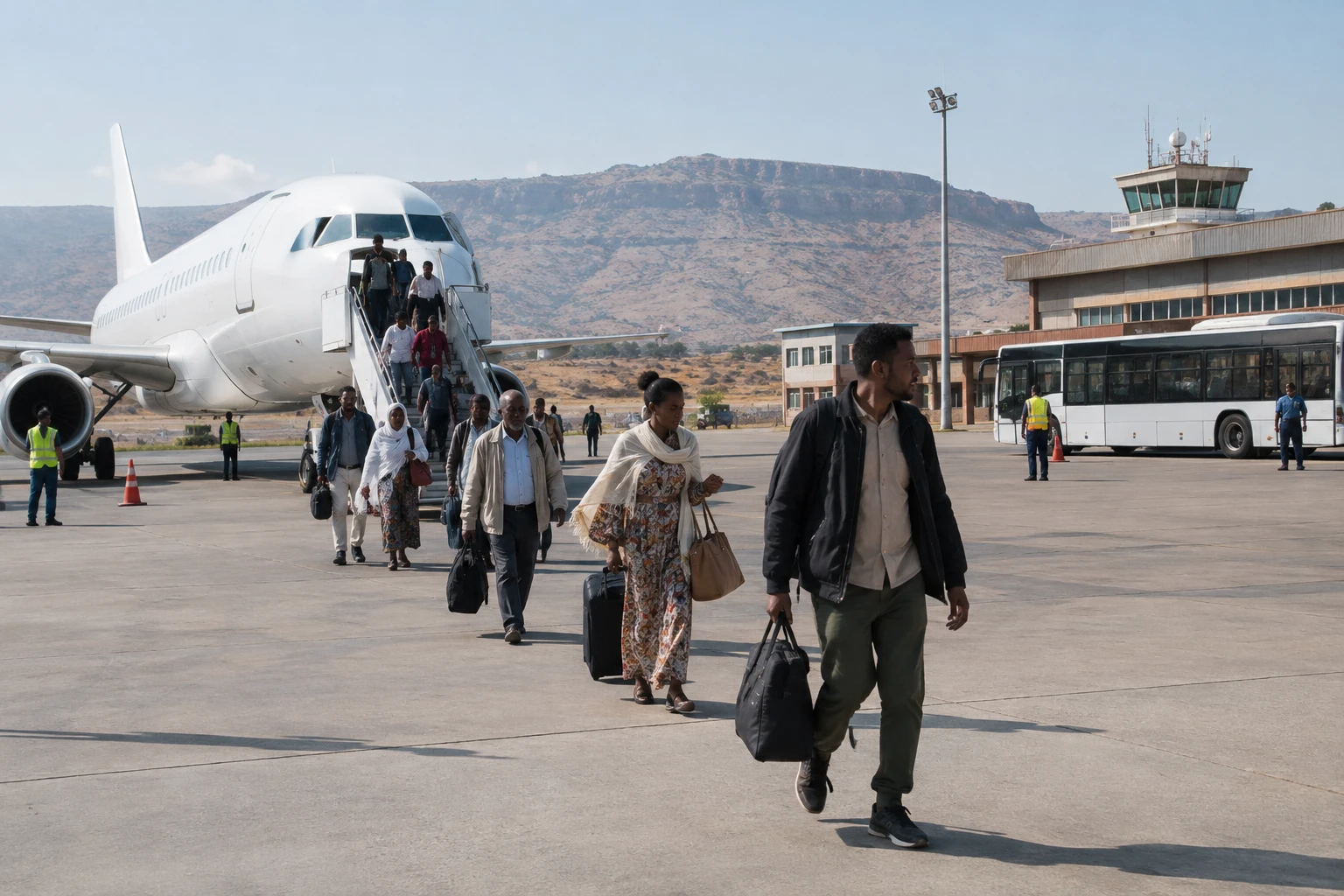
A commercial flight landing in Mekelle is not enough to guarantee a return to calm. But for residents of Tigray, the link with Addis Ababa is a practical service: it allows them to visit relatives, travel for work and reduce the isolation of a region where fighting has once again disrupted movement.
Air link restored after Mekelle changes hands
Ethiopian Airlines resumed regular flights between Addis Ababa and Mekelle on Sunday 11 October 2026. The state-owned carrier had suspended the service after fighters from the Tigray People’s Liberation Front (TPLF) took control of Mekelle airport on 23 September. The resumption had been announced a few days earlier.
The restart comes after a rapid shift in control of the city. Federal forces and their allies entered Mekelle on 4 October, following the announced withdrawal of TPLF fighters. The airport had been recaptured earlier, according to residents cited by the Associated Press. The news agency noted, however, that communications problems made it difficult to independently verify some details about troop movements.
Ethiopian state news agency and the Associated Press have confirmed that flights resumed on 11 October. The available information does not, however, confirm the long-term schedule or the number of daily services. An estimate of about five flights a day is circulating, but it should not be presented as an official schedule.
The resumption initially covers the regional capital. Ethiopian Airlines had also suspended flights to Axum and Shire. The carrier said those services could resume soon, but that prospect does not amount to confirmation of a reopening date.
2022 truce weakened by renewed clashes
Tigray lies in northern Ethiopia, a federal state whose capital is Addis Ababa. The region was at the centre of a war between federal forces and the TPLF from November 2020 to November 2022. The Pretoria Agreement, signed on 2 November 2022 under the auspices of the African Union, ended large-scale hostilities and provided for a political and security process.
The settlement did not, however, resolve all disputes. Implementation of the agreement remains a challenge, particularly with regard to disarmament, the administration of the region and disputed territories. The Intergovernmental Authority on Development (IGAD), a regional organisation in the Horn of Africa, has called for the agreement to be fully implemented. The return of flights should therefore be seen as a practical measure, not proof of political reconciliation.
The resumption of fighting in September has revived these concerns. On 20 September, seven armed opposition groups announced the creation of a coalition against Prime Minister Abiy Ahmed’s government. The TPLF is among them, alongside the Amhara Fano movement and the Oromo Liberation Army. The coalition has stated its aim of replacing the federal government, but the announcement of the alliance alone does not make it possible to assess its coordination or its capabilities on the ground.
For residents, access matters as much as symbolism
The air link cuts travel time between Mekelle and Addis Ababa and makes it easier for families, traders and people needing medical care or administrative services to get around. Passengers were stranded in the federal capital during the suspension, Ethiopian state news agency reports. For travellers who can afford a ticket, flying offers an alternative to road travel, whose availability and safety can vary from one area to another.
The benefits will not, however, be automatic or the same for everyone. A limited resumption of services may improve access to the city without resolving the difficulties faced by residents far from Mekelle. Nor does it guarantee the regular delivery of goods, the availability of health services or freedom of movement in areas affected by fighting. Ethiopian news agency reports the hope expressed by passengers, but these accounts do not amount to an overall assessment of the economic or humanitarian situation.
The chronology also calls for caution. The reopening followed the withdrawal of TPLF fighters and the entry of forces allied to the government. It therefore depends on security conditions that could change. An operational airport can reconnect a city with the rest of the country; on its own, it does not show who has lasting control of the roads or whether civilians can travel safely.
A regional signal to watch, not a settlement of the conflict
Events in Tigray go beyond the issue of domestic transport. Ethiopia occupies a central place in the Horn of Africa and hosts the African Union’s headquarters in Addis Ababa. A further escalation could weigh on regional mediation efforts and fuel tensions already reported between Addis Ababa and Eritrea. IGAD, for its part, has reiterated the importance of fully implementing the Pretoria Agreement.
What happens next will be measured by more substantial signs than a first landing: the continued operation of flights, the effective reopening of other airports, access for civilians and essential services, and the resumption of dialogue between the federal authorities and Tigrayan leaders. For now, the Addis Ababa–Mekelle route is operating again. Stability remains to be demonstrated.



