Algeria
 Egypt
 Libya
 Morocco
 Sudan
 Tunisia
 Benin
 Cabo Verde
 Côte d'Ivoire
 Ghana
 Guinea
 Guinea-Bissau
 Liberia
 Mali
 Mauritania
 Niger
 Nigeria
 Senegal
 Sierra Leone
 The Gambia
 Togo
 Cameroon
 Central African Republic
 Chad
 DR Congo
 Equatorial Guinea
 Gabon
 Republic of the Congo
 São Tomé and Príncipe
 Burundi
 Comoros
 Djibouti
 Eritrea
 Ethiopia
 Kenya
 Madagascar
 Malawi
 Mauritius
 Mozambique
 Rwanda
 Seychelles
 Somalia
 South Sudan
 Tanzania
 Uganda
 Angola
 Botswana
 Eswatini
 Lesotho
 Namibia
 South Africa
 Zambia
 Zimbabwe
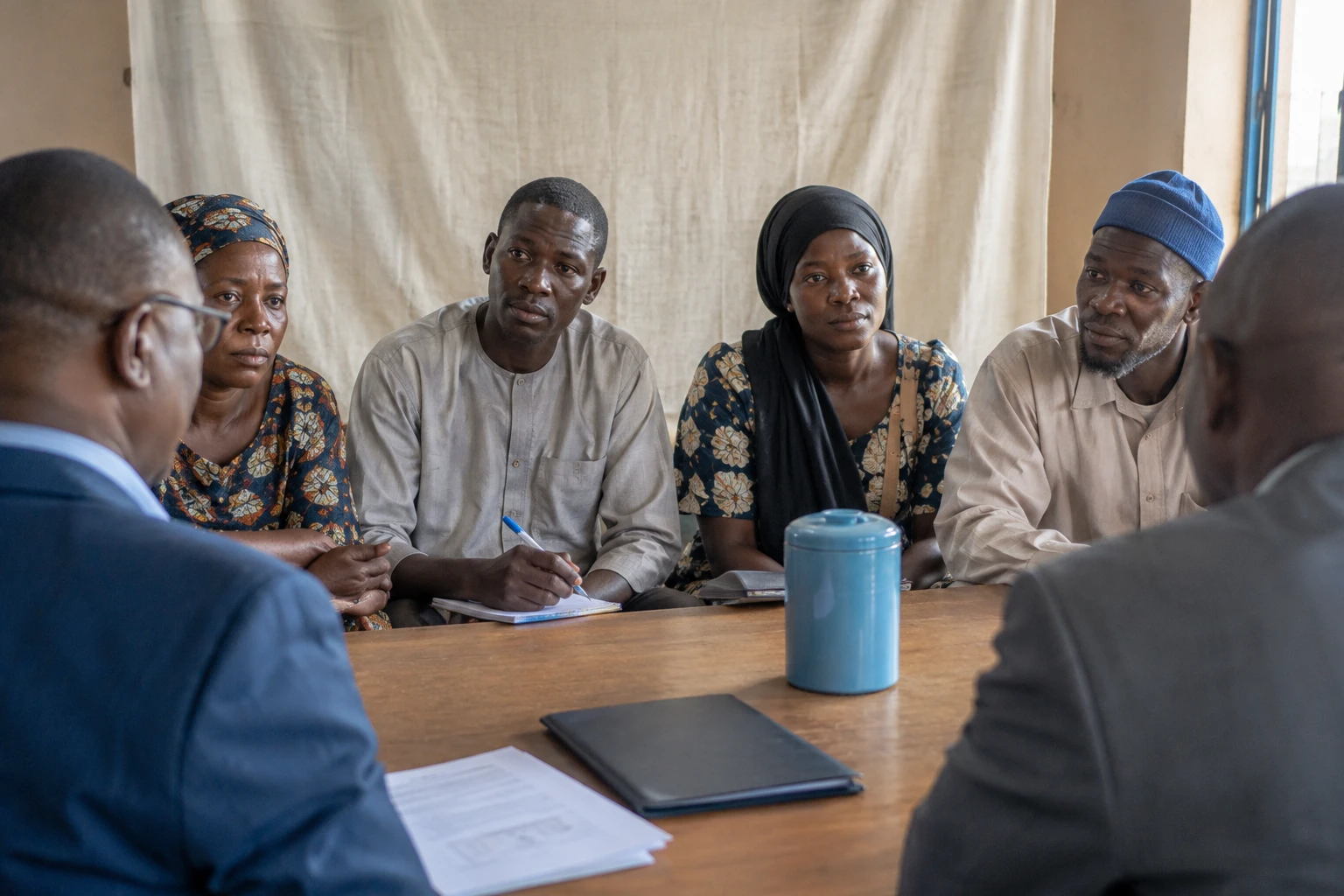
In the central Sahel, fleeing violence does not always mean finding a safe place. Displaced families have to share land, water points and services already under strain, while others cross borders into neighbouring countries. Displacement has thus become a regional reality, not just a local emergency.
A crisis that crosses borders
Burkina Faso, Mali and Niger are at the heart of this crisis. The three countries are part of the Sahel region and share long borders, particularly in the so-called tri-border area. Displacement patterns follow changes in insecurity: a person may first seek refuge in a nearby town, then cross the border if conditions worsen.
Coastal countries are also affected. People from Burkina Faso and Niger have found refuge in Benin, Côte d’Ivoire, Ghana and Togo. These states belong to the Economic Community of West African States (ECOWAS), a regional organisation that facilitates cooperation among its members. However, the withdrawal of Mali, Burkina Faso and Niger from ECOWAS, which took effect in 2025, makes the regional political framework for discussions on mobility and security more complex.
Since 2022, the three countries have also established the Alliance of Sahel States (AES), a confederation for political and security cooperation. Their authorities say restoring security is their top priority. But people continue to move, driven by attacks by armed groups and persistent insecurity. The available figures alone do not make it possible to attribute every departure to a specific actor.
Nearly four million people affected
On 9 October 2026, Abdouraouf Gnon-Konde, the regional director of the United Nations High Commissioner for Refugees (UNHCR), raised the alarm over nearly four million displaced people or refugees in Burkina Faso, Mali and Niger. According to UNHCR, this total has almost doubled since 2020. It includes more than 818,000 refugees and asylum-seekers; the others are mainly internally displaced people, who have fled without leaving their country.
UNHCR also says security incidents in the three countries have almost doubled since 2020. The agency links this trend to the weakening of the state’s presence in some areas and increased risks for displaced people and their hosts. This is the UN agency’s assessment; displacement data, meanwhile, combine information provided by national authorities and UNHCR.
An independent point of comparison confirms the scale of the phenomenon across the region, although it covers a different period and area. The International Organization for Migration (IOM) counted about 3.44 million displaced people in the central Sahel and Liptako-Gourma in December 2025, including nearly 2.72 million internally displaced people and 720,000 refugees. These figures do not replace UNHCR’s latest count, but they show that forced displacement was already measured in millions.
The datasets are not perfectly comparable. Update dates differ from one country to another, and administrations do not all revise their figures at the same pace. In Burkina Faso, for example, the official data on internally displaced people cited by UNHCR date back to March 2023. The regional total is therefore an indicator of the scale of need, not a real-time count of every person present.
Pressure on host communities
The case of Koro, in the Bandiagara region of central Mali, illustrates the concrete effects of these arrivals. UNHCR reports that in July 2026 the town was hosting about 86,000 Burkinabè refugees. Successive arrivals can increase demand for water, healthcare and land, while reducing the resources available to long-term residents.
This pressure is not evenly distributed. Refugee families need shelter, protection and access to services. Host communities, often based in areas where infrastructure is already limited, must also contend with additional needs. Markets, health centres and water supply systems become pressure points, but also places where aid can benefit several groups at once.
Movements to cities and neighbouring countries also change livelihoods. Displaced people may have to abandon farming or commercial activities; small local economies absorb new needs and take on additional workers. The consequences vary by household, region and access to employment. Aggregate data alone cannot tell these individual stories.
High needs, uncertain resources
UNHCR says a lack of funding is reducing its capacity to maintain its operations in the region. In September 2026, the agency said it had received 27% of the nearly three million euros needed for its Sahel operations. This figure, provided by UNHCR, describes the funding for its own plan; it does not represent the total humanitarian spending of all organisations.
When budgets fall short, teams have to set priorities among registering people, providing shelter, healthcare, protection and access to water. The consequences can differ by location: a border town receiving refugees, a city where internally displaced people are settling, and a hard-to-reach rural area do not have the same needs. Local authorities and community networks therefore play a central role in receiving people, even when available resources remain limited.
An issue for the Sahel and its neighbours
The situation is testing cooperation between Sahel countries and coastal states. Population movements cross areas where the AES and ECOWAS intersect, while assistance mechanisms also involve UNHCR and IOM. A lasting response will depend on practical coordination: information-sharing, refugee protection, access to services and support for host communities.
The next challenge will be to track both changes in displacement and the resources devoted to aid. Regularly updated national figures will make it easier to distinguish returns, new departures and prolonged stays. For now, the central fact remains: in these three countries, the promise of restoring security coexists with mass displacement, with consequences felt as far as border towns and neighbouring countries.
UNHCR’s warning on displacement in the central Sahel · IOM’s regional displacement data for December 2025 · UNHCR’s statistical monitoring of the Sahel crisis