Algeria
 Egypt
 Libya
 Morocco
 Sudan
 Tunisia
 Benin
 Burkina Faso
 Cabo Verde
 Côte d'Ivoire
 Ghana
 Guinea
 Guinea-Bissau
 Liberia
 Mali
 Mauritania
 Niger
 Nigeria
 Senegal
 Sierra Leone
 The Gambia
 Togo
 Cameroon
 Central African Republic
 Chad
 DR Congo
 Equatorial Guinea
 Gabon
 Republic of the Congo
 São Tomé and Príncipe
 Burundi
 Comoros
 Djibouti
 Eritrea
 Ethiopia
 Kenya
 Madagascar
 Malawi
 Mauritius
 Mozambique
 Rwanda
 Seychelles
 Somalia
 South Sudan
 Tanzania
 Uganda
 Angola
 Botswana
 Eswatini
 Lesotho
 Namibia
 Zambia
 Zimbabwe
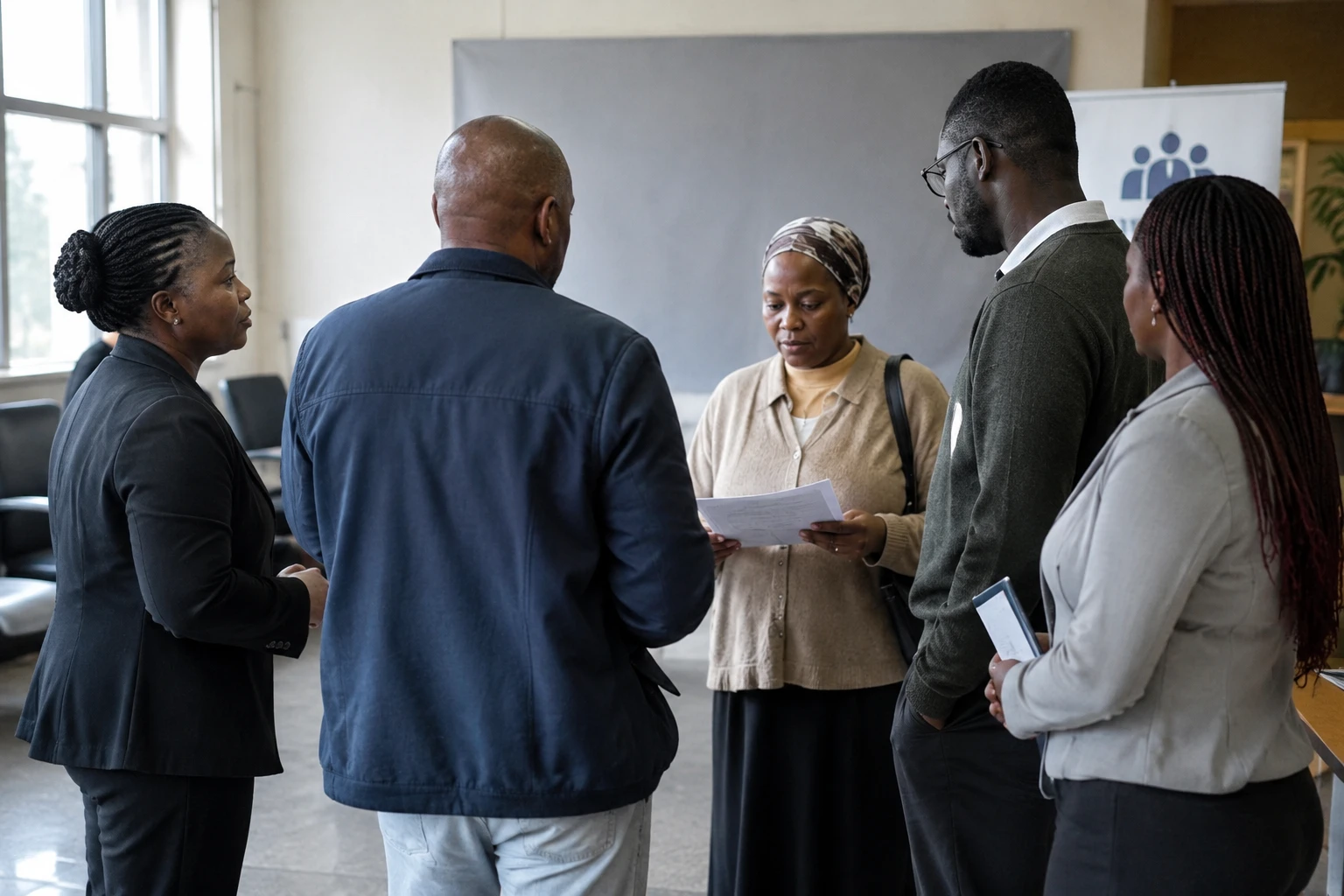
In Durban and Soweto, violence on 8 October turned a debate over access to asylum into an immediate threat to residents, shopkeepers and people seeking protection. In South Africa, however, a court ruling on procedure does not automatically regularise someone’s status or recognise them as a refugee.
A court ruling at the heart of tensions
South Africa’s Constitutional Court ruled on 7 July 2026 in a case brought by the Scalabrini Centre of Cape Town against the Department of Home Affairs. It confirmed the invalidity of provisions that could prevent some people from applying for asylum on procedural grounds, including after irregular entry or a delay in presenting themselves to the authorities. The ruling by South Africa’s Constitutional Court requires that claims be considered on their merits.
This principle does not prejudge the outcome of any individual case. Applying for asylum opens an assessment process; it does not automatically confer refugee status, permanent residence or citizenship. The authorities must still determine whether a person meets the criteria for protection.
On 28 September, the director-general of the Department of Home Affairs had instructed refugee reception offices to receive applications in accordance with the ruling. The department later acknowledged that the offices had been overwhelmed by people coming to submit claims.
Vehicles torched and shops looted
On Thursday 8 October, protests turned violent in Durban, in KwaZulu-Natal province, and in Soweto, a township in Johannesburg. Police reported that 24 vehicles had been set on fire: 14 in Durban and 10 in Soweto. Three arrests were announced in Durban. The South African Police Service condemned the violence and said reinforcements had been deployed to the affected areas.
In Durban, protesters had gathered near the refugee reception office on Che Guevara Road, where asylum seekers were queuing. The office closed during the unrest. A fire later broke out at a nearby scrapyard, while cars were set alight and shops looted in the city centre. Robert Netshiunda, the KwaZulu-Natal police spokesperson, said the alleged assault of a protester may have contributed to the outbreak of violence. This remains an attribution by police, not a judicial finding.
In Orlando West, in Soweto, local shops run by foreign nationals were targeted. Metropolitan police spokesperson Xolani Fihla reported gunfire that allegedly preceded the vehicle fires. The circumstances and identities of those involved had not been established in the information available. Law enforcement used crowd-control measures in both cities.
Directive withdrawn, but ruling remains in force
On Friday 9 October, the department’s director-general withdrew the 28 September directive. In its statement, the department cited overcrowding at offices, staff safety and risks to public order. It said the Constitutional Court ruling remained in force and announced a new procedure to set out how its requirements would be implemented, without giving an immediate timetable. The official statement on the directive’s withdrawal describes it as an operational measure issued by the director-general.
This administrative decision cannot, by itself, overturn the judgment. It does, however, create practical uncertainty for applicants: how can they submit their claims while the department seeks a new approach? For officials, the priority is to process applications without exposing reception offices to another surge. For people seeking protection, any delay can prolong a precarious situation. For shopkeepers targeted in the looting, security and the resumption of business are also at stake.
Local tensions in a region with a long history of mobility
South Africa is the main migration destination in southern Africa. According to Statistics South Africa, more than three million immigrants live in the country, representing 5.1% of its population, and almost two-thirds come from member states of the Southern African Development Community (SADC), the regional co-operation organisation. Statistics South Africa’s immigration data highlight how directly these movements affect ties between neighbouring countries.
Pressure on jobs and public services fuels political debate, but accusations against foreign nationals do not, on their own, prove that they are responsible for unemployment or crime. Migrant workers and asylum seekers are not a uniform group: their immigration status, occupations and backgrounds differ. At local level, the violence also harms neighbourhoods, small businesses and people waiting for an official decision.
Xenophobic attacks have marked South Africa on several occasions, notably in 2008, then in 2015 and 2019. This history gives October’s violence a significance that extends beyond Durban and Soweto. In southern Africa, workers’ movements and family ties cross borders; tensions in South Africa can therefore affect relations with countries of origin and co-operation within SADC.
What happens next will depend on two practical responses: the department’s ability to establish a procedure that complies with the ruling, and the authorities’ ability to protect the people and businesses targeted. The court decision upholds an essential principle — an asylum claim must be examined — but its implementation still needs to be organised amid strong opposition.