Algeria
 Egypt
 Libya
 Morocco
 Sudan
 Tunisia
 Benin
 Burkina Faso
 Cabo Verde
 Côte d'Ivoire
 Ghana
 Guinea
 Guinea-Bissau
 Liberia
 Mali
 Mauritania
 Niger
 Nigeria
 Senegal
 Sierra Leone
 The Gambia
 Togo
 Cameroon
 Central African Republic
 Chad
 DR Congo
 Equatorial Guinea
 Gabon
 Republic of the Congo
 São Tomé and Príncipe
 Burundi
 Comoros
 Djibouti
 Eritrea
 Ethiopia
 Madagascar
 Malawi
 Mauritius
 Mozambique
 Rwanda
 Seychelles
 Somalia
 South Sudan
 Tanzania
 Uganda
 Angola
 Botswana
 Eswatini
 Lesotho
 Namibia
 South Africa
 Zambia
 Zimbabwe
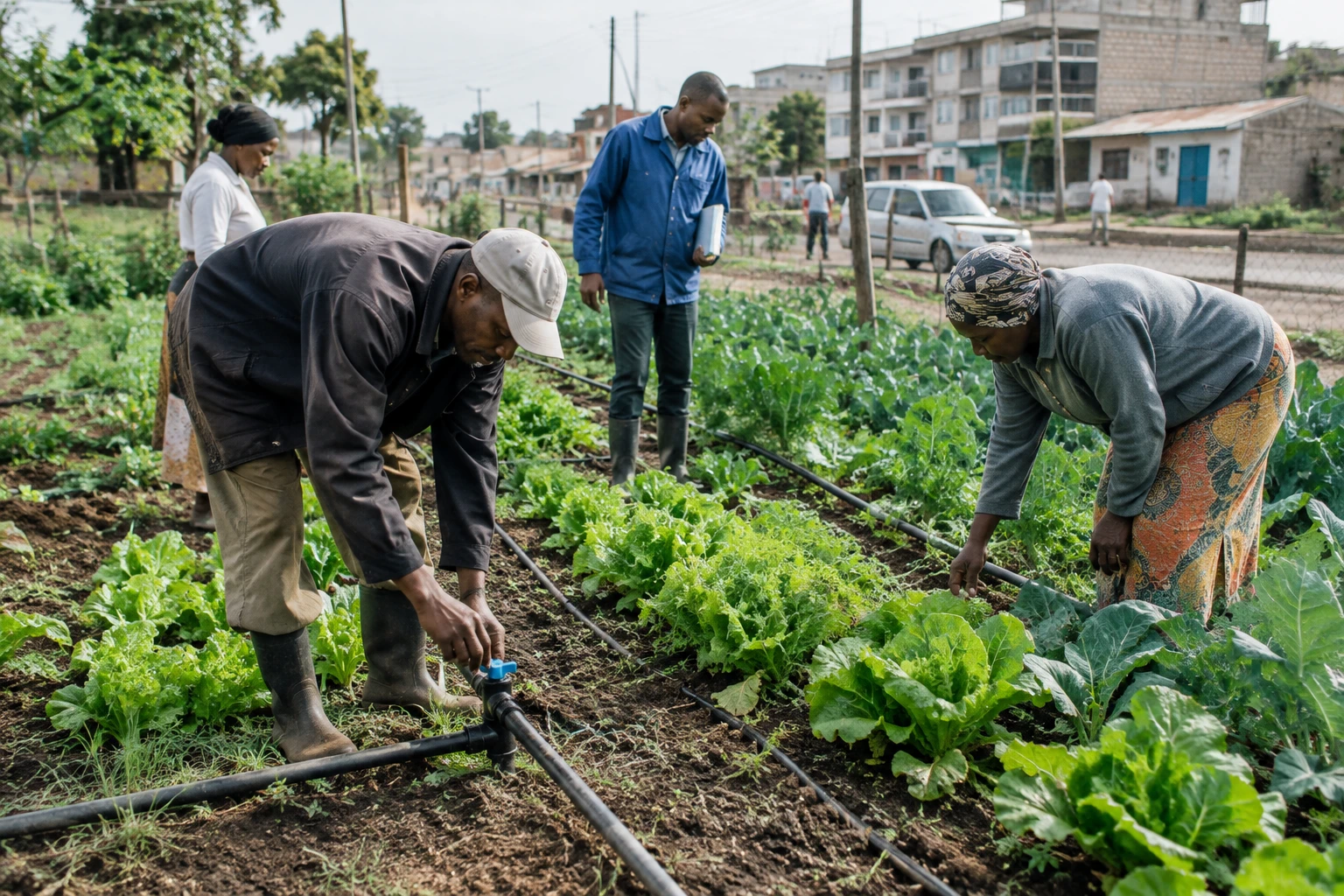
In Kenya, securing a harvest still often depends on the timing of the rains. The government wants to change this equation by attracting investors to irrigation, but the challenge is not limited to building canals: access to water, credit and markets must also be guaranteed for farms of all sizes.
A 10-year plan, with high expectations of investors
Presented at the Eastern and Southern Africa Irrigation Private Sector Forum, held in Nairobi on 5 and 6 October 2026, the National Irrigation Sector Investment Plan (NISIP) covers the period 2025-2035. Kenya’s Minister for Water, Sanitation and Irrigation, Eric Muriithi, said its implementation would require 598 billion Kenyan shillings, or about $4.6bn.
According to the plan’s official document, 61% of this total — some 365 billion shillings, or $2.8bn — is expected to come from farmers and the private sector. The state and development partners would fund the remaining 39%. These figures set a mobilisation target; they do not mean the funds have already been committed.
The NISIP aims to expand irrigated areas to about 1.5 million acres, or nearly 607,000 hectares, by 2035. It provides for investment in water storage, dams, distribution networks, pumping and farmer-led irrigation. The NISIP planning document sets out the targets and funding needs.
Irrigated land, but a resource to manage
The starting point is modest compared with the estimated potential. The national plan states that about 711,000 acres, or 284,000 hectares, had been developed for irrigation in 2023. This represented 21% of the potential, estimated at about 3.35 million acres, and less than 5% of arable land. About 89% of Kenya’s territory lies in arid or semi-arid areas, according to the document.
This dependence on rainfall exposes harvests, farm incomes and food supplies to droughts and irregular precipitation. Irrigation does not, however, eliminate climate risk: it shifts some of the pressure to rivers, aquifers and water-storage infrastructure. The plan itself stresses the need to concentrate new developments in areas where water resources allow, without undermining ecosystems.
How the benefits are distributed will be just as important. Large companies can finance costly equipment and networks, while small farms often need affordable credit, locally scaled solutions and technical support. Without these conditions, investment risks favouring operators able to secure land, water and markets, rather than the farming communities that need them most.
The authorities have also presented the plan as a common framework for coordinating banks, equipment suppliers, agribusinesses, government and development partners. The Kenya News Agency reported in March 2025 that the scheme was to combine private funding, credit guarantees for smallholders and commercial farming. The challenge will be to turn this promised coordination into projects that are funded, accessible and maintained over the long term.
A Kenyan issue that reaches beyond its borders
For farmers, the practical impact will depend on the cost of water and energy, the reliability of supply and the ability to sell their produce. For households, a more stable supply could curb some shortages and price fluctuations. For public finances, attracting private capital can reduce the immediate share of investment required, without removing the state’s responsibilities for regulation, equitable access and monitoring water withdrawals.
The issue is also part of the East African Community (EAC), which brings Kenya and its neighbours together around goals for food security, climate resilience and agricultural trade. In July 2026, EAC ministers adopted a regional investment plan for agrifood systems for 2026-2035. More regular production in Kenya could affect regional trade, provided infrastructure, trade rules and water-resource management keep pace.
Progress will therefore be measured less by the amounts announced than by the funds actually mobilised and the land genuinely served. The pace of construction, the place given to smallholders and the mechanisms for monitoring water will show whether the NISIP strengthens agricultural resilience without widening gaps between regions and producers.