Algeria
 Egypt
 Libya
 Morocco
 Sudan
 Tunisia
 Benin
 Burkina Faso
 Cabo Verde
 Côte d'Ivoire
 Ghana
 Guinea
 Guinea-Bissau
 Liberia
 Mali
 Mauritania
 Niger
 Nigeria
 Senegal
 Sierra Leone
 The Gambia
 Togo
 Cameroon
 Central African Republic
 Chad
 DR Congo
 Equatorial Guinea
 Gabon
 Republic of the Congo
 São Tomé and Príncipe
 Burundi
 Comoros
 Djibouti
 Eritrea
 Ethiopia
 Kenya
 Madagascar
 Malawi
 Mauritius
 Mozambique
 Seychelles
 Somalia
 South Sudan
 Tanzania
 Uganda
 Angola
 Botswana
 Eswatini
 Lesotho
 Namibia
 South Africa
 Zambia
 Zimbabwe

Connecting Dakar with Kigali means more than opening a new trade route. For Senegalese and Rwandan businesses, the challenge is to turn already strong political relations into contracts, investment and tangible exchanges between two regions of the continent.
On 7 October 2026, in Kigali, the agencies responsible for promoting investment in the two countries signed a memorandum of understanding. The meeting formed part of a broader rapprochement: the first session of the Rwanda-Senegal Joint Commission for Cooperation, held on 6 and 7 October, resulted in eleven texts, including three agreements and eight protocols or memorandums. The Senegalese Press Agency and Rwandan media reported these outcomes. The APS report on the agreements signed.
From political ties to business opportunities
Senegal, in West Africa, and Rwanda, in the Great Lakes region of East Africa, had already expanded their cooperation. During Senegalese President Bassirou Diomaye Faye’s state visit to Kigali from 17 to 19 October 2025, five agreements covered agriculture, health, development planning and prison services, among other areas. The Senegalese presidency confirmed these commitments. The official account of Bassirou Diomaye Faye’s visit.
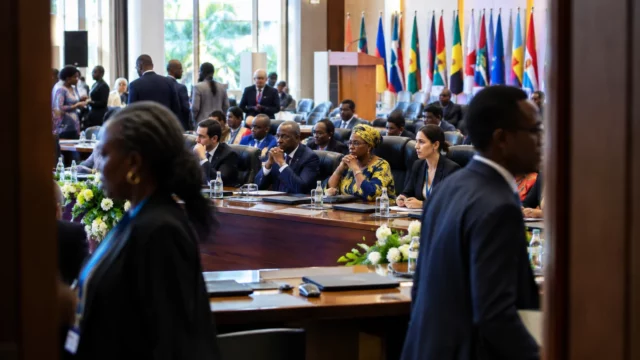
The economic forum held in Kigali in October 2026 extends this momentum into the commercial sphere. The memorandum was signed by Juliana Muganza, deputy chief executive of the Rwanda Development Board (RDB), and Moustapha Cissé, deputy chief executive of APIX Sénégal, the public agency responsible for promoting investment and major projects.
The text provides for the two agencies to share experience and improve connections between businesses. The sectors mentioned include logistics, construction and real estate, leather and fashion, agriculture and agro-processing, as well as trade-related services. Juliana Muganza highlighted opportunities for partnership and mutual learning between the two markets. Rwandan media also reported the signing and the sectors discussed. The report on the Rwanda-Senegal forum.
Complementary economies, but distance to overcome
Rwandan officials describe Senegal as a partner with established expertise in trade, services, entrepreneurship and industrial activity. Dakar plays an important role in West African commerce. Kigali, for its part, is seeking to strengthen its position as an East African business hub. This complementarity is an opportunity, not a guarantee: it must translate into identified markets and viable operations for businesses.
Geography makes this an ambitious undertaking. The two countries are far apart and belong to distinct regional economic blocs. Senegal is a member of the Economic Community of West African States (ECOWAS), while Rwanda participates in the East African Community (EAC). Exporters must therefore contend with transport costs, delays, applicable rules and access to distribution networks. An agreement between agencies can facilitate contacts and information-sharing, but it cannot by itself remove these obstacles.
So far, the announcements have not set out a detailed public timetable for projects arising from the memorandum. Nor do they specify an expected investment figure. The partnership will therefore have to be judged by what follows: trade missions, signed partnerships, simplified procedures and actual exchanges, rather than by the number of texts concluded alone.
Implementation, the partnership’s next test
For businesses, the memorandum’s practical value will depend in part on the agencies’ ability to provide reliable market information and direct investors to the right contacts. Large companies are not the only ones concerned. SMEs, processing businesses and logistics providers will need to understand standards, market-entry costs and concrete financing and distribution opportunities.
The impact will not necessarily be the same in both countries. Businesses based in Dakar or Kigali may be better placed to seize networking opportunities. Producers and companies outside the capitals will need access to the same information and logistics chains. In agriculture and agro-industry, the challenge also involves processing products and meeting the requirements of target markets.
The first Joint Commission for Cooperation provides a political framework for overseeing several aspects of bilateral relations. According to the APS, the eleven texts signed cover a range of areas. This diversity could support economic exchanges, but it also makes follow-up essential: each administration will have to specify responsibilities, deadlines and implementation mechanisms. Details reported on the eleven cooperation texts.
At pan-African level, the initiative forms part of efforts to bring distant markets closer and strengthen business ties between regions. The African Continental Free Trade Area (AfCFTA), which aims to facilitate trade between African countries, provides a general framework, but bilateral agreements remain important for addressing practical difficulties. For Dakar and Kigali, the next measure of progress will therefore be whether commitments are delivered: businesses connected, exchanges better documented and projects able to bridge the gap between announcement and economic activity.