Algeria
 Egypt
 Libya
 Morocco
 Sudan
 Tunisia
 Benin
 Burkina Faso
 Cabo Verde
 Côte d'Ivoire
 Ghana
 Guinea
 Guinea-Bissau
 Liberia
 Mali
 Mauritania
 Niger
 Nigeria
 Senegal
 Sierra Leone
 The Gambia
 Togo
 Cameroon
 Central African Republic
 Chad
 DR Congo
 Equatorial Guinea
 Gabon
 Republic of the Congo
 São Tomé and Príncipe
 Burundi
 Comoros
 Djibouti
 Eritrea
 Ethiopia
 Kenya
 Madagascar
 Malawi
 Mauritius
 Mozambique
 Rwanda
 Seychelles
 Somalia
 South Sudan
 Tanzania
 Uganda
 Angola
 Botswana
 Eswatini
 Lesotho
 Namibia
 South Africa
 Zimbabwe

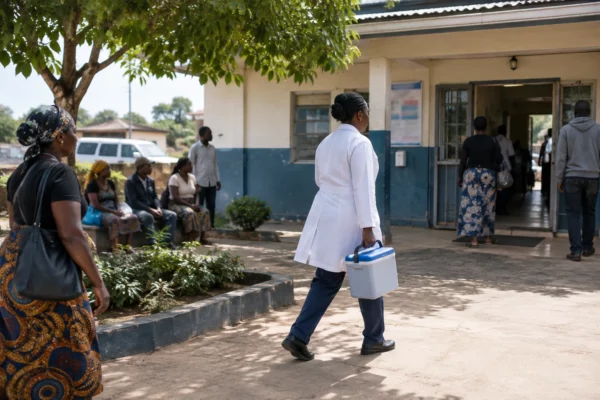
A health agreement can fund treatments and laboratories. It can also raise a question of sovereignty: who controls patient data and biological samples collected in the country? For Zambia, this question weighed on negotiations with Washington.
A compromise after months of disagreements
The Zambian government plans to sign a five-year health memorandum of understanding with the United States this Thursday, 8 October 2026. Health Minister Roma Chilengi said on 6 October that the revised version would no longer require Lusaka to provide biological samples or individual patient data. The announcement was reported by several media outlets, including the Associated Press and Reuters. The final text had not yet been made public at the time of the announcements.
The compromise follows discussions on medical confidentiality, intellectual property and information-sharing. In May, Zambia’s Foreign Minister, Mulambo Haimbe, had also publicly expressed reservations about data-sharing and US requests related to critical minerals. The finalisation announced in October therefore marks a shift in position on the health component, without erasing the tensions that emerged during the talks.
According to figures provided by Roma Chilengi and reported by Reuters, the United States would contribute $1.5bn over five years. Zambia’s contribution would reach $2.1bn, bringing the combined total to about $3.6bn. This is joint funding: the total does not represent US aid alone. The details of the commitments and their timetable will need to be verified in the signed memorandum.
Funding and its conditions
The programme is intended to support the fight against HIV, tuberculosis and malaria, as well as disease surveillance, laboratories and the functioning of the health system. Zambia’s health ministry had already outlined the principle of phased co-financing tied to results, with national spending expected to increase. The challenge is to maintain services as external support changes.
This transition is not simply an accounting transfer between donors and the government. Funding supports essential programmes, as well as staff, medicine supply chains and monitoring systems. A rapid increase in public spending could put pressure on the national budget. Conversely, prolonged dependence on external funding leaves services exposed to shifts in partners’ priorities.
For patients, the announced removal of requirements to share individual records represents an important safeguard on paper. It does not, on its own, resolve the question of protecting health information: the rules for collection, storage, access and transfer under the programme’s technical arrangements will need to be examined. Publication of the text and the oversight arrangements will therefore be crucial.
Zambian laboratories could receive new resources to detect and track epidemics. But the value of these capabilities will also depend on training, equipment availability and the integration of local facilities. In cities and rural areas alike, the impact will be measured by continuity of care and facilities’ ability to obtain tests and treatments quickly.
A negotiation within a wider African debate
Zambia’s case is part of a new series of bilateral health agreements proposed by Washington to African countries. Several governments have debated requests concerning health data and biological samples. Neighbouring Zambia, Zimbabwe, rejected a US agreement in February, in particular because of data-sharing clauses its authorities considered problematic. Circumstances and texts vary from one country to another, however.
The debate concerns the balance between disease surveillance and the fair sharing of scientific benefits. Epidemiological data can help identify a threat and prepare a response. Samples can be used for research. But the countries providing them also want to know who can use them, for what purpose and under what guarantees of access to the diagnostics or treatments developed. These questions concern health sovereignty, but also patient trust.
For Lusaka, concluding an agreement while removing the disputed clauses makes it possible to preserve a financial partnership without accepting the conditions initially discussed on individual data and samples. This does not mean that all the concerns raised have disappeared. The scope of the commitments will depend on the signed text, its implementation and the monitoring mechanisms.
A regional and continental issue
Zambia is a member of the Southern African Development Community (SADC), a regional organisation that coordinates work on HIV, malaria, tuberculosis and health emergency preparedness, among other issues. Diseases do not stop at borders, so surveillance and response benefit from regional cooperation, alongside partnerships concluded country by country.
The contrast between bilateral negotiations and regional cooperation will be worth watching. National funding can strengthen Zambia’s services, while common rules among neighbouring countries facilitate the sharing of alerts and coordination during an epidemic. SADC has already put these issues on the agenda of its health ministers. The announced agreement does not replace this collective work.
The immediate next step is the signing announced for 8 October. After that, the points to watch will be publication of the memorandum, the actual allocation of funds, co-financing obligations and concrete guarantees for data protection. For Zambians, the test will not only be the amount written into the agreement: it will also be the public system’s ability to turn these commitments into accessible, sustainable care.