Algeria
 Libya
 Morocco
 Sudan
 Tunisia
 Benin
 Burkina Faso
 Cabo Verde
 Côte d'Ivoire
 Ghana
 Guinea
 Guinea-Bissau
 Liberia
 Mali
 Mauritania
 Niger
 Nigeria
 Senegal
 Sierra Leone
 The Gambia
 Togo
 Cameroon
 Central African Republic
 Chad
 DR Congo
 Equatorial Guinea
 Gabon
 Republic of the Congo
 São Tomé and Príncipe
 Burundi
 Comoros
 Djibouti
 Eritrea
 Ethiopia
 Kenya
 Madagascar
 Malawi
 Mauritius
 Mozambique
 Rwanda
 Seychelles
 Somalia
 South Sudan
 Tanzania
 Uganda
 Angola
 Botswana
 Eswatini
 Lesotho
 Namibia
 South Africa
 Zambia
 Zimbabwe
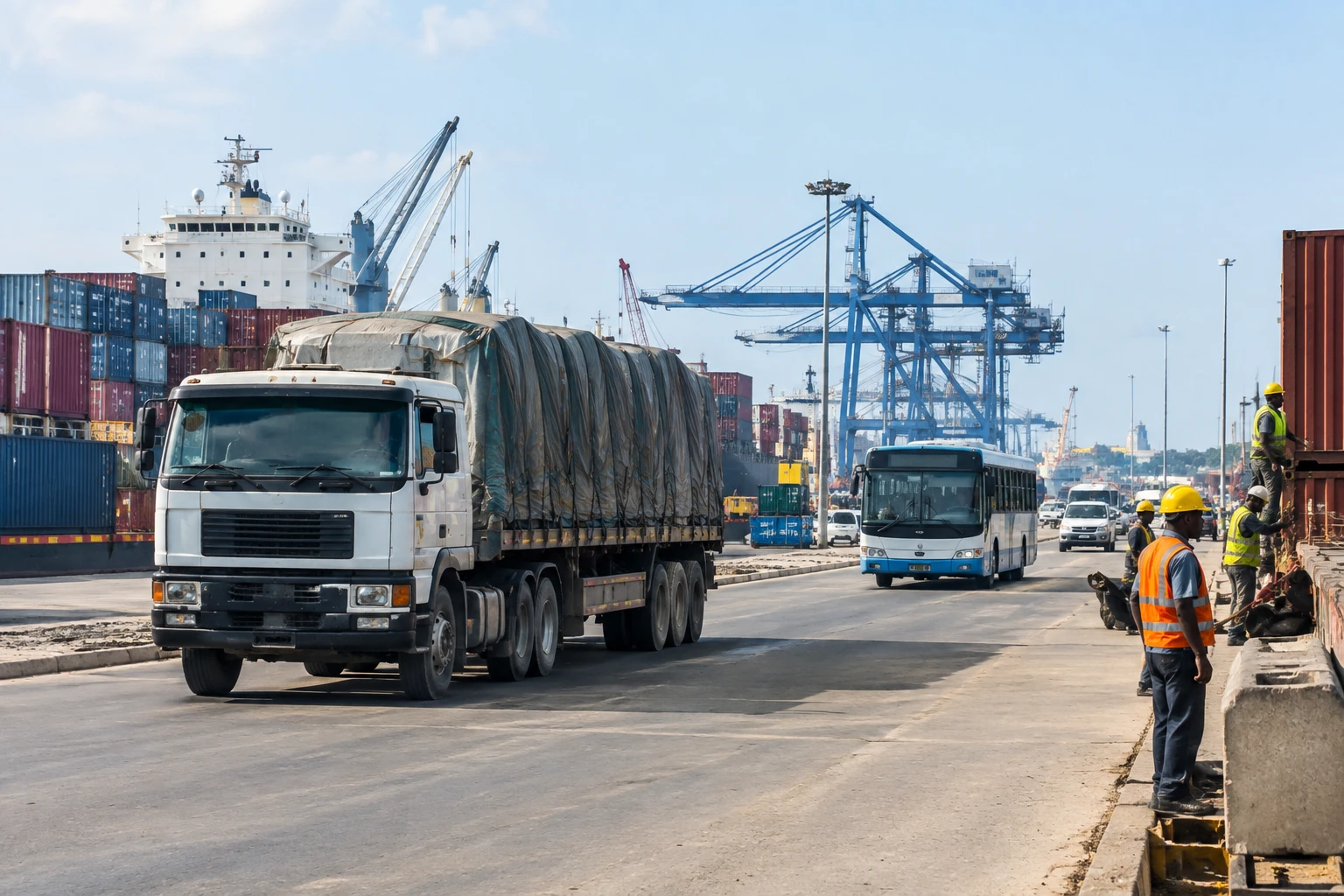
A port can open a gateway to several neighbouring economies. For Egypt, the question is how to turn that geography into regular trade with East Africa and the landlocked countries of the Great Lakes region.
On 5 October 2026, in Cairo, the Egyptian and Tanzanian transport ministers discussed strengthening their logistics cooperation. The idea is ambitious. But the announcements still concern projects to be formalised, not a corridor that is already operational.
Dar es Salaam, an established regional gateway
The port of Dar es Salaam is Tanzania’s main maritime outlet. It also serves neighbouring countries without direct access to the sea, notably Rwanda, Burundi, Uganda, Zambia, Malawi and the Democratic Republic of the Congo. For these economies, transit times and costs depend as much on port infrastructure as on roads, railways and border procedures.
The port is part of the Central Corridor, a transport network linking Dar es Salaam to Tanzania’s interior and several countries in the region. It is one option among others: the Northern Corridor, centred on the Kenyan port of Mombasa, also serves the Great Lakes markets. The choice of route therefore depends on costs, reliability and the ability to deliver goods to their final destination.
Tanzania thus plays a transit role that extends beyond its domestic market. The Tanzania Ports Authority describes Dar es Salaam as a gateway to the region’s landlocked countries. For local operators, the challenge is to benefit from additional traffic without worsening congestion or lengthening transit times.
A project still at the discussion stage
At their meeting, Kamel El-Wazir and Makame Mnyaa Mbarawa discussed a memorandum of understanding that remains to be signed. The proposals announced include the creation and operation of a multipurpose terminal in Dar es Salaam by an Egyptian-Tanzanian consortium. Such a terminal could handle several types of goods, but its construction will depend on agreements, financing and works that have not yet been established in the available announcements.
The discussions form part of a broader ambition: to facilitate trade between Egypt’s Red Sea ports and the Tanzanian coast, and then transport cargoes to inland markets. Regular maritime services, rail connections and logistics zones in both countries were presented as areas for cooperation. At this stage, they should be distinguished from infrastructure already built or services actually launched.
This distinction matters. A sea crossing alone does not make a competitive corridor. Ship and train schedules must be coordinated, goods transhipped, customs procedures harmonised and reliable overland connections ensured. Without continuity between these stages, businesses may favour competing routes, even if the new one appears shorter on a map.
Egypt’s bet on African trade
For Cairo, the project is part of a policy to strengthen economic ties with the continent. Statistics relayed from data by Egypt’s CAPMAS agency put Egypt’s trade with African Union countries at $6.1bn between January and July 2026, compared with $5.5bn over the same period in 2025. Egyptian exports reportedly rose by 3.4% to $4.5bn, while imports from these countries increased by 45.5% to $1.6bn. These figures have been reported by several Egyptian media outlets, which attribute them to CAPMAS.
The increase in imports is notable: the trade relationship is not limited to Egyptian sales to African markets. However, aggregate data for the African Union do not show what share involves Tanzania, or which goods might use a future route via Dar es Salaam. They are therefore insufficient to establish the project’s profitability.
Egypt has a Red Sea coastline and port infrastructure including Sokhna and Safaga. It is also taking part in preparations for the VICMED project, which aims to study a waterway between Lake Victoria and the Mediterranean. The African Development Bank continues to publish preparation and study milestones for the initiative: it is not a completed commercial link.
Costs and benefits are not shared equally
A more efficient corridor can reduce transport costs for importers and exporters. It can also improve access to inputs and expand business opportunities. But the benefits will depend on how investments and contracts are allocated, as well as on local carriers’ and service providers’ access to the new traffic.
Major port operators and logistics companies could capture a significant share of the activity. By contrast, road hauliers, small freight forwarders and traders could face greater competition or changes in practices, especially if procedures and infrastructure evolve without support. People in port cities could benefit from jobs and additional services, but also face more traffic and pressure on urban facilities.
The regional significance is therefore tangible. Tanzania is a member of the East African Community and the Southern African Development Community. A better-connected corridor could support trade across several economic blocs, without eliminating competition between ports and routes. For the African Union, these projects are part of the goal of smoother movement of goods across the continent, but their contribution will depend on how they are integrated into existing networks.
The next steps to watch are the signing of the memorandum, followed by the publication of verifiable details about the terminal, its financing, maritime services and rail connections. Until these elements are in place, the corridor between Egypt’s ports and Dar es Salaam remains a prospect for cooperation. Its success will be measured by transit times, prices and the reliability of the entire journey, all the way to businesses and consumers in the countries it serves.