
 Algeria
 Egypt
 Libya
 Morocco
 Sudan
 Tunisia
 Benin
 Burkina Faso
 Cabo Verde
 Côte d'Ivoire
 Ghana
 Guinea
 Guinea-Bissau
 Liberia
 Mali
 Mauritania
 Niger
 Nigeria
 Sierra Leone
 The Gambia
 Togo
 Cameroon
 Central African Republic
 Chad
 DR Congo
 Equatorial Guinea
 Gabon
 Republic of the Congo
 São Tomé and Príncipe
 Burundi
 Comoros
 Djibouti
 Eritrea
 Ethiopia
 Kenya
 Madagascar
 Malawi
 Mauritius
 Mozambique
 Rwanda
 Seychelles
 Somalia
 South Sudan
 Tanzania
 Uganda
 Angola
 Botswana
 Eswatini
 Lesotho
 Namibia
 South Africa
 Zambia
 Zimbabwe
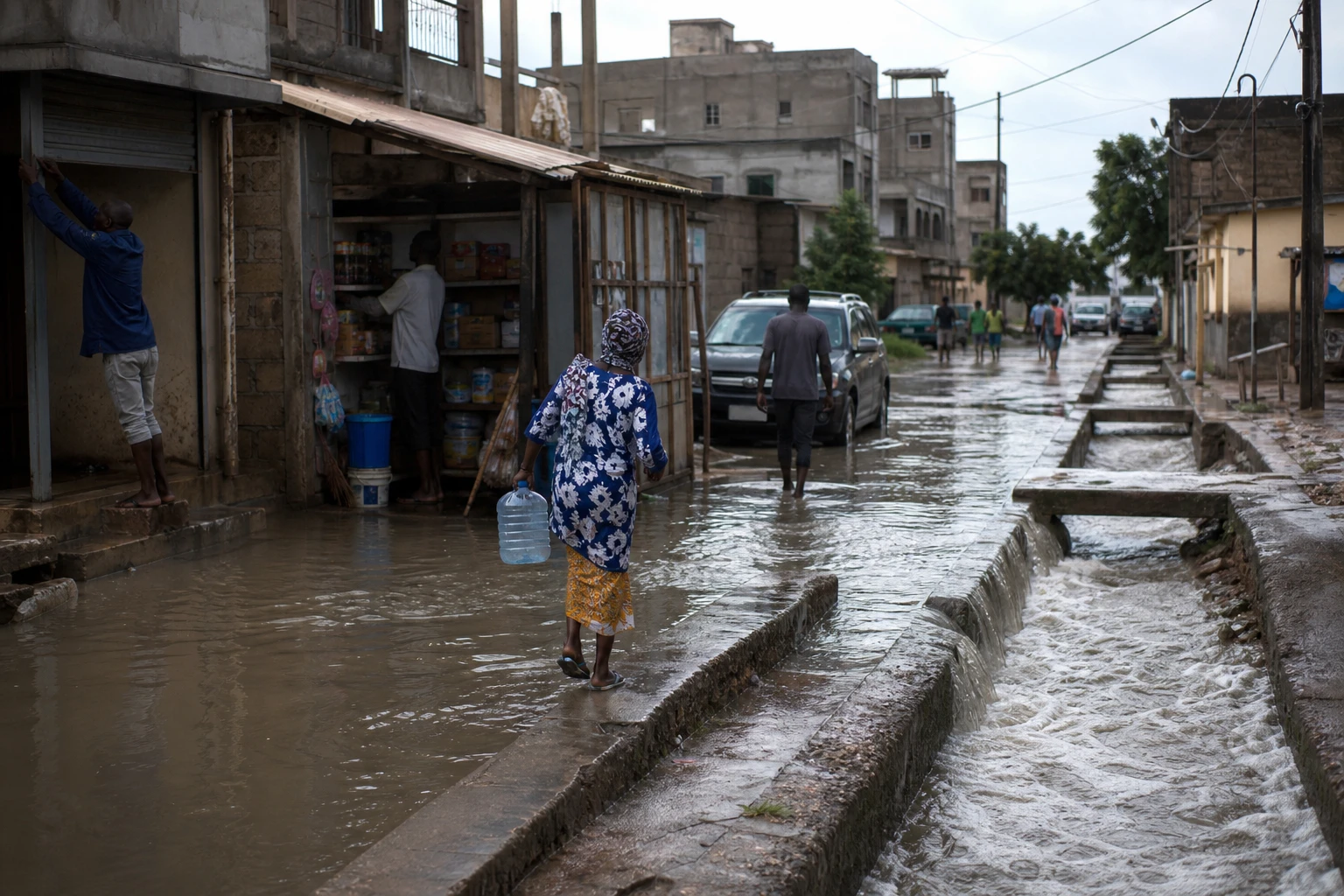
In Dakar, water has once again turned several neighbourhoods into hard-to-reach areas. On the night of Sunday 4 to Monday 5 October 2026, heavy rains hit the capital, as well as Kaolack and Matam. Rescue teams were still at work on Monday morning, while the death toll remained incomplete.
The situation is a reminder of a reality well known to Senegalese people: the rainy season is not simply a matter of how much rain falls. Vulnerability also depends on drainage, the condition of buildings and occupation of exposed areas. In densely populated neighbourhoods, just a few hours of rainfall can be enough to disrupt travel and weaken homes.
A spell of rain stretching from Dakar to Matam
According to initial meteorological data reported on Monday, several stations recorded more than 100 millimetres of rainfall over 24 hours. Readings cited by Senegalese media included 142 millimetres in Rufisque and Ranérou, in the Matam region, and 138 millimetres in Yoff, Dakar. These figures give an indication of the intensity of the event, although readings may vary from one station to another.
The capital was particularly hard hit. In Parcelles Assainies, in Unit 7, a woman aged about 25 and her four-year-old son died after floodwater rose inside their home. The tragedy was reported by several Senegalese media outlets, including SenePlus and Seneweb. An investigation was expected to establish the precise circumstances of the deaths.
In Kaolack, an R+2 building housing a Quranic school collapsed in the Tabangoye neighbourhood on the night of Saturday 3 to Sunday 4 October. Firefighters found three people injured and another dead beneath the rubble. The response involved 43 firefighters and 11 military engineers, according to information published by SenePlus.
Casualties and injuries were also reported in the Matam region. However, the precise circumstances of these incidents were not documented consistently in the initial reports available. The Ministry of the Interior and Public Security described the toll as provisional and subject to change, without immediately confirming a definitive national figure.
A death toll that remains difficult to establish
Several figures circulated on Monday. Some media reported at least five deaths, while others counted as many as seven over the weekend as a whole, including separate incidents involving collapses, electrocution or drowning. The discrepancies reflect the time needed to reconcile on-the-ground findings, police investigations and administrative records.
In this context, the most cautious figure remains a provisional toll comprising several deaths and injuries across different regions. Deaths directly linked to flooding must be distinguished from accidents that occurred during the same period. This distinction is important for accurately assessing the impact of the event and directing rescue efforts.
Local authorities were mobilised to secure exposed areas, assist those affected and facilitate pumping operations. The government also announced the activation of emergency measures. On the ground, firefighters carried out evacuations, cleared debris from weakened buildings and treated the injured.
Dakar faces the challenge of water and urbanisation
In the Dakar region, the consequences are immediate. Roads become impassable, transport slows and commercial activity is disrupted. The most exposed households may have to choose between staying in an unsafe home and finding temporary accommodation, often with no easy solution nearby.
Popular neighbourhoods are not the only areas affected. Essential infrastructure can also suffer from heavy rain. Healthcare facilities, schools, electricity networks and roads can all be hit when water accumulates rapidly. The impact is therefore not confined to homes: it affects the continuity of public services and the local economy.
The problem stems from a combination of factors. Dakar is experiencing rapid urban growth, with built-up areas sometimes located on land poorly suited to the natural drainage of water. In some areas, drainage networks remain inadequate or are quickly overwhelmed. Elsewhere, the upkeep of infrastructure and the strength of buildings are decisive factors.
The regions of Kaolack and Matam face other vulnerabilities. In Kaolack, the collapses highlight the risks posed by weakened buildings. In Matam, proximity to the Senegal river and the exposure of some areas to heavy rain complicate the response. Measures must therefore be tailored to local conditions, rather than designed solely in Dakar.
A national and regional challenge
Senegal has disaster-management mechanisms, including the ORSEC plan, which coordinates emergency services. However, the effectiveness of a response also depends on early warnings, mapping risk areas and local authorities’ ability to act before water levels rise.
This issue extends beyond national borders. Senegal belongs to the Economic Community of West African States, ECOWAS, which promotes regional cooperation in response to climate risks and disasters. Extreme rainfall also affects Mauritania, Mali, The Gambia and other West African countries, with different consequences depending on river basins and available infrastructure.
The priority in the coming days will be to stabilise the death toll, evacuate dangerous areas and reopen routes. Damage to homes, schools, places of worship and public facilities will then need to be assessed. The central question will remain the same: how can emergency responses be turned into a lasting prevention policy, when episodes of intense rainfall are becoming a recurring risk for Senegalese cities ?



