Algeria
 Egypt
 Libya
 Morocco
 Sudan
 Tunisia
 Benin
 Burkina Faso
 Cabo Verde
 Côte d'Ivoire
 Ghana
 Guinea
 Guinea-Bissau
 Liberia
 Mali
 Niger
 Nigeria
 Senegal
 Sierra Leone
 The Gambia
 Togo
 Cameroon
 Central African Republic
 Chad
 DR Congo
 Equatorial Guinea
 Gabon
 Republic of the Congo
 São Tomé and Príncipe
 Burundi
 Comoros
 Djibouti
 Eritrea
 Ethiopia
 Kenya
 Madagascar
 Malawi
 Mauritius
 Mozambique
 Rwanda
 Seychelles
 Somalia
 South Sudan
 Tanzania
 Uganda
 Angola
 Botswana
 Eswatini
 Lesotho
 Namibia
 South Africa
 Zambia
 Zimbabwe
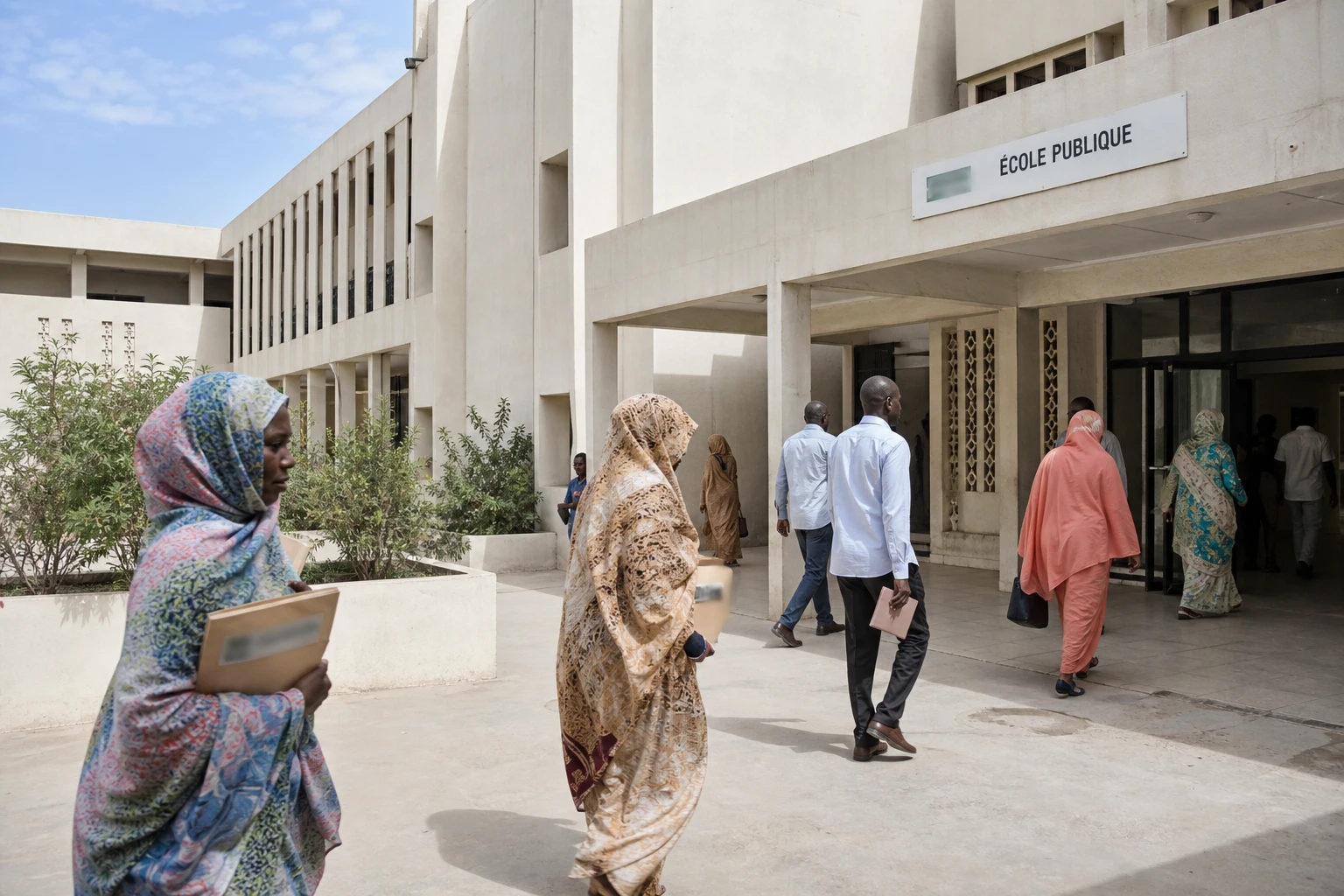
In Nouakchott, the start of the school year on Monday 5 October 2026 is not playing out only in classrooms. It marks a new stage in a state policy: to reserve basic education gradually for the public sector, while leaving private institutions a role mainly at middle and secondary school levels.
This policy is reshaping Mauritania’s school landscape. It affects school management, contract teachers, families and pupils who for several years have relied on private schools for their organisation, language of instruction or smaller class sizes.
A reform enshrined in the 2022 law
The change is not based on a simple back-to-school circular. It stems from Law No. 23-2022, the framework law on the national education system, adopted on 17 August 2022. The text provides for a gradual restriction of private-sector involvement to levels beyond primary school.
In Mauritania, primary education lasts six years. It is part of basic education, which also includes three years of middle school. The authorities describe this basic schooling as compulsory and under the joint responsibility of the state, families and legal guardians.
The government is therefore championing the Republic School project. It aims to strengthen a shared framework, with national curricula, increased public oversight and a commitment to inclusion among the different components of Mauritanian society.
The minister of education and reform of the education system again presented the reform as a means of strengthening and building resilience in the education system, including at an international meeting on transforming education in July 2026.
Private schools gradually pushed out of primary education
Ahead of the 2026-2027 school year, the ministry asked private schools without recognised equivalence not to enrol pupils in primary classes from first to fifth year. Under the instruction made public on 14 September 2026, these institutions may enrol pupils in sixth year.
This official clarification qualifies the timetable outlined by some sector players, who had referred to the phasing out of first- to fourth-year classes, followed by an extension to the remaining classes. The principle, however, is now established: access to private primary education is expected to shrink until it disappears for most schools.
The ministry warns that schools that fail to comply with this rule will face legal measures. It has also asked parents to check the administrative status of schools before enrolling their children. The aim is to prevent years of study from going unrecognised or pupils from encountering difficulties in national exams and competitive examinations.
The regulatory framework was strengthened in 2025. A decree requires private schools, among other things, to follow official curricula, respect national values and standards, and submit to the administration’s educational and organisational inspections.
Schools face an economic shock
For private schools, the stakes go beyond a change to the curriculum. Primary education often provides the financial foundation of a school. Families enrol their children for several years, helping to stabilise income and sustain jobs.
The gradual disappearance of these classes therefore risks cutting the revenues of the schools concerned. It could also jeopardise the jobs of teachers who do not have civil servant status. In some institutions, middle and secondary school activities will not be enough to make up for the loss of primary pupils.
School owners are also concerned about investments already made in buildings, specialist classrooms, equipment, school transport and staff recruitment. A school that retains only a few higher year groups may be forced to cut its workforce or completely overhaul its business model.
However, opposition is not solely about finances. Private-sector representatives believe the reform also entails a linguistic and cultural choice. They fear that concentrating primary education in the public sector will strengthen the place of Arabic in teaching, at the expense of other linguistic expectations within Mauritanian society.
This is a sensitive issue in a country where Arabic is the official language, while Pulaar, Soninke and Wolof are recognised national languages. Debates about schools therefore touch on the representation of different communities, access to public-sector jobs and the place of languages in shaping citizenship.
The central challenge: accommodating pupils and teachers
The reform’s success will depend less on its announcement than on the public sector’s ability to accommodate the pupils concerned. This requires enough classrooms, trained teachers, textbooks and inspection resources, in Nouakchott as well as in the inland regions.
The government itself acknowledges that improving access to equitable education, the quality of learning and governance is a priority for the 2026-2027 school year. Transferring pupils from private to public schools could strengthen equality of access, but only if the necessary capacity is in place.
The impact will also vary by location. In the capital, families can sometimes compare several schools and arrange a change. In rural or remote areas, the choice of schools is more limited. The closure of a private class could then mean a longer journey, overcrowded public-school classes or pupils dropping out.
Families will also have to deal with the practical consequences of the reform. Some choose private schools for their timetables, supervision, proximity or language of instruction. If public provision does not meet these needs, the measure could increase demand for foreign schools or informal institutions, risking the creation of new inequalities.
A test for the Republic School model
Mauritania is not the only African country seeking a balance between a unifying public education service and a private sector that has become indispensable in cities. But Mauritania’s approach stands out for the gradual, regulatory nature of the state’s reassertion of control over primary education.
This change comes as the country strengthens its links with West Africa. Mauritania has not been a member of the Economic Community of West African States, ECOWAS, since 2000, but it remains connected to its neighbours through mobility, trade, languages and education. Decisions taken in Nouakchott may therefore affect cross-border families and regional schooling pathways.
In the coming months, three indicators will help measure the reform’s real impact: the number of pupils actually transferred to the public sector, schools’ capacity to accommodate them, and the fate of teachers employed by private schools.
Ultimately, the debate in Mauritania is not only about the survival of private schools. It raises a broader question: how can a shared school system be built without narrowing the diversity of educational pathways, languages and social expectations? The answer will depend far more on how the reform is implemented in practice than on its official principles.