
 Algeria
 Egypt
 Libya
 Morocco
 Sudan
 Tunisia
 Benin
 Burkina Faso
 Cabo Verde
 Côte d'Ivoire
 Ghana
 Guinea
 Guinea-Bissau
 Liberia
 Mali
 Mauritania
 Niger
 Nigeria
 Senegal
 Sierra Leone
 The Gambia
 Togo
 Cameroon
 Central African Republic
 Chad
 DR Congo
 Equatorial Guinea
 Gabon
 Republic of the Congo
 São Tomé and Príncipe
 Burundi
 Comoros
 Djibouti
 Eritrea
 Ethiopia
 Kenya
 Madagascar
 Malawi
 Mauritius
 Mozambique
 Rwanda
 Seychelles
 Somalia
 South Sudan
 Tanzania
 Uganda
 Angola
 Botswana
 Eswatini
 Lesotho
 Namibia
 Zambia
 Zimbabwe
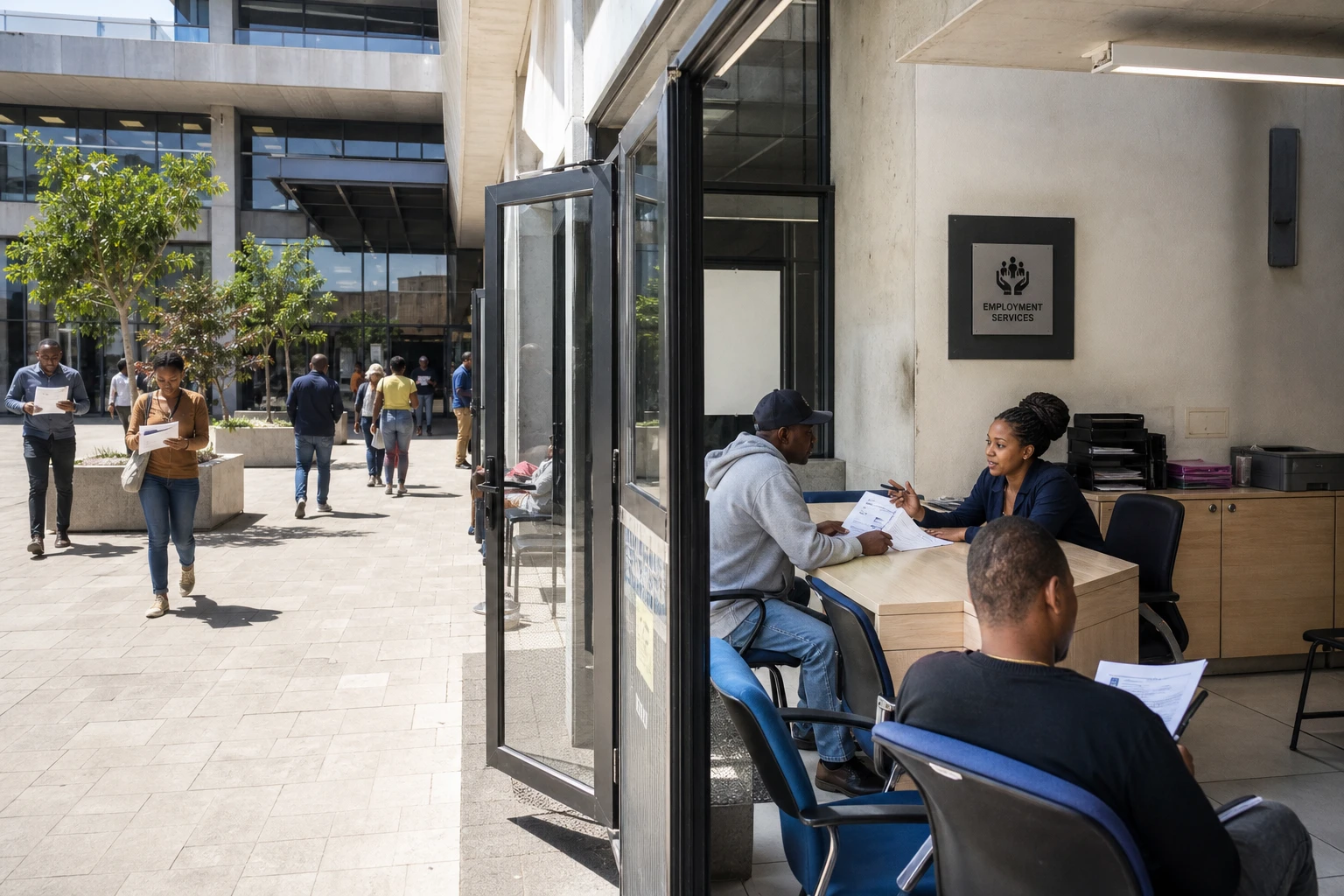
In Pretoria, employment figures point to a difficult reality that is hard to mask: even when some sectors are hiring, the South African economy is still not creating enough jobs to absorb new entrants to the labour market.
The latest available data show a double strain. Formal non-agricultural employment has edged down. At the same time, the number of people looking for work has risen sharply. For households, this pressure directly affects income, consumption and the ability to meet day-to-day expenses.
Another fall in formal employment
According to Statistics South Africa’s formal employment data, the non-agricultural sector lost 14,000 jobs between March and June 2026. Employment fell from 10.439 million to 10.425 million.
This decline follows a sharper fall in the first quarter. Between December 2025 and March 2026, 80,000 jobs had already been lost in this statistical category. Year on year, the sector had 95,000 fewer jobs in June 2026.
The trend remains uneven across industries. Manufacturing recorded the biggest decline in the second quarter, with 20,000 fewer jobs. Business services shed 13,000 jobs. Trade cut 8,000 and transport 5,000.
Community services provided the main bright spot, adding 29,000 jobs. Electricity, mining and construction also grew, but only slightly, with 1,000 jobs each.
The decline is concentrated in full-time employment. The number of full-time jobs fell by 40,000 between the first and second quarters, to 9.33 million. This shift weighs more heavily on households than the change in the total number of jobs alone, because full-time work generally offers greater stability and a more predictable income.
Unemployment rises faster than employment
Statistics South Africa’s Quarterly Labour Force Survey provides a broader picture of the labour market. Between the first and second quarters of 2026, the number of people in employment fell by 16,000, to 16.7 million.
Over the same period, the number of unemployed people rose by 345,000, to 8.5 million. The official unemployment rate consequently increased from 32.7% to 33.6%. This rate measures the share of people without jobs who are actively seeking work among the labour force.
The labour force nevertheless grew by 329,000 people. This gap is crucial: more South Africans are looking for work, but job creation is not keeping pace. The problem is therefore not limited to job losses. It also concerns the economy’s ability to absorb a working-age population that continues to grow.
Young people remain the most exposed. Among 15- to 34-year-olds, unemployment stood at 47.4% in the second quarter. The number of young people without work rose by 264,000, while the number of young workers fell by 40,000.
The labour underutilisation rate stood at 46.3%. It includes the unemployed, people working fewer hours than they would like and some people who could work but are not actively seeking a job. It therefore describes a broader vulnerability than the official unemployment rate alone.
Earned income at the heart of household budgets
The deterioration in the labour market is particularly significant in a country where wages remain the main resource for many households. The General Household Survey 2025 indicates that wages and salaries were the main source of income for 54.3% of South African households.
Social protection also plays a major role. Social grants were the main source of income for 23.4% of households. In 2025, 39.5% of people received at least one social grant. The proportion reached 50.6% of households when at least one member of the household received assistance.
These figures do not make it possible to say that the job losses recorded in 2026 have already led to a measurable fall in household incomes. They nevertheless show how exposed households are to changes in the labour market. When a job disappears, the shock can affect spending on food, transport, housing, school fees or debt repayments.
The impact is not uniform. Households with several sources of income can cushion the loss of a job. Those relying on a single wage are more vulnerable. Differences between provinces also widen the gaps, as formal job opportunities remain concentrated in major economic and urban centres.
Pressure extending beyond South Africa’s borders
For South Africa, employment is directly linked to its growth trajectory. An economy that creates few jobs struggles to broaden its consumer base and reduce inequality. It must also meet social needs without putting further strain on public finances.
The issue also concerns the Southern African Development Community, or SADC, which brings together several countries in the region for economic and political co-operation. South Africa carries considerable weight within the bloc. Its industrial, commercial and financial activity influences supply chains and neighbouring markets.
What happens next will depend in particular on the productive sectors’ ability to reverse the trend, as well as on developments in community services and infrastructure investment. The next indicators will show whether the second-quarter decline marks a temporary slowdown or a new period of weakness in formal employment.
The most closely watched signal will remain the gap between growth in the labour force and growth in employment. As long as that gap persists, pressure on South African households will remain high, despite the resilience seen in some sectors.



