Algeria
 Egypt
 Libya
 Morocco
 Sudan
 Tunisia
 Benin
 Burkina Faso
 Cabo Verde
 Côte d'Ivoire
 Ghana
 Guinea
 Guinea-Bissau
 Liberia
 Mali
 Mauritania
 Niger
 Nigeria
 Senegal
 Sierra Leone
 The Gambia
 Togo
 Cameroon
 Central African Republic
 Chad
 DR Congo
 Equatorial Guinea
 Gabon
 Republic of the Congo
 São Tomé and Príncipe
 Burundi
 Comoros
 Djibouti
 Eritrea
 Kenya
 Madagascar
 Malawi
 Mauritius
 Mozambique
 Rwanda
 Seychelles
 Somalia
 South Sudan
 Tanzania
 Uganda
 Angola
 Botswana
 Eswatini
 Lesotho
 Namibia
 South Africa
 Zambia
 Zimbabwe

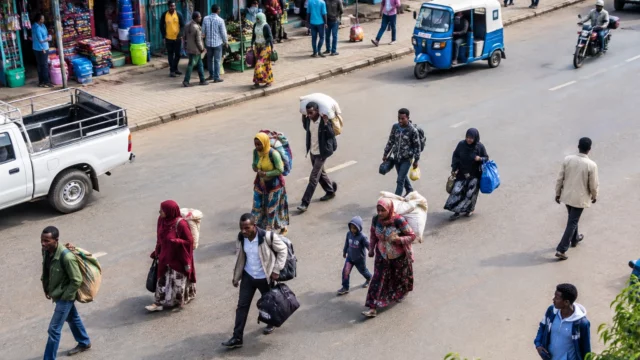
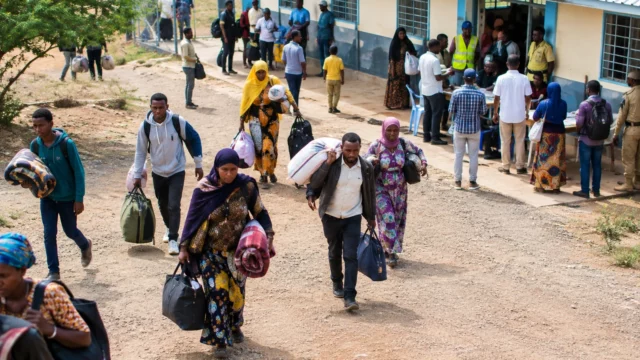
In Addis Ababa and Gondar, Ethiopian families continue to wait for a decision that could transform their lives. They have submitted applications to join relatives living in Israel. Yet the wait can last for years, as eligibility criteria and funding change with political decisions.
An ancient history, marked by several waves of departure
The Beta Israel community is one of Africa’s oldest Jewish traditions. Its history is rooted in northern Ethiopia, particularly in the present-day regions of Amhara and Tigray. Some religious accounts link it to the Queen of Sheba and King Solomon. This origin is, however, a matter of tradition and is not the subject of an established historical consensus.
The Beta Israel have maintained their religious practices in a predominantly Christian environment. Over the centuries, they have also faced discrimination, land restrictions and religious pressure. Some of their descendants were forced or encouraged to convert to Christianity. These people are often referred to as Falash Mura, a term that remains contested and encompasses different family circumstances.
The revolutionary period that began in 1974 heightened instability. The Derg military and then socialist regime governed Ethiopia until 1991. Civil war, forced displacement and food crises made departures even more dangerous for civilians, including members of the Jewish community.
In the 1980s and 1990s, several operations enabled thousands of Beta Israel to leave Ethiopia. Operation Moses, launched in 1984, organised departures via Sudan. Operation Solomon then led to the evacuation of more than 14,000 people from Addis Ababa in about 36 hours on 24 and 25 May 1991, according to the Jewish Agency’s archives.
In Addis Ababa, the wait goes on
These operations did not end family separations. Thousands of people remained in Ethiopia. Some settled in the capital. Others went to Gondar, in the country’s north-west, to be closer to the services responsible for reviewing applications to leave.
The current situation involves several categories. People recognised as Jewish under Israeli criteria may be eligible under the Law of Return, which governs the immigration to Israel of people considered Jewish and certain members of their families. Falash Mura, by contrast, do not automatically have the same status. Their departure depends primarily on government decisions, verification of their family links and, in many cases, family reunification.
This distinction accounts for much of the administrative delay. Applications must be examined individually. Applicants must provide identity documents, establish family ties and complete medical and administrative procedures. In some cases, available documents are incomplete, particularly for families displaced by conflict and political crises.
In March 2024, a committee of the Knesset, Israel’s parliament, estimated that about 14,000 people were still waiting in Ethiopia. The same debate said that 1,226 applicants had been deemed eligible but could not leave immediately because of a lack of funding. In May 2025, another Israeli parliamentary meeting repeated the figure of 1,226 people awaiting departure and reported that 56 people from Ethiopia had arrived in Israel since the start of the year.
These figures do not necessarily refer to the same population. They may include people eligible under different provisions and members of separated families. Overall figures should therefore be treated with caution. The Jewish Agency, which supports the process in Ethiopia, says it works in Addis Ababa and Gondar on medical examinations, travel documents, language preparation and immigration formalities.
A visa is only the first step
For the families concerned, permission to leave does not mean they can immediately begin a new life. They still have to pay for travel, arrange transport to Addis Ababa, obtain the necessary documents and prepare for arrival in Israel. People living far from major urban centres are particularly affected by transport costs and administrative delays.
The wait also weighs on household finances. Many have left their villages of origin to move closer to offices and transit camps. They have consequently lost some of their agricultural or commercial activities. In Addis Ababa, the cost of housing and food adds further pressure. Children may also experience interruptions to their schooling when families move several times.
Meanwhile, relatives already settled in Israel have to support family members who remain in Ethiopia. Money transfers can sometimes cover housing, healthcare or travel. But they cannot replace an official decision. Family reunification thus becomes a long, costly and uncertain process.
Arrival in Israel brings its own difficulties. New immigrants have to learn Hebrew, find work and access public services. They may also face income disparities, discrimination and difficulties getting their qualifications recognised. Israel’s Ministry of Aliyah and Integration has a service dedicated to immigrants from Ethiopia, but integration varies greatly depending on age, education and whether relatives are already in the country.
An issue that goes beyond relations between Ethiopia and Israel
Departures directly concern Ethiopia’s sovereignty. The country has to manage civil-status documents, internal movements and consular relations. The issue also concerns Israel, which must weigh family reunification requests against religious criteria and budgetary constraints.
The issue also resonates across the Horn of Africa. Ethiopia remains a key member of the Intergovernmental Authority on Development, or IGAD, a regional organisation working on peace, security and mobility. Conflict in the north of the country, intercommunal tensions and economic difficulties have complicated travel and the handling of administrative procedures.
Across Africa, this history is a reminder that migration is not limited to large international flows. It also involves separated families, hard-to-obtain documents and decisions made far from where people live. For the Beta Israel and Falash Mura, the next steps will depend chiefly on three factors: the publication of clear criteria, funding for approved departures and the authorities’ ability to process applications without extending the wait indefinitely.
For families gathered in Addis Ababa or Gondar, the issue is therefore not simply whether they can obtain a visa. It is whether a promise of family reunification can finally become a concrete administrative decision after decades of separation.