
 Algeria
 Egypt
 Libya
 Morocco
 Sudan
 Tunisia
 Benin
 Cabo Verde
 Côte d'Ivoire
 Ghana
 Guinea
 Guinea-Bissau
 Liberia
 Mali
 Mauritania
 Niger
 Nigeria
 Senegal
 Sierra Leone
 The Gambia
 Togo
 Cameroon
 Central African Republic
 Chad
 DR Congo
 Equatorial Guinea
 Gabon
 Republic of the Congo
 São Tomé and Príncipe
 Burundi
 Comoros
 Djibouti
 Eritrea
 Ethiopia
 Kenya
 Madagascar
 Malawi
 Mauritius
 Mozambique
 Rwanda
 Seychelles
 Somalia
 South Sudan
 Tanzania
 Uganda
 Angola
 Botswana
 Eswatini
 Lesotho
 Namibia
 South Africa
 Zambia
 Zimbabwe
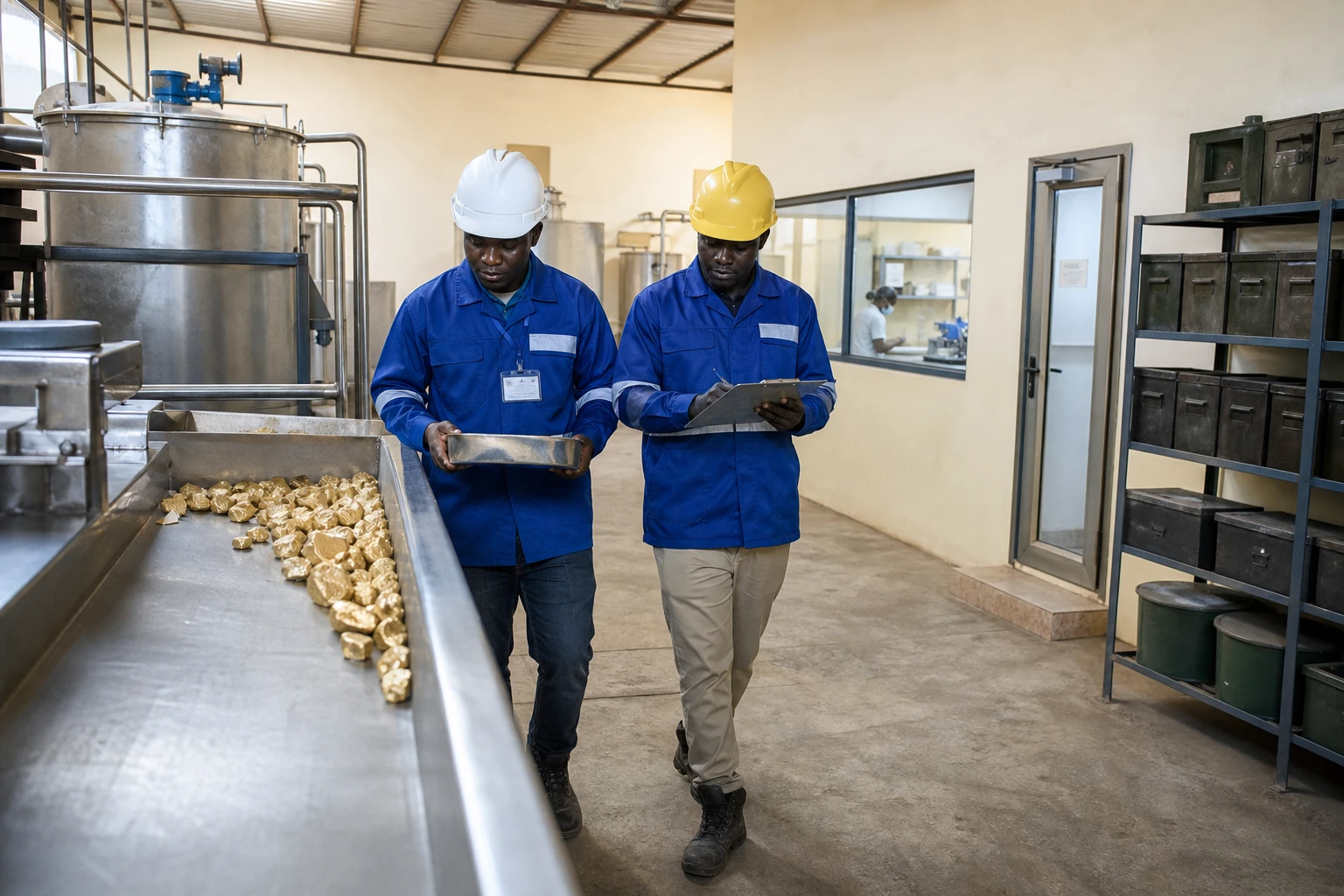
In Ouagadougou, Burkina Faso’s first gold refinery is changing the question facing the mining sector. The issue is no longer simply extracting the metal, but retaining some of its processing, traceability and value within the country.
An industrial facility at the heart of mining strategy
President Ibrahim Traoré inaugurated Raffinor-BF on Monday 28 September 2026 in the Burkinabè capital. The facility is intended to process doré from mines into fine gold with a purity of up to 99%, according to information provided at the ceremony.
The project represents an investment of more than 11 billion CFA francs. Funding was mobilised by the state, notably through the National Precious Substances Company, Sonasp, with the participation of Burkinabè private-sector partners. The refinery is located on a five-hectare site in the Ouaga 2000 district.
Its initial refining capacity is announced at between 164 and 167 tonnes a year. The authorities plan to scale this up to as much as 515 tonnes. This projection exceeds Burkina Faso’s currently declared industrial production. It therefore reflects a broader ambition: eventually to process gold from different channels and potentially handle some regional production.
At the inauguration, Ibrahim Traoré argued for a break with the model of exporting raw materials for processing abroad. “We want to refine all our metals here (…) we want the entire value chain here,” he said, according to the Burkina Faso Government Information Service.
From mine to gold bar: what the refinery could change
Until now, much of the added value from Burkinabè gold was created after it left the country. Local refining can reduce this dependence. It can also strengthen checks on volumes, operators and financial flows linked to the precious metal.
For the state, the primary concern is tax revenue. Better knowledge of the quantities produced makes it easier to collect taxes, royalties and other levies provided for under mining legislation. It can also improve the authorities’ ability to negotiate with companies and plan public investment.
For workers, local processing creates demand for skills in metallurgy, quality control, industrial maintenance, security and logistics. The government also presents the refinery as a technical training facility. However, its impact on employment will depend on the number of jobs actually created and the opportunities available to Burkinabè workers.
The project will not automatically resolve the sector’s difficulties. A refinery can operate sustainably only if it receives a regular, legal and adequately documented supply. It also needs electricity, reliable laboratories, certification standards and independent monitoring mechanisms.
Artisanal gold remains the main test
Burkina Faso has a substantial artisanal and small-scale mining sector. It provides livelihoods for many households, particularly in rural areas. However, it remains difficult to measure because some production bypasses official channels.
Smuggling deprives local authorities and the national budget of revenue. It also makes gold traceability more difficult: identifying its origin, the parties involved in its production and the conditions under which it is sold.
The Burkinabè authorities also say that some illegal networks may contribute to the financing of armed groups operating in the country. This allegation must be examined area by area and case by case. It nevertheless highlights the link between mining governance, security and border controls.
In 2024, the government suspended exports of gold from artisanal and semi-mechanised mining. The stated aim was to bring the sector under better control. The refinery will now need to be part of a more comprehensive system: licensed buying offices, site inspections, monitoring of transporters, action against false declarations and fair market access for producers.
The challenge will vary from one area to another. In Ouagadougou, the refinery could support industrial and financial activities. In rural mining areas, priorities are more likely to include security, community incomes, access to public services and reducing risks associated with artisanal sites.
A policy of greater state control
The inauguration is part of the economic policy pursued since Ibrahim Traoré came to power in September 2022. The authorities are seeking to strengthen the public sector’s presence in industries considered strategic, including mining, and increase the share of processing carried out in Burkina Faso.
The government has, among other measures, created a state-owned mining company and required the state to take a 15% stake in certain operations. Mining companies must also contribute to training local workers. The policy is intended to increase national benefits, but requires a stable framework, clear rules and transparent management.
Rising production strengthens the case for this strategy. The World Gold Council said Burkina Faso’s gold production had risen by 17% year on year in the second quarter of 2026. The increase was due in part to higher processing volumes at several industrial mines.
High gold prices offer a favourable opportunity. But they also expose the country to heavy dependence on a single commodity. Local processing will therefore not replace economic diversification. It will need to be accompanied by investment in agriculture, energy, transport, textiles and services.
The West African bet
Burkina Faso is not the only West African country seeking to capture more value from the gold sector. Ghana, Guinea, Mali and Côte d’Ivoire are developing or considering local refining capacity and export controls.
This competition could usher in a new phase for regional value chains. But a landlocked country such as Burkina Faso will have to address the transport and security of gold flows. Co-operation with neighbouring countries will be crucial, particularly in combating smuggling and harmonising certification standards.
The issue therefore extends beyond Burkina Faso’s mining policy. It speaks to West Africa’s industrialisation ambitions in a region undergoing a realignment of alliances and debating economic sovereignty. Raffinor-BF’s success will be measured less by its inauguration than by its ability to produce consistently, integrate artisanal operators and turn mining revenue into tangible benefits for the population.



