
 Algeria
 Egypt
 Libya
 Morocco
 Sudan
 Tunisia
 Benin
 Burkina Faso
 Cabo Verde
 Côte d'Ivoire
 Ghana
 Guinea
 Guinea-Bissau
 Liberia
 Mali
 Mauritania
 Niger
 Nigeria
 Sierra Leone
 The Gambia
 Togo
 Cameroon
 Central African Republic
 Chad
 DR Congo
 Equatorial Guinea
 Gabon
 Republic of the Congo
 São Tomé and Príncipe
 Burundi
 Comoros
 Djibouti
 Eritrea
 Ethiopia
 Kenya
 Madagascar
 Malawi
 Mauritius
 Mozambique
 Rwanda
 Seychelles
 Somalia
 South Sudan
 Tanzania
 Uganda
 Angola
 Botswana
 Eswatini
 Lesotho
 Namibia
 South Africa
 Zambia
 Zimbabwe
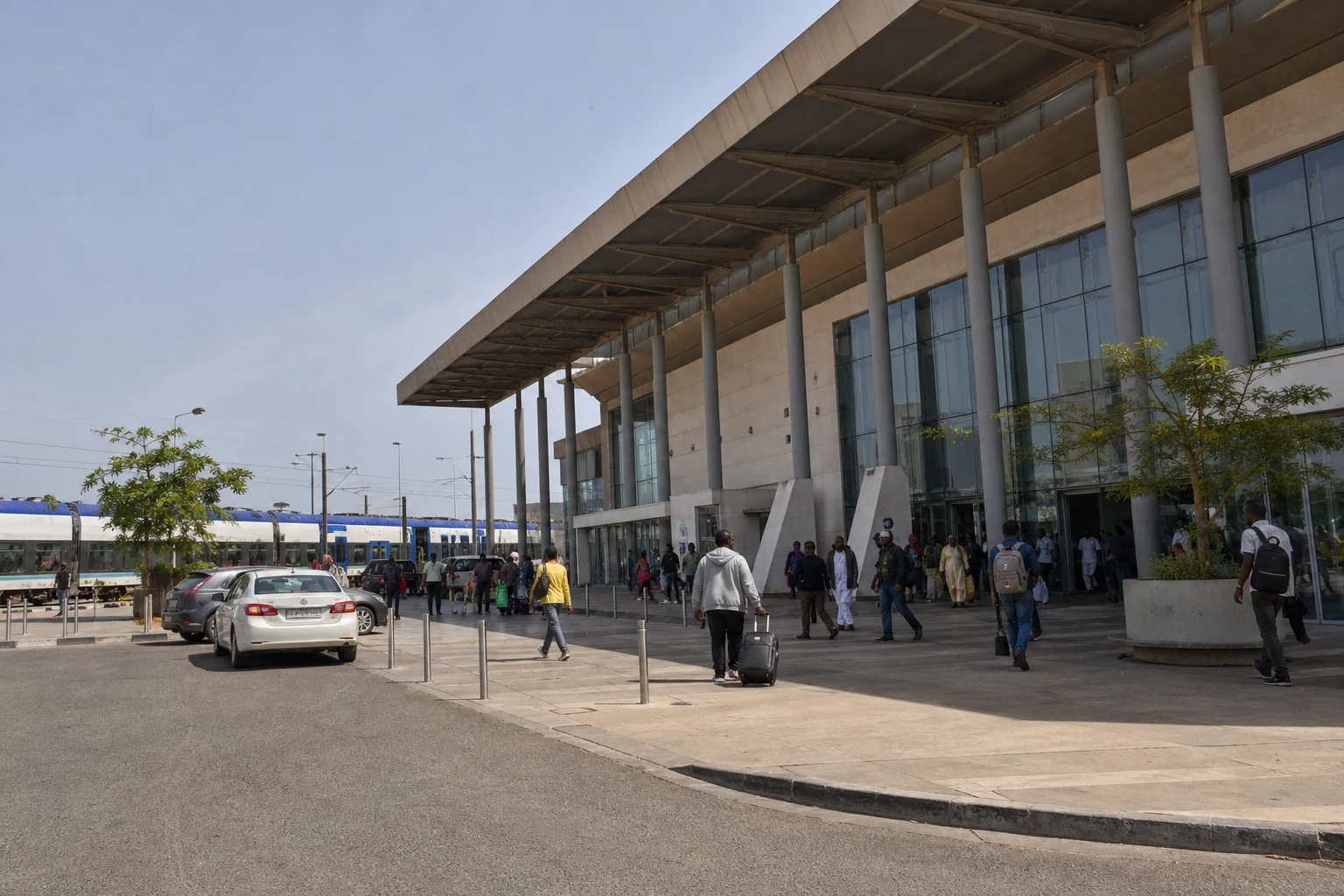
For travellers arriving in Dakar, the final kilometres to Blaise Diagne International Airport are no longer covered solely by road. Since Monday 28 September 2026, the Regional Express Train (TER) has linked the Senegalese capital directly to the airport in Diass. The journey is expected to take around 55 minutes, with trains running every 24 minutes between Diamniadio and AIBD.
A new link between Dakar, Diamniadio and Diass
The new service runs along a 19-kilometre stretch between Diamniadio and Blaise Diagne International Airport. The extension brings the network’s total length to 55 kilometres, between Dakar station and AIBD. It includes a double electrified track, upgraded signalling equipment and a station next to the terminal.
The project changes the role of the TER. The train no longer serves only Dakar’s suburbs and the economic hub of Diamniadio. It is also a link between central Dakar’s administrative and commercial districts, residential areas in the east of the metropolitan area and Senegal’s main international airport.
The new transport plan provides for a train every eight minutes between Dakar and Diamniadio. On the new section, between Diamniadio and AIBD, trains will run every 24 minutes. Seven dual-mode trainsets, capable of running on electricity and diesel, have been added to the fleet, which now numbers 22.
The service was inaugurated on 28 September by Senegal’s Minister of Land and Air Transport, Abdoul Ahad Ndiaye. According to the Senegalese Press Agency, investment in this phase exceeds CFA francs 300 billion. Travel on the new section is free from 28 September to 4 October 2026, giving passengers the chance to try the service.
Passengers look forward to saving time
For Senegalese people working at the airport, the link offers a more predictable alternative to road travel. Employees of airlines, security companies, catering businesses and logistics firms are directly affected. Until now, their journey times have depended on traffic on the toll motorway and congestion on the outskirts of Dakar.
Travellers and their families are also set to benefit. AIBD is in Diass, in the Thiès region, several dozen kilometres from Dakar. The journey by car or taxi varies considerably depending on the time of day and traffic conditions. The TER therefore offers a more consistent scheduled journey time, particularly for early departures and international arrivals.
The improvement will not resolve every difficulty. Night-time timetables, connections between trains and late flights, and baggage transport will remain key to the passenger experience. The service will also need to remain regular as passenger numbers rise.
The project was also completed after several delays. Its high cost has fuelled strong expectations around service quality and equipment maintenance. Infrastructure on this scale cannot be judged by its inauguration alone. It will need to stand the test of time, with punctual trains, accessible stations and clear information for passengers.
Sébikotane, the next sticking point
Residents of Sébikotane, between Diamniadio and AIBD, are still waiting for a station of their own. Senegalese authorities have announced plans to build a new one. In the meantime, a bus shuttle is due to link Sébikotane with Diamniadio, allowing residents to access the network.
This step is important to ensure the extension does not chiefly benefit travellers starting out in Dakar or Diamniadio. A regional link becomes more useful when the municipalities it passes through can genuinely use it for education, work, healthcare and administrative appointments.
Fares will also be crucial. Prices must remain affordable for regular users while enabling the operator to fund operations and maintenance. The priorities differ by passenger: an air traveller may value speed, while an employee or student will first consider the total cost of their journeys.
A full-scale test ahead of the Dakar 2026 Youth Olympics
The service is opening just weeks before the Dakar 2026 Youth Olympic Games, scheduled for 31 October to 13 November. Senegal will host the first Olympic event to be held on the African continent. Competition venues will be spread across Dakar, Diamniadio and other hubs in the country.
The TER is expected to carry some athletes, delegations, officials, workers and visitors. The link to AIBD will ease their arrival in the country and their onward travel to accommodation and competition venues. The National TER Asset Management Company has already held a security exercise in Sébikotane to test evacuation procedures and the coordination of emergency services.
The sporting event will therefore put the system to the test. It will show whether the network can handle a temporary rise in demand while maintaining daily services for residents. Visitors will not be the only ones judging the system. Senegalese passengers will be watching above all to see whether the train remains reliable during this period of intense pressure.
Towards a broader rail backbone
The extension to AIBD is part of a wider ambition for Senegal’s rail network. Technical and environmental studies for an extension to Thiès are reported to have secured funding, with contributions from the Government of Senegal, the French Development Agency and the European Union.
Thiès is a major industrial, university and rail hub. A more direct link with Dakar and the airport could strengthen connections between the capital, the Thiès region and the new economic zone of Diamniadio. It could also reduce dependence on road travel along a busy corridor.
Across West Africa, Senegal’s experience highlights a shared challenge: connecting capitals, suburbs, industrial zones and airports without relying entirely on cars for mobility. The TER’s success will now depend less on announcements of new lines than on service reliability, affordability and integration with other forms of transport.



