
 Algeria
 Egypt
 Libya
 Morocco
 Sudan
 Tunisia
 Benin
 Burkina Faso
 Cabo Verde
 Ghana
 Guinea
 Guinea-Bissau
 Liberia
 Mali
 Mauritania
 Niger
 Nigeria
 Senegal
 Sierra Leone
 The Gambia
 Togo
 Cameroon
 Central African Republic
 Chad
 DR Congo
 Equatorial Guinea
 Gabon
 Republic of the Congo
 São Tomé and Príncipe
 Burundi
 Comoros
 Djibouti
 Eritrea
 Ethiopia
 Kenya
 Madagascar
 Malawi
 Mauritius
 Mozambique
 Rwanda
 Seychelles
 Somalia
 South Sudan
 Tanzania
 Uganda
 Angola
 Botswana
 Eswatini
 Lesotho
 Namibia
 South Africa
 Zambia
 Zimbabwe
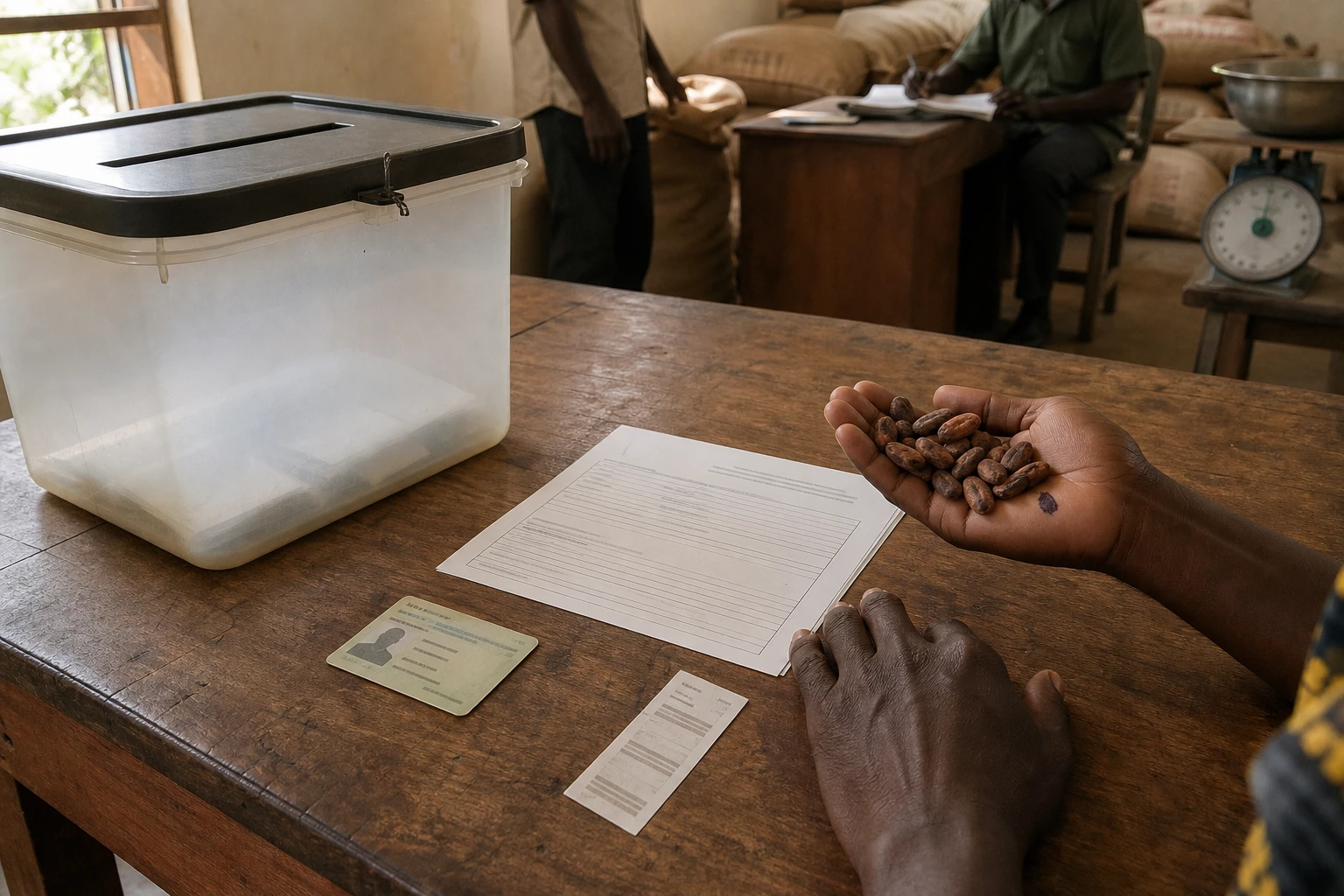
In cocoa-growing villages in eastern Côte d’Ivoire and in Ghana’s producing regions, the new season is opening with a pay gap rarely so pronounced. For beans of comparable quality, Ghanaian farmers are now receiving a markedly higher price than the one announced in Côte d’Ivoire, the world’s leading cocoa producer.
Two neighbours, two pricing methods
Ghana and Côte d’Ivoire account for a major share of global cocoa supply. Their decisions therefore directly affect farmers, buyers, exporters and chocolate manufacturers.
Both countries set the price paid to producers. However, their mechanisms are not based on the same benchmark. Accra relies mainly on the gross FOB value, that is, the value of the goods at the port of departure, before sea freight and insurance.
Abidjan, by contrast, works from the CIF price. This value includes the cost of the cocoa, insurance and transport to the port of destination. The difference between these two calculation bases affects the amount ultimately paid to farmers.
The Côte d’Ivoire-Ghana Cocoa Initiative notes that origin differentials are added to the international price. They reflect, among other things, bean quality, delivery consistency and the reputation of each origin.
Accra raises its price for the 2026-2027 season
The Ghana Cocoa Board, the public body that oversees Ghana’s cocoa sector, has set the producer price at 42,400 cedis per tonne for the 2026-2027 season. The decision took effect on Friday 25 September 2026.
This amounts to 2,650 cedis for a 64-kilogramme bag. The COCOBOD statement says the rate represents 71.18% of the realised gross FOB value.
The new price is slightly above the 41,392 cedis per tonne applied at the end of the previous season. The increase is modest in local currency, but takes on a different significance when compared with the Ivorian rate.
Ghana now says it is enshrining this guarantee in law. The Ghana Cocoa Board Act, 2026, introduced as Act 1182, provides that at least 70% of the realised gross FOB value must go to the producer. The rule is intended to give farmers greater certainty when international prices fluctuate sharply.
Abidjan holds its price at 1,200 CFA francs
In Côte d’Ivoire, the 2026-2027 main season began on 1 September. The government kept the guaranteed minimum price at 1,200 CFA francs per kilogramme for beans that are properly fermented, dried and sorted.
The announcement was made in Abidjan by Bruno Nabagné Koné, the Minister of Agriculture, Rural Development and Food Crops, at the opening of the National Cocoa and Chocolate Days.
The Ivorian Press Agency confirmed the figure, which is the same as the one applied during the 2025-2026 mid-crop season. It is well below the 2,800 CFA francs per kilogramme announced for the 2025-2026 main season.
Based on the equivalent figures provided for the two markets, Ghana’s price comes to about $3.65 per kilogramme, compared with nearly $2.07 in Côte d’Ivoire. The gap is therefore close to 75%, although the comparison depends on the exchange rate and the calculation methods used.
The Ivorian government explains its decision by the fall in world prices, forward sales already made and the need to preserve the financial balance of the marketing system. The guaranteed price protects producers from an immediate decline, but also limits Abidjan’s ability to pass on a market rebound or fall quickly.
Ghana’s advantage could divert trade flows
The price differential affects more than farm incomes. It also changes incentives along the border between the two countries, which stretches for several hundred kilometres and is crossed by long-established trading networks.
When prices are more attractive on one side, beans can be channelled to that market through informal routes. The phenomenon is not new. Ghana’s Ministry of Finance has previously described price disparities as a factor that could fuel cocoa smuggling between the two neighbours.
An operation carried out in April 2026 in Ghana’s Bono Region led to the seizure of a lorry carrying more than 100 bags suspected of originating in Côte d’Ivoire. Ghanaian authorities at the time cited the impact of differences in producer payments on cross-border trafficking.
If the current gap persists, buyers based near the border could offer more attractive terms to Ivorian producers. Operators in rural areas close to Ghana would be the first exposed, particularly those already facing high transport costs and difficulties accessing collection points.
For Côte d’Ivoire, beans leaving official channels would reduce the volumes recorded by cooperatives and licensed exporters. For Ghana, the arrival of foreign cocoa could artificially inflate the volumes marketed as Ghanaian in origin and complicate quality monitoring.
Traceability becomes a tool of commercial sovereignty
Both countries are therefore strengthening their monitoring systems. In Ghana, COCOBOD says it has deployed a national traceability system in the main production areas.
In Côte d’Ivoire, a producer card became mandatory for transactions from 1 September 2026. The system is intended to link the farmer, their plot, the quantity sold and the route taken to the port.
The AIP describes the system as a way to track beans more effectively from the plantation to export. It also responds to growing demands in international markets for product-origin information and action against deforestation.
Traceability alone, however, will not be enough. It will need to be accompanied by credible checks, regular payments and fair access to licensed buyers. In border areas, the ability of institutions to offer a service that pays better than informal networks will be crucial.
The season’s test will be financial and regional
Ghana must now establish whether the legal guarantee of 70% is compatible with its financing needs, stocks and price volatility. The 2025-2026 season showed how difficult it is to maintain a high price when markets turn.
Côte d’Ivoire, for its part, will have to protect farmers’ incomes without undermining its forward-sales system. Keeping the price low may support the sector’s cash flow, but it also risks weakening producers’ commitment if informal buyers offer more.
Across West Africa, the issue therefore goes beyond the comparison between Accra and Abidjan. Both countries are seeking to retain control of their supply chains, improve farm-gate prices and gain greater leverage in negotiations with international processors.
The 2026-2027 season will above all provide a chance to monitor three indicators: the volumes actually collected in Côte d’Ivoire, purchases recorded in Ghana and changes in cross-border flows. These figures will show whether the price gap remains a simple market signal or becomes a lasting driver of change in regional cocoa trade.



