Algeria
 Egypt
 Libya
 Morocco
 Sudan
 Tunisia
 Benin
 Burkina Faso
 Cabo Verde
 Côte d'Ivoire
 Ghana
 Guinea
 Guinea-Bissau
 Liberia
 Mali
 Niger
 Nigeria
 Senegal
 Sierra Leone
 The Gambia
 Togo
 Cameroon
 Central African Republic
 Chad
 DR Congo
 Equatorial Guinea
 Gabon
 Republic of the Congo
 São Tomé and Príncipe
 Burundi
 Comoros
 Djibouti
 Eritrea
 Ethiopia
 Kenya
 Madagascar
 Malawi
 Mauritius
 Mozambique
 Rwanda
 Seychelles
 Somalia
 South Sudan
 Tanzania
 Uganda
 Angola
 Botswana
 Eswatini
 Lesotho
 Namibia
 South Africa
 Zambia
 Zimbabwe
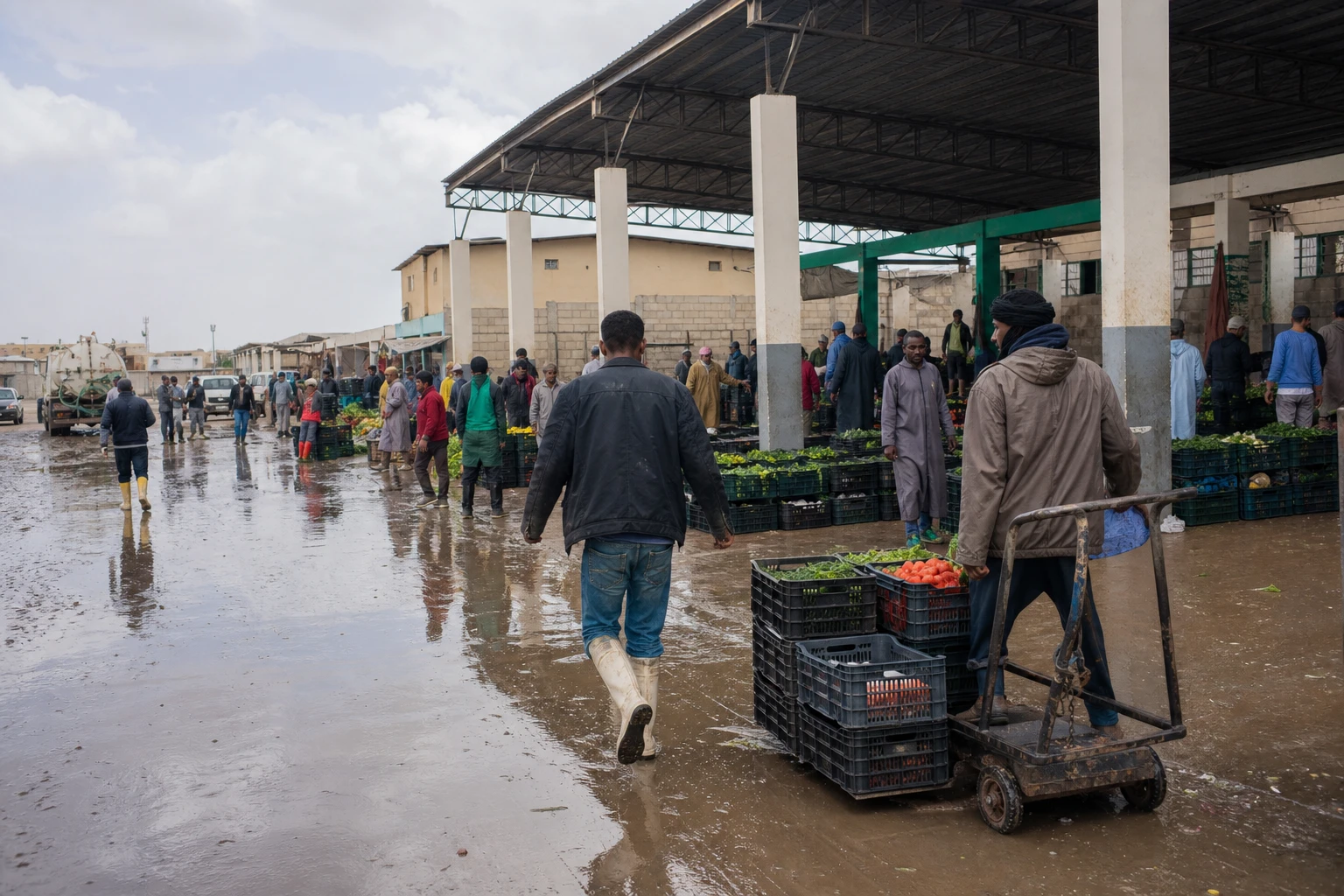
In Nouakchott, just a few hours of rain are still enough to turn key roads into hard-to-reach areas. Since the night of Wednesday 23 to Thursday 24 September 2026, travel has been severely disrupted in several districts of the Mauritanian capital. Workers, vendors and drivers have had to contend with water-covered roads and a drainage network struggling to absorb the rainfall.
A capital slowed by stagnant water
The rain began overnight and continued on Thursday morning. Readings published by Mauritanian media show varying totals across different areas. The moughataas of Riyad, El Mina and Arafat, in Nouakchott-South, recorded 45, 24 and 20 millimetres respectively over 24 hours. Other districts, including Toujounine, Dar Naïm, Sebkha, Ksar and Tevragh-Zeina, were also affected.
These figures need to be considered in the context of Nouakchott. The capital usually receives little rain, but its sandy soil, low gradient and proximity to the water table limit infiltration. Water therefore accumulates quickly in low-lying areas, on damaged roads and around homes.
In several outlying areas, taxis have cut back on journeys. Drivers fear breakdowns and mechanical damage on roads that can be difficult to make out beneath the water. For many residents, reaching a market, workplace or school now takes more time and caution.
Informal activities are also directly affected. Vegetable sellers, small traders and day labourers often depend on daily travel. When transport slows, their incomes fall immediately. Districts furthest from major roads also have fewer alternatives.
Emergency pumping tackles a structural problem
The National Office for Sanitation, ONAS, has begun pumping operations in Nouakchott’s three wilayas. Teams are working on several roads and main thoroughfares to clear the most congested areas and gradually restore traffic.
The authorities have also deployed pumping equipment in busy areas, particularly around the city centre, Marché Capitale and the BMD junction. These operations help limit disruption. However, they remain a temporary response to a phenomenon that recurs with every significant rainfall event.
The use of pumps and tanker trucks points to the persistent weakness of urban drainage. In several districts, residents are calling for pipes capable of carrying water away without having to wait for response teams to arrive. They also report risks associated with septic pits emptied into the public space, which can lead to rainwater mixing with wastewater.
This combination complicates travel and increases health risks. Stagnant water can encourage mosquitoes to breed and come into contact with waste or domestic discharges. Caution is therefore advised in flooded areas, particularly for children, older people and residents whose homes are at street level.
Works under way, but coverage remains incomplete
ONAS’s response comes as the first phase of a sewerage network project is under way. The programme is intended to cover Tevragh-Zeina, Ksar and Sebkha, as well as parts of El Mina and Teyarett. It provides for both rainwater drainage and wastewater treatment.
According to information published by the Mauritanian News Agency on pumping operations, the future system is intended to reduce water accumulation and help lower the water table in the areas it serves.
The project is part of a broader transformation of Nouakchott. The capital concentrates a large share of Mauritania’s population, public services and economic activity. However, urban expansion in several areas has outpaced the development of drainage infrastructure.
Technical documents for the sanitation programme provide for the installation of dozens of kilometres of pipes and the construction of pumping stations. This equipment is intended to improve the network’s capacity. Its effectiveness will nevertheless depend on the speed of the works, their maintenance and their rollout in districts that remain among the least well served.
The issue therefore goes beyond managing rainfall. It also concerns urban planning, road maintenance, wastewater management and the regulation of construction in exposed areas. In Nouakchott, every new road or home can alter the natural flow of water.
A test of the Mauritanian capital’s resilience
The September 2026 rains are a reminder of Nouakchott’s particular vulnerability. The city lies in a low-lying coastal environment, exposed to a rising water table and changes to the coastline. According to an analysis of climate risks in Mauritania, a failure to adapt could ultimately weigh on economic activity and public finances.
The challenge is also social. Central districts benefit more quickly from pumping operations and the presence of services. By contrast, outlying areas can remain cut off for longer. This disparity affects access to work, markets, healthcare and schools.
Mauritania will therefore need to judge the success of its investments by a practical measure: the ability to keep the city functioning after intense rainfall. Infrastructure must protect major roads, but also residential districts and the areas where informal economy workers earn their living.
Across the region, Nouakchott shares this kind of challenge with several Sahelian and coastal cities. More erratic rainfall, rapid urbanisation and pressure on networks call for better co-ordinated prevention policies. For the Mauritanian capital, the next steps will be to continue the sanitation project, maintain facilities and ensure services can respond before water brings travel to a standstill.