Algeria
 Egypt
 Libya
 Morocco
 Sudan
 Tunisia
 Benin
 Burkina Faso
 Cabo Verde
 Côte d'Ivoire
 Ghana
 Guinea
 Liberia
 Mali
 Mauritania
 Niger
 Nigeria
 Senegal
 Sierra Leone
 The Gambia
 Togo
 Cameroon
 Central African Republic
 Chad
 DR Congo
 Equatorial Guinea
 Gabon
 Republic of the Congo
 São Tomé and Príncipe
 Burundi
 Comoros
 Djibouti
 Eritrea
 Ethiopia
 Kenya
 Madagascar
 Malawi
 Mauritius
 Mozambique
 Rwanda
 Seychelles
 Somalia
 South Sudan
 Tanzania
 Uganda
 Angola
 Botswana
 Eswatini
 Lesotho
 Namibia
 South Africa
 Zambia
 Zimbabwe
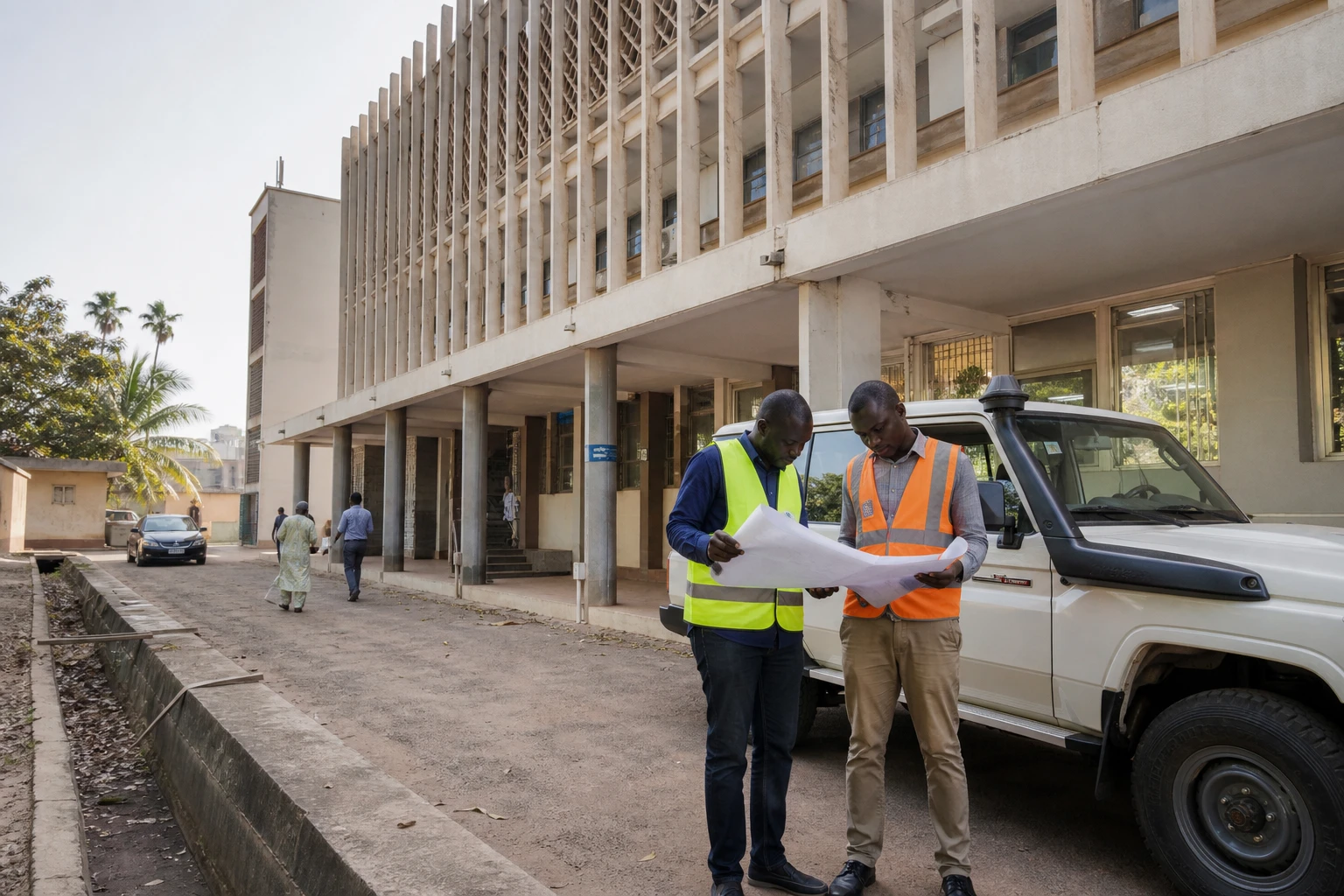
A few kilometres from Bissau, the condition of the roads still determines how quickly trade moves between the capital and the northern regions. The announced funding for the Safim–Jugudul route opens a new chapter: the aim is not simply to lay asphalt, but to secure a link that could bring Guinea-Bissau’s markets closer to those of Senegal and the wider West African region.
A short but strategic route for Guinea-Bissau
The West African Development Bank (BOAD), a joint financial institution of the West African Economic and Monetary Union, has approved an initial tranche of CFA30bn for the development and asphalting of the Safim–Jugudul road. The decision was taken at the 152nd meeting of its board of directors, held on 24 September 2026 in Lomé, according to several consistent reports published on 24 and 25 September.
The amount represents about $52m, based on the exchange rate used in communications about the project. The funding is intended to improve mobility, road safety and regional connectivity along the route.
Guinea-Bissau’s national media put the stretch at about 40 kilometres. It links Safim, north of Bissau, with Jugudul in the Oio region. The route forms part of the road network serving the centre and north of the country, extending to areas near the Senegalese border. It should therefore not be seen as merely a local road.
An initial rehabilitation operation had already been launched on the route. In 2024, the authorities announced the rehabilitation of a 40-kilometre unpaved road, at a cost of CFA300m, with the work entrusted to the civil engineering corps of the Guinea-Bissau armed forces. The new funding is intended to take the project to a new scale, with the route to be asphalted.
The northern link in a still-fragile network
For residents of the communities along the route, road quality directly affects access to markets, schools, health centres and administrative services. During the rainy season, delays and road damage can lengthen journeys and increase the cost of transporting people and goods.
The project is being carried out in a country where the road network remains sparse and unevenly paved. In its 2019–2021 country strategy, the African Development Bank estimated that about 28% of the national network was asphalted. Road transport then accounted for between 60% and 70% of passenger and freight traffic, in the absence of a functioning railway network.
This dependence gives each main route particular importance. A deteriorated road does more than slow travel. It also raises the cost of collecting agricultural produce, complicates the supply of markets and makes trade less predictable for businesses in Bissau and the regions.
The Safim–Jugudul corridor should also be viewed as part of a wider network. Other programmes concern the Safim–Mpack road, which extends the connection towards the country’s north-west and the Senegalese border. The Northern Connectivity Project, supported by the World Bank, includes plans to rehabilitate sections between Safim, Bula, São Vicente and Antotinha. Meanwhile, in March 2026, the European Investment Bank published a contract notice for work on the Antotinha–Ingoré–São Domingos–Jegue–Mpack stretch.
These projects show that Guinea-Bissau is seeking to address several sections of the same transport system. Their co-ordination will be crucial. A modernised road connected to a severely deteriorated section will deliver only some of the expected benefits.
Expected gains for regional trade
The Safim–Jugudul route could reduce journey times between Bissau and the northern areas. It could also make it easier to move agricultural produce, particularly goods destined for regional markets. For transport operators, however, the key issue will be as much the regularity of traffic as the speed of travel.
The road lies within the WAEMU, which brings together eight countries using the CFA franc and co-ordinates several economic and trade policies. It is also part of the regional dynamic of ECOWAS, the Economic Community of West African States, of which Guinea-Bissau and Senegal are members.
This regional dimension makes transport standards particularly important. WAEMU is working, in particular, to implement Regulation R14, which harmonises checks on the weight, dimensions and axle loads of heavy vehicles. The rules are intended to limit overloading that accelerates road deterioration, but their effectiveness will depend on weigh stations, transparent procedures and consistent enforcement.
The Safim weigh station is among the infrastructure mentioned by Guinea-Bissau’s authorities and the WAEMU Commission. Its operation will need to accompany the road’s modernisation. Without checks on heavy traffic, the new investment could quickly face the same pressures as previous infrastructure.
The real challenge will begin after construction
The CFA30bn in funding is an important step forward, but it does not by itself resolve the question of durability. Drainage, the quality of materials, supervision of construction and regular maintenance will all affect the road’s lifespan.
Rainfall, water runoff and the movement of heavily loaded lorries can quickly weaken a road that is not properly protected. Drainage structures will therefore need to be designed to suit local conditions. The shoulders, bridges, culverts and road signs will matter just as much as the main surface for road-user safety.
The impact will not be the same for everyone. Transport operators and formal businesses will benefit from more predictable journeys. Women traders, small-scale producers and informal-economy operators may find it easier to reach markets, provided transport costs actually fall. In rural areas, access to essential services will also depend on traffic continuing to move during the rainy season.
The next step for the authorities will be to set out the construction timetable, the project’s full financing structure and the arrangements for monitoring it. BOAD refers to an initial tranche, so the programme’s total cost, implementation schedule and any additional financing will need to be clarified.
For Guinea-Bissau, the Safim–Jugudul route is therefore more than a road project. It is a test of the state’s ability to connect its territories, maintain its infrastructure and turn its regional geographical position into a tangible advantage. Success will be measured less by the opening ceremony than by the effective movement of people and goods in the years that follow.