Algeria
 Egypt
 Libya
 Morocco
 Sudan
 Tunisia
 Benin
 Burkina Faso
 Cabo Verde
 Côte d'Ivoire
 Ghana
 Guinea
 Guinea-Bissau
 Liberia
 Mali
 Niger
 Nigeria
 Senegal
 Sierra Leone
 The Gambia
 Togo
 Cameroon
 Central African Republic
 Chad
 DR Congo
 Equatorial Guinea
 Gabon
 Republic of the Congo
 São Tomé and Príncipe
 Burundi
 Comoros
 Djibouti
 Eritrea
 Ethiopia
 Kenya
 Madagascar
 Malawi
 Mauritius
 Mozambique
 Rwanda
 Seychelles
 Somalia
 South Sudan
 Tanzania
 Uganda
 Angola
 Botswana
 Eswatini
 Lesotho
 Namibia
 South Africa
 Zambia
 Zimbabwe
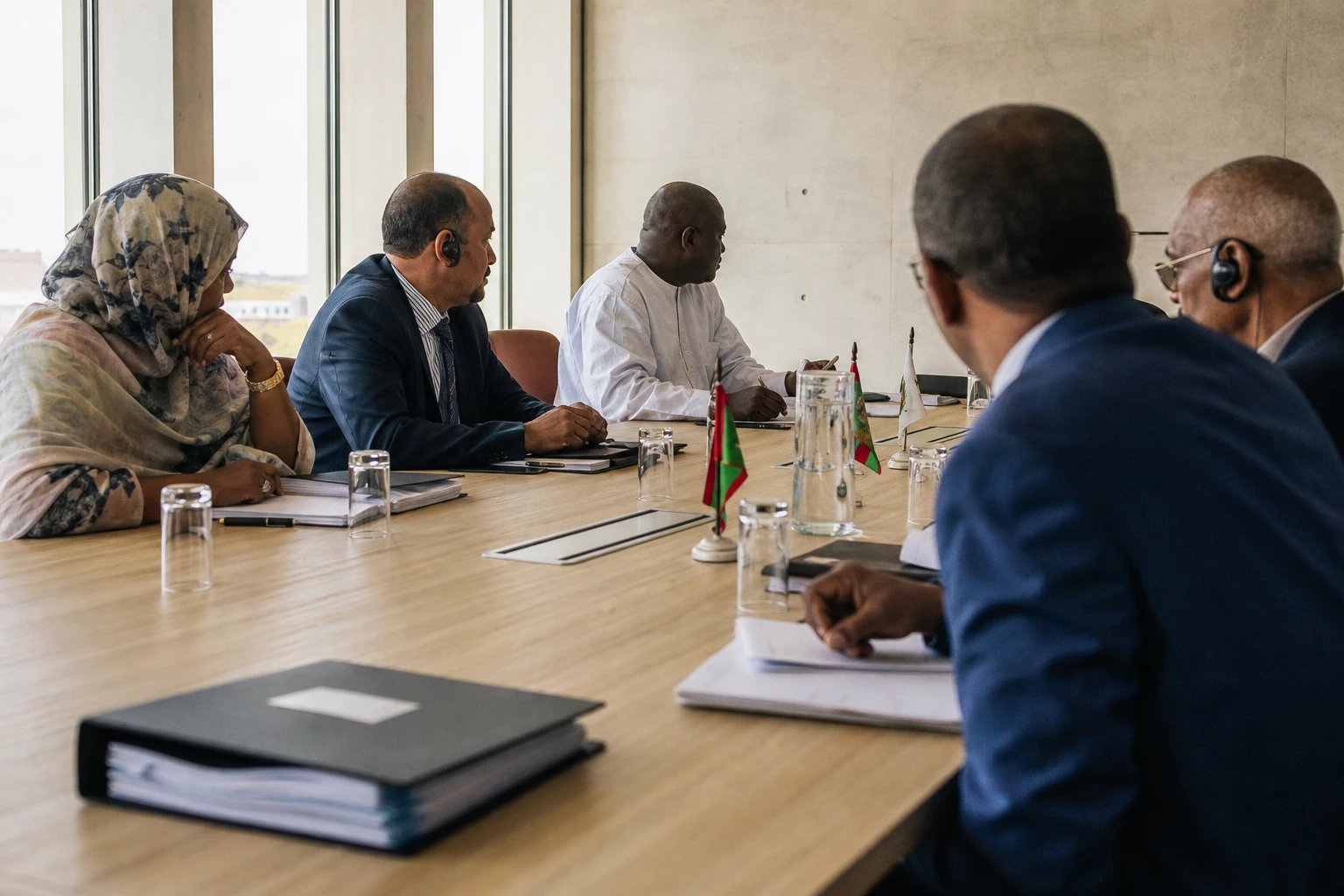
Days before the 2026-2027 school year begins, salaries are once again at the centre of the education debate in Mauritania. In Nouakchott, teachers are calling for commitments announced by the authorities to translate into visible changes on their payslips and in their working conditions.
Mobilisation in Nouakchott ahead of the school year
On Thursday 24 September 2026, the Unified Trade Union Coordination brought together several hundred teachers outside the Ministry of National Education. The mobilisation took place in the rain, while some roads in the capital were difficult to access.
The participating organisations are calling for higher salaries, the payment of allowances and, for some staff, the settlement of arrears. They are also demanding greater recognition of the rising cost of living, which they say is reducing teachers’ ability to meet everyday expenses.
Abdoulaye Ndary Niang, one of the trade union leaders present, described a salary situation that had become difficult. He believes official announcements are no longer enough when their implementation on the ground is delayed.
The gathering comes amid already heightened tensions. In March 2026, the National Union of Technical Education and Vocational Training Teachers announced a week-long strike. The organisation denounced the lack of response to several demands, particularly on housing, career advancement and deductions from some salaries following previous protests. The Mauritanian outlet MADAR’s account of the mobilisation shows that discontent extends beyond the issue of pay alone.
Commitments announced, but implementation disputed
The Mauritanian government has nonetheless announced targeted measures in support of teachers. At the Council of Ministers meeting on 8 July 2026, a draft decree provided for a monthly increase of 1,000 ouguiyas for civil-service teachers actually working in the classroom. The text also provides for a “chalk allowance” of 6,500 ouguiyas a month, net of tax, for a period of 12 months.
These provisions also apply to heads of primary and secondary schools, as well as some technical education staff. They must, however, be translated into administrative procedures and actual payments, which is the main point of friction with the unions. The Mauritanian News Agency provided details of the draft decree adopted on 8 July 2026.
Trade union representatives say several decisions arising from conciliation meetings are still pending. Amadou Tidiane Ba, a secondary education representative, is calling for the timetable to be speeded up. He is also seeking redress for situations deemed unfair and an increase in allowances.
Another issue concerns trade union representation. The organisations are awaiting a decree that will specify which bodies are recognised to negotiate on behalf of teachers. This clarification is intended to determine who will represent them in talks with the ministry and the conditions for taking part in social dialogue.
The demands also include integrating some contract teachers into the civil service. They further call for premises to be made available to the unions and for a clearer professional framework for pedagogical advisers and administrative attachés.
Purchasing power at the heart of the dispute
For teachers, the announced increase does not fully address the rise in expenses. The unions cite the costs of housing, transport and food in Nouakchott. In the regions, the distance to schools creates additional costs, particularly for staff posted outside their area of residence.
The situation also varies according to employment status. Civil servants who have already been integrated may benefit from the measures set out in the decree. Contract teachers, meanwhile, are seeking regularisation and clarity about their careers. This difference fuels a sense of inequality in a sector that relies heavily on staff with varied administrative backgrounds.
The problem is therefore not limited to the level of pay. It also concerns the regularity of payments, access to allowances, promotion opportunities and posting conditions. In rural areas and remote schools, these factors have a direct bearing on the stability of teaching teams.
The government, for its part, must fund these measures while maintaining budgetary balance. Education is among the stated priorities for the 2026-2027 school year. On 16 September, Prime Minister El Moctar Ould Djay chaired a meeting on preparations for the new school year, including a review of infrastructure, equipment and the availability of education staff. The Mauritanian News Agency published the official follow-up on preparations for the new school year.
A school year under scrutiny
The 24 September mobilisation is not simply a protest over pay. It tests the ministry’s ability to turn announcements into administrative decisions that can be quickly verified.
The unions say the gathering could be followed by further action if talks fail to produce results. They have not yet specified the form or timing of any such initiatives. This caution leaves room for dialogue, but keeps pressure on as classes are about to resume.
For families, the stakes are tangible. Prolonged tensions could disrupt the start of the school year, particularly at schools already short of staff or reliant on contract teachers. The authorities’ response must therefore avoid two pitfalls: announcing new measures without a clear timetable, or opting for a one-off response without addressing career and representation issues.
Mauritania is monitoring these developments in a regional environment marked by high expectations of public services. It is not a member of ECOWAS, the economic organisation comprising several West African states, and instead conducts much of its regional engagement through the Maghreb and Sahel frameworks. The difficulties faced by its teachers nevertheless reflect a broader debate about the quality of public education, staff pay and states’ ability to retain professionals.
The next points of tension will be the effective implementation of the decree announced in July, publication of the text on trade union representation and the handling of contract teachers’ cases. In Nouakchott and across Mauritania’s other regions, teachers are now waiting for precise deadlines rather than further commitments in principle.