Algeria
 Egypt
 Libya
 Morocco
 Sudan
 Tunisia
 Benin
 Burkina Faso
 Cabo Verde
 Côte d'Ivoire
 Ghana
 Guinea
 Guinea-Bissau
 Liberia
 Mali
 Mauritania
 Niger
 Nigeria
 Senegal
 Sierra Leone
 The Gambia
 Togo
 Cameroon
 Central African Republic
 Chad
 DR Congo
 Equatorial Guinea
 Gabon
 Republic of the Congo
 São Tomé and Príncipe
 Burundi
 Comoros
 Djibouti
 Eritrea
 Ethiopia
 Madagascar
 Malawi
 Mauritius
 Mozambique
 Rwanda
 Seychelles
 Somalia
 South Sudan
 Tanzania
 Uganda
 Angola
 Botswana
 Eswatini
 Lesotho
 Namibia
 South Africa
 Zambia
 Zimbabwe
In Abuja, the question is no longer simply how to produce more milk. Nigeria is also seeking to build a sector capable of guaranteeing quality, organising collection and processing locally a raw material that remains in very short supply.
This ambition has a regional dimension. West Africa’s largest economy and biggest major consumer market, Nigeria wants to reduce its dependence on imports. To do so, industry professionals are looking to Kenya, a country that organised its collection networks, health standards and processing facilities earlier.
Nigerian mission to Kenya to study the entire supply chain
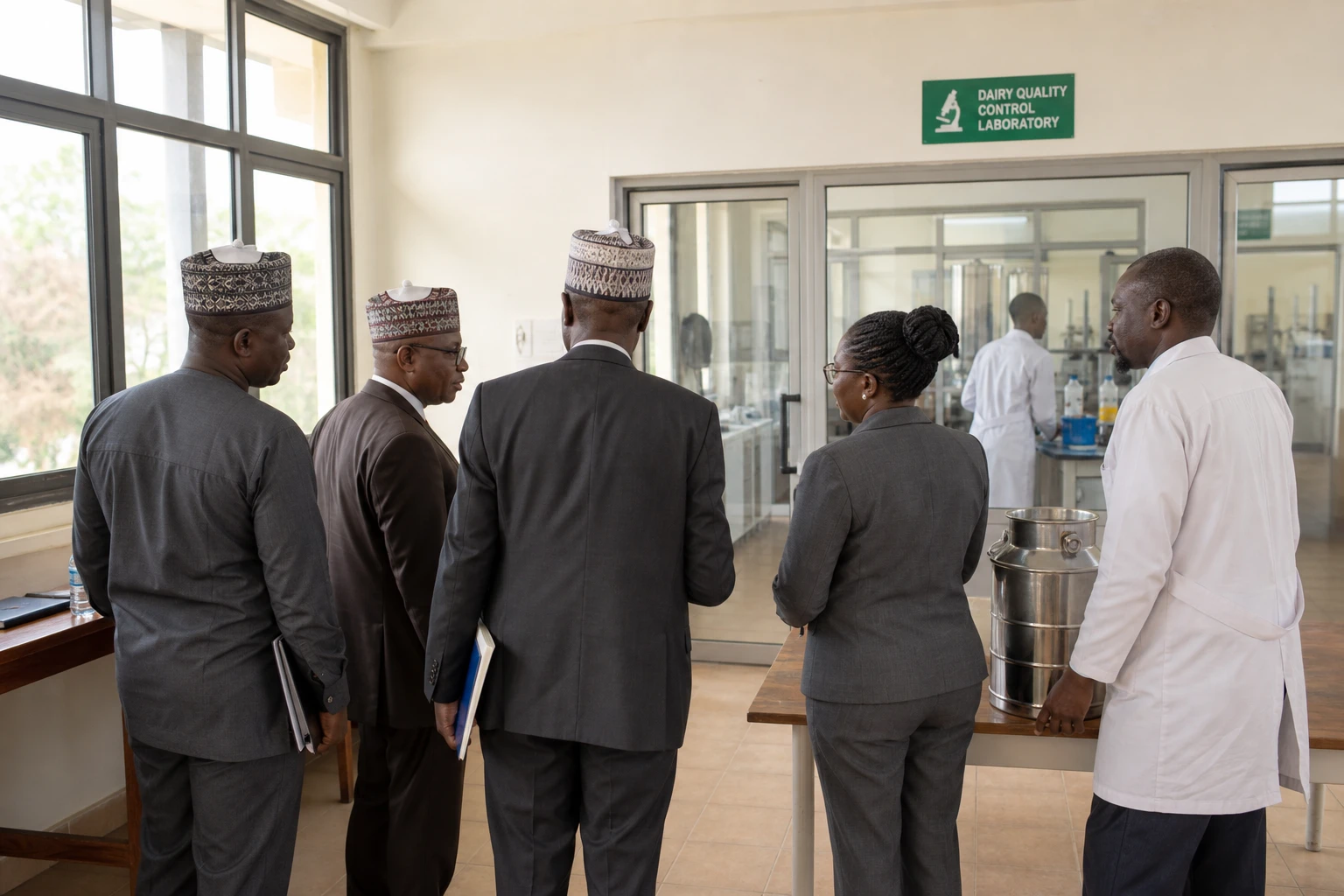
A delegation from the Commercial Dairy Ranchers Association of Nigeria (CODARAN), the organisation representing Nigeria’s commercial dairy farmers, began an exchange mission in Kenya in September 2026.
The visit is organised with the Africa Agribusiness Academy. It covers the entire supply chain, from farming to marketing. Discussions include herd productivity, quality control, regulation and market development.
On 23 September 2026, the Kenya Dairy Board, the body responsible for overseeing and regulating Kenya’s dairy sector, said it had received the Nigerian delegation. Participants also visited Kenya’s national dairy regulatory laboratory.
This is an important step. In a dairy sector, production alone is not enough. Milk must be collected quickly, stored in suitable conditions, tested and then processed. Any weak link increases losses and undermines consumer confidence.
Kenya has useful experience in these areas. According to a Kenyan government performance report, industrial and co-operative plants processed 987.4 million litres of milk between July 2024 and June 2025. The volume exceeded the annual target of 825 million litres.
This increase was attributed to several factors. The report cites improved weather conditions, greater compliance with production rules and investment in collection and processing.
Kenya offers experience, not a ready-made formula
The choice of Nairobi does not mean Nigeria wants to replicate the Kenyan model in its entirety. The two countries have different circumstances. Kenya relies on a long-established network of dairy co-operatives and a high concentration of small-scale producers in some regions. Nigeria must contend with a much larger territory, varied livestock systems and a significant presence of pastoral communities.
Animal feed will be central to the issue. A dairy cow produces more when it has a regular supply of fodder, access to water and appropriate veterinary care. But feed costs, logistical difficulties and tensions over access to land weigh on Nigerian farms.
The mission will therefore primarily allow the delegation to study methods. The aim is to understand how to organise relations between farmers, co-operatives, processors, laboratories and public authorities. These practices will then have to be adapted to the realities of Nigeria’s federated states.
This adaptation will also need to take account of producers operating outside industrial channels. A strategy focused solely on large farms could leave out some farmers and collectors. Conversely, the gradual integration of small-scale producers could increase local supply and create more income in rural areas.
Abuja sets target of 1.4 million tonnes by 2030
On 1 June 2025 in Abuja, the federal government announced its intention to increase national milk production from 700,000 to 1.4 million tonnes a year within five years. The target is to double production by 2030.
The Federal Ministry of Livestock Development wants to bring together states, private companies, technical partners, researchers and pastoral communities. This approach is intended to produce a shared roadmap rather than multiply isolated projects.
The government also believes that increasing local production could reduce an annual import bill estimated at more than $1.5 billion. This figure, provided by the ministry, should nevertheless be treated as a baseline estimate. It depends on consumption, international prices, the exchange rate and the composition of imported products.
The national strategy is based on several priorities. It aims to improve animal nutrition, herd health, genetics, access to finance and processing. It also highlights the participation of young people and women, who play an important role in collection, artisanal processing and marketing.
Investment is coming, but execution will be decisive
The private sector is already beginning to support this new direction. In March 2026, the Nigeria Sovereign Investment Authority (NSIA), Nigeria’s sovereign wealth fund, signed a memorandum of understanding with UK company Asset Green Ltd.
The announced project is worth about $496 million. It includes 20,000 hectares for fodder crops, a farm that can accommodate 10,000 dairy cows and a processing plant. According to Channels Television, the plant is to produce fresh milk, milk powder, butter and cream, as well as up to 15,000 tonnes of infant formula a year.
Another project has been announced in Ogun State. Pure Dairy Herds plans to develop a dairy farm there, valued at about $250 million. Details of production capacity and the implementation timetable remain limited at this stage.
These announcements show growing investor interest. However, they do not yet amount to an actual increase in supply. A memorandum of understanding establishes a framework for co-operation, but it must be followed by confirmed financing, permits, infrastructure and actual commissioning.
The challenge will also be social and territorial. Large-scale complexes can quickly increase volumes, but they will need to secure access to land, preserve water resources and maintain clear relations with neighbouring farmers. In cities, the issue will be price and availability. In rural areas, it will mainly concern income, employment and access to veterinary services.
An issue for ECOWAS and beyond
The transformation of Nigeria’s dairy sector will affect the Economic Community of West African States (ECOWAS), which is seeking to strengthen trade among its members. Higher local production could ease pressure on regional imports and create new opportunities for equipment, animal feed and specialist services.
But Nigeria will also have to strike a balance between protecting domestic production and keeping the market accessible to consumers. Restrictions on imports imposed too quickly could push up prices if local supply fails to keep pace.
The next step will therefore be less dramatic than announcing an investment. Yet it will be decisive: measuring actual production, improving collection, enforcing standards and integrating farmers into the value chain. Nigeria’s ability to reduce its external dependence sustainably will be judged by these indicators, rather than by the value of announced projects.