Algeria
 Egypt
 Libya
 Morocco
 Sudan
 Tunisia
 Benin
 Cabo Verde
 Côte d'Ivoire
 Ghana
 Guinea
 Guinea-Bissau
 Liberia
 Mali
 Mauritania
 Niger
 Nigeria
 Senegal
 Sierra Leone
 The Gambia
 Togo
 Cameroon
 Central African Republic
 Chad
 DR Congo
 Equatorial Guinea
 Gabon
 Republic of the Congo
 São Tomé and Príncipe
 Burundi
 Comoros
 Djibouti
 Eritrea
 Ethiopia
 Kenya
 Madagascar
 Malawi
 Mauritius
 Mozambique
 Rwanda
 Seychelles
 Somalia
 South Sudan
 Tanzania
 Uganda
 Angola
 Botswana
 Eswatini
 Lesotho
 Namibia
 South Africa
 Zambia
 Zimbabwe
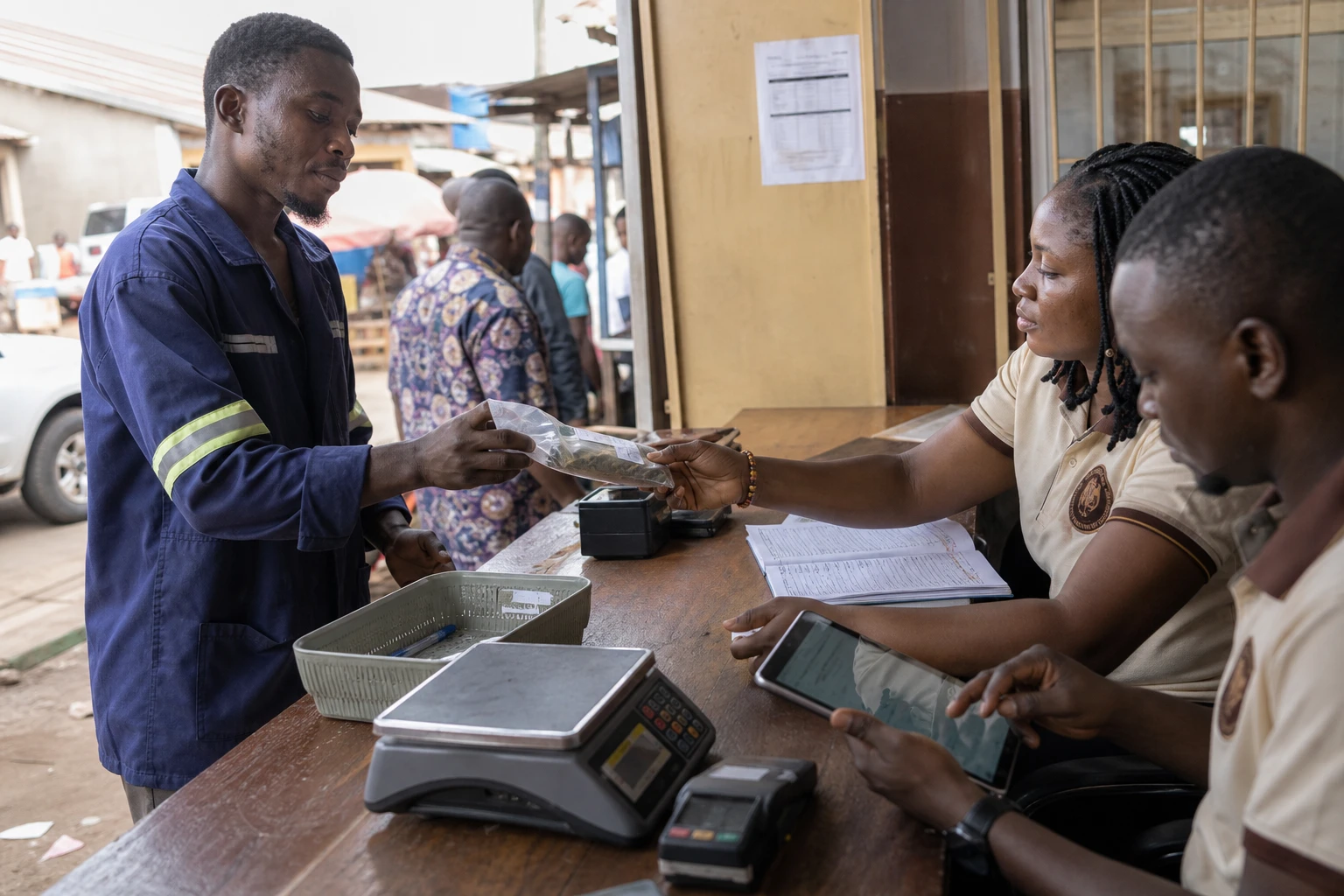
In West Africa’s gold-producing regions, the question is no longer simply how much gold is recorded in national statistics. It is also necessary to determine who produces it, under what conditions and with what benefits for mining areas. This step is becoming crucial as several governments seek to curb smuggling and regain control of an activity that supports millions of people.
An economic activity governments are seeking to bring into view
Artisanal and small-scale mining refers to activities carried out with limited resources, often by individuals, families or cooperatives. It remains difficult to measure, because some production is not recorded in official registers and moves through informal networks.
Across Africa, the stakes go far beyond the gold trade. The United Nations Economic Commission for Africa cites an estimate of more than 40 million people directly engaged in artisanal and small-scale mining. Including their dependants and the local economies that rely on them, the sector affects up to 150 million people.
These figures give an idea of the role the activity plays in rural areas. Miners are not the only people involved. Transporters, restaurant owners, mechanics, equipment suppliers, traders and ore-processing workers also take part in this economy. A reform focused solely on gold collection would therefore leave much of the value chain out.
The issue is particularly sensitive in Ghana, Burkina Faso, Mali, Côte d’Ivoire, Senegal and Tanzania. In these countries, artisanal gold supports household incomes, but also exposes workers to accidents, debt to buyers and often unsafe working conditions.
Ghana aims to turn collection into a tracking system
Ghana currently offers one of the most structured examples of the state reasserting control. The Ghana Gold Board, or GoldBod, is responsible for organising the purchase and export of gold from artisanal and small-scale mines. Its model relies on licensed buyers, who acquire the metal from producers before selling it to the public body.
According to figures released by GoldBod, artisanal gold exports reached about 100 tonnes in 2025. The organisation had reported 63.6 tonnes for 2024. This increase shows that a centralised system can bring greater volumes into official channels. It does not, however, reveal on its own how many miners are involved or how revenues are distributed.
The next task is therefore traceability. GoldBod plans to begin with a pilot programme covering about 600 artisanal and small-scale mining operations. The aim is to track gold from the extraction site to export, then gradually extend the system to all operations supplying the formal market.
The initiative also responds to a domestic concern. In Ghana, illegal mining, often referred to by the local term “galamsey”, is degrading some waterways and fuelling political debate about protecting farmland and natural resources. Tracking volumes will not be enough. It must be accompanied by environmental checks, safety standards and legal access to sites.
Formalising without pushing producers away
Formalisation is not just a matter of recording production or issuing a permit. Miners must have a concrete incentive to join official channels. Without more transparent prices, access to finance, suitable equipment or technical support, registration may be seen as an additional administrative burden.
The risk is well known. If procedures are lengthy, costly or concentrated in capital cities, producers may continue selling to informal intermediaries. These sometimes offer immediate payment, while public channels involve more checks and delays. Efforts to curb smuggling will therefore also depend on how fast and accessible the service is.
Access to finance is central. Many small-scale operators work with advances from traders. In return, they sell their production on terms they do not always control. Suitable credit schemes, combined with strong cooperatives, could reduce this dependence.
Safety is another essential concern. Unstable shafts, a lack of protective equipment and the uncontrolled use of chemicals put workers and communities at risk. A credible policy must provide for training, accessible inspections and technical solutions suited to the means available to small-scale operations.
Different approaches in different countries
In Burkina Faso, formalisation is being pursued in part through the creation of artisanal mining cooperatives. This structure can make it easier to access permits, training and equipment. However, it must preserve producers’ role, so that power is not shifted from informal buyers to new administrative intermediaries.
In Senegal, efforts are focused mainly on the regions of Kédougou and Tambacounda, in the south-east of the country. A registration drive aims to issue 10,000 digital cards to artisanal gold miners. The identification process is intended to help the authorities gain a better understanding of the sector’s participants and regulate access to formal sites.
The Senegalese scheme is being implemented in an area where artisanal gold mining is heavily concentrated in Kédougou. The authorities will therefore need to take local realities into account: workers’ mobility, the presence of cross-border communities, the importance of commercial activities and unequal access to public services. A card will have lasting effects only if it genuinely provides access to rights and services.
In Mali and Côte d’Ivoire, as in other countries in the region, the issue is regional too. Gold routes do not follow national borders. A producer may work in one country, sell to a trader in another and see the metal reach an international market by way of a third route. Cooperation between customs administrations, mining authorities and local officials is therefore essential.
The next test will be social, not just statistical
African governments now have more tools to capture volumes: public buying centres, licensed buyers, cooperatives, digital cards and traceability systems. But an increase in official exports alone will not prove that these policies have succeeded.
It will also be necessary to measure how many producers are genuinely integrated, their incomes, their access to credit, safety at sites and the share of revenue that remains in local economies. Women, who are often involved in crushing, washing and trading, will need to be included in these figures. Migrant workers and communities living near mining sites must not remain invisible either.
The next phase will therefore hinge on balancing control with incentives. Governments want to reduce lost tax revenue and limit clandestine gold exports. Producers, for their part, will seek safer and more profitable terms of sale. Formalisation will be sustainable only if official gold brings tangible benefits to the areas where it is produced.
Ghana will offer an initial indicator when it expands its traceability system in 2026. Senegal will need to assess the impact of its digital cards in the eastern regions. In Burkina Faso, the way cooperatives work in practice will be decisive. These experiences will show whether African mining policies can move beyond simply capturing flows and build a clearer, safer sector that is better integrated into local economies.