
 Algeria
 Egypt
 Libya
 Morocco
 Sudan
 Tunisia
 Benin
 Burkina Faso
 Cabo Verde
 Côte d'Ivoire
 Ghana
 Guinea
 Guinea-Bissau
 Liberia
 Mali
 Mauritania
 Niger
 Nigeria
 Senegal
 Sierra Leone
 The Gambia
 Togo
 Cameroon
 Central African Republic
 Chad
 DR Congo
 Equatorial Guinea
 Gabon
 Republic of the Congo
 São Tomé and Príncipe
 Burundi
 Comoros
 Djibouti
 Eritrea
 Ethiopia
 Kenya
 Madagascar
 Malawi
 Mauritius
 Mozambique
 Rwanda
 Seychelles
 Somalia
 South Sudan
 Tanzania
 Uganda
 Angola
 Botswana
 Eswatini
 Lesotho
 Namibia
 Zambia
 Zimbabwe
In Pretoria, Nissan’s withdrawal from local manufacturing does not spell the end of its industrial and commercial presence in South Africa. The Japanese carmaker is changing its model: more of its vehicles will be produced in India and shipped to the continent’s largest automotive market.
A logistical shift after the sale of the Rosslyn site
The change is part of a process that began in January 2026. Nissan reached an agreement with Chery South Africa to sell its production assets at Rosslyn, north of Pretoria. The deal covered the land, buildings and a nearby stamping plant used to make certain body parts.
The South African government welcomed Chery’s arrival. The Chinese carmaker was due to take over the site and maintain industrial activity there. In July 2026, it officially opened its Rosslyn factory. It plans to develop local production gradually, including plug-in hybrid and electric vehicles, as well as models from its Jetour brand.
For Nissan, the sale ends several decades of vehicle assembly at Rosslyn. It does not, however, affect its commercial activity in South Africa. The carmaker is keeping its dealership network, after-sales services and national distribution operations.
The distinction matters. A brand can leave local manufacturing while remaining active in a market. It then relies more heavily on overseas factories, ports, transport operators and its dealers’ ability to maintain regular stock.
The Tekton is the first test of the new arrangement
Nissan unveiled its Tekton SUV in the South African market on 21 September 2026, at an event in Midrand, Gauteng province. The model is made in India, which is becoming one of the carmaker’s main bases for supplying South Africa.
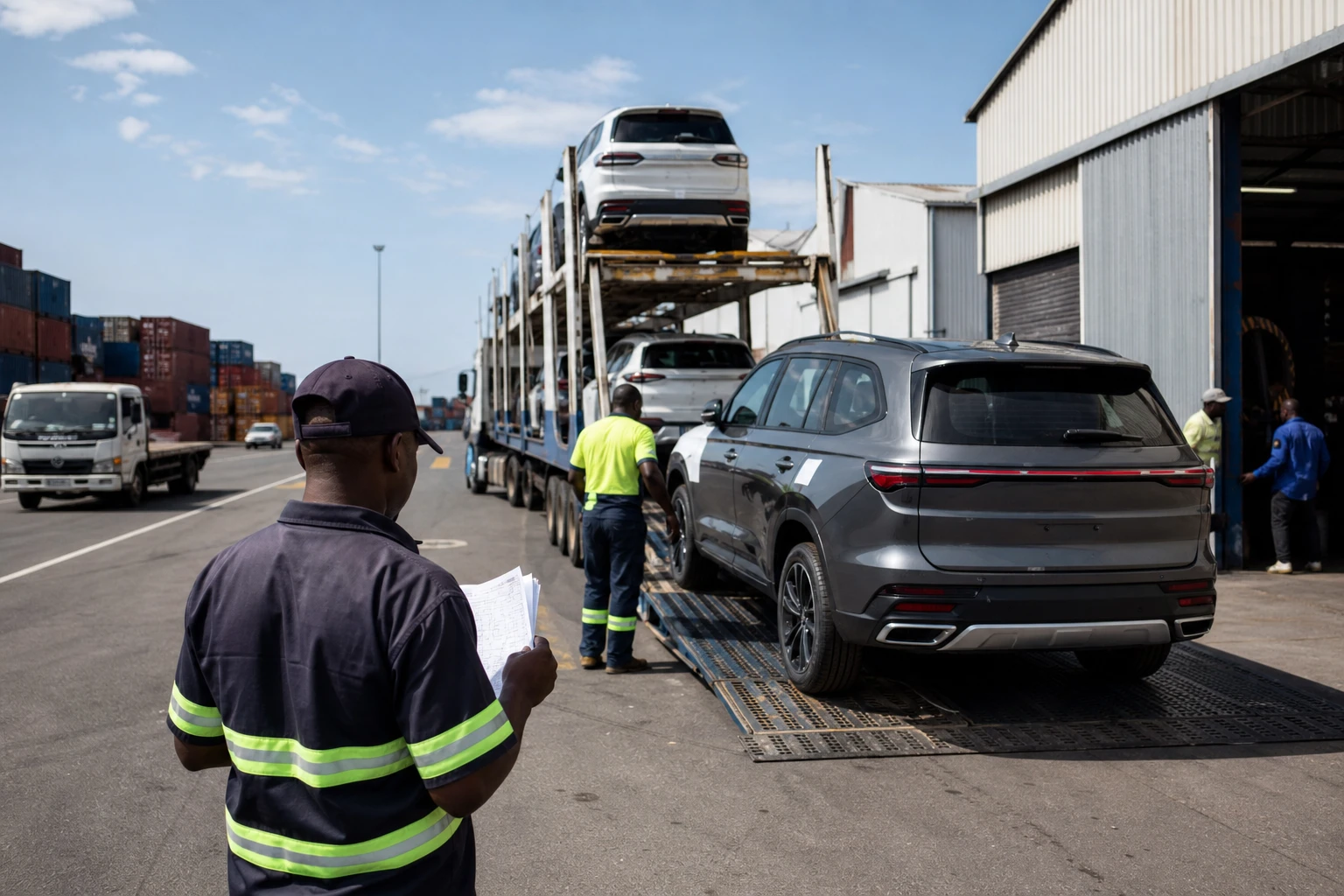
The launch is therefore more than the arrival of a new vehicle. It marks the shift from production based in Pretoria to an international supply chain. The Tekton is made in India, shipped by sea, received at a South African port and then distributed to dealerships.
Nissan said at the start of September that an initial batch of more than 1,300 Tektons had begun shipping from India to South Africa, Bhutan and Nepal. The carmaker is thus positioning its Indian factory as a regional export hub for the model.
The South African line-up is also set to change. The new X-Trail is already available in the country. Nissan plans to introduce an updated version of the Navara and the eighth-generation Patrol during its current financial year. More models could follow in 2027.
Jordi Vila, Nissan Africa’s president, said the group was looking to make better use of capacity at its other industrial sites. The strategy is intended to enable it to continue offering several models in South Africa despite the end of Nissan assembly at Rosslyn.
India already plays a central role in South African imports
India’s selection comes as imported vehicles gain ground in the market. According to NAAMSA’s 2026 automotive trade manual, the South African automotive industry association, imports of light vehicles reached 391,287 units in 2025.
That was a 28.6% increase on the 304,175 vehicles imported in 2024. Imports’ share of light-vehicle sales rose from 62.7% to 69.1% in a year.
India supplied South Africa with 219,796 light vehicles in 2025, accounting for 56.2% of imports in the segment. China was second, with 91,326 units, or 23.3% of the total.
The figures show why India has become a particularly important industrial partner for carmakers operating in South Africa. The country has production lines capable of supplying compact vehicles and SUVs at costs suited to a South African market where consumers are under pressure.
The shift also reflects the growing presence of Chinese and Indian brands in South African dealerships. Consumers have a wider choice, but established carmakers must now weigh local production against imports and price competitiveness.
Ports and dealerships become the new pressure points
Nissan’s reorganisation shifts some of the industrial risk to logistics. When vehicles are no longer made close to the market, a shipping delay, port congestion or a dealership stockout can directly affect sales.
South African infrastructure is already handling significant volumes. According to Transnet Port Terminals’ preliminary results for the 2025-2026 financial year, its terminals handled 910,424 fully built-up vehicles. Imports accounted for 42% of the total, compared with 52% for exports and 6% for transshipment.
This activity involves several ports and feeds into an extensive land transport network. Vehicles must then reach Pretoria, Johannesburg, Durban, Cape Town, Gqeberha and other major sales centres. For remote areas, the cost and reliability of delivery can have a greater bearing on lead times and prices.
The effects will therefore vary between stakeholders. Customers in major cities could benefit sooner from the new models. In less well-served areas, parts availability and delivery frequency will remain decisive. Dealerships, meanwhile, will have to manage imported stock while maintaining the quality of after-sales service.
A transformation extending beyond Nissan
The Nissan case illustrates a broader reshaping of South Africa’s automotive industry. The country retains expertise, suppliers, a skilled workforce and export infrastructure. However, carmakers are reassessing their volumes, models and investments in an increasingly competitive market.
Chery’s takeover of Rosslyn offers the prospect of continued local production. It does not, by itself, guarantee the return of a complete industrial supply chain. Job creation, the involvement of South African suppliers and the ability to export will be the real indicators of this next phase.
Across the Southern African Development Community, the issue extends beyond South Africa’s borders. South Africa remains the region’s main automotive hub and a potential platform for serving neighbouring markets. Nissan’s strategy will therefore be judged by its sales, the consistency of its imports and its ability to maintain a strong regional network.
The next question is whether importing India-made models will enable Nissan to regain market share without losing distributors’ confidence. At the same time, Chery’s expansion in Pretoria will show whether South African industry is entering a new phase, with greater emphasis on Asian investment, electrified vehicles and regional exports.



