Algeria
 Egypt
 Libya
 Morocco
 Sudan
 Tunisia
 Benin
 Burkina Faso
 Cabo Verde
 Côte d'Ivoire
 Ghana
 Guinea
 Guinea-Bissau
 Liberia
 Mali
 Mauritania
 Niger
 Nigeria
 Senegal
 Sierra Leone
 The Gambia
 Togo
 Cameroon
 Central African Republic
 Chad
 Equatorial Guinea
 Gabon
 Republic of the Congo
 São Tomé and Príncipe
 Burundi
 Comoros
 Djibouti
 Eritrea
 Ethiopia
 Kenya
 Madagascar
 Malawi
 Mauritius
 Mozambique
 Rwanda
 Seychelles
 Somalia
 South Sudan
 Tanzania
 Uganda
 Angola
 Botswana
 Eswatini
 Lesotho
 Namibia
 South Africa
 Zambia
 Zimbabwe
A larger budget, but little room for manoeuvre
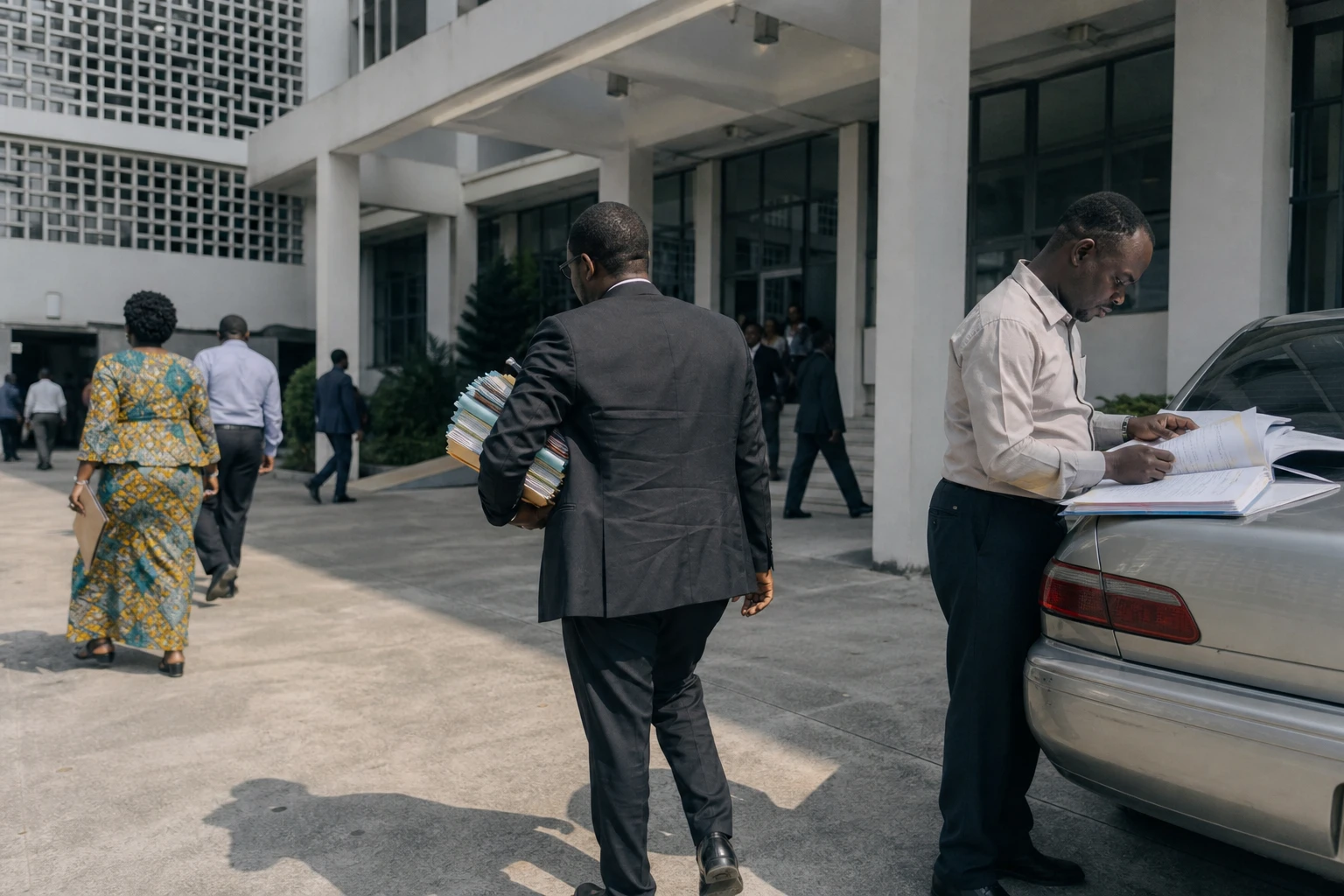
In Kinshasa, the budget debate is about more than figures. It also reflects what the Congolese state can actually afford in a country where security, public-sector wages and infrastructure compete for the same resources. The draft 2027 finance law, submitted on 15 September 2026, sets the budget of the Democratic Republic of the Congo at 56,929bn Congolese francs, or $24.8bn, balanced between revenue and spending.
This increase is part of a trend already under way for several budget cycles. The Ministry of the Budget began preparing the 2027 text in the summer of 2026, with a drafting circular dated 15 June and a schedule of budget conferences published in August. The government therefore wants to give its budget a multi-year framework, rather than make a simple year-end adjustment.
Domestic revenue: the government’s central bet
The core of the plan is a sharp increase in tax collection. Domestic revenue would rise from $15.3bn in 2026 to $17.5bn in 2027, an increase of $2.2bn in one year. At that level, it would fund just over seven dollars in every ten of the general budget. The target tax burden would reach 12.8% of gross domestic product.
This level remains below that of many African countries and primarily reflects the government’s ambition to broaden the tax base. Preparatory documents refer to bringing more informal activities into the tax net, expanding the standardised invoice system, biometric registration of taxpayers and tighter checks. The government also plans to raise some excise duties on vehicles and plastic goods.
The approach itself is not new. In recent budgets, Kinshasa had already emphasised formalising the informal economy, modernising VAT and using digital collection tools. The difference here is the scale expected. The government is no longer seeking only marginal gains; it is aiming for a rapid increase in revenue to support a larger budget.
Security, social spending and the credibility of forecasts
This budget strategy comes amid persistent insecurity. The United Nations reported in June 2026 that eastern DR Congo remained highly unstable, with continued population displacement and repeated violence in North Kivu, South Kivu and Ituri. The Congolese Ministry of the Budget itself acknowledges that the war in the east weighs on public finances and investor confidence.
In the 2026 budget, defence already accounted for 7,929.7bn Congolese francs, or 14.78% of central government spending, while public order and security represented a further 7.39%. The government had also announced, as part of its three-year plan, a gradual increase in the tax burden and greater reliance on domestic funding for defence and security. The 2027 draft therefore extends an already visible approach: securing the state before expanding the scope for social spending.
Another issue will matter in parliament: the credibility of implementation. The draft assumes that the tax administration will rapidly improve its performance, even though collection capacity remains fragile in both the formal and informal economies. If revenue grows more slowly than forecast, the government will have to choose between social protection, public-sector pay, infrastructure and security, with the risk of payment pressures.
What the 2027 budget says about DR Congo and the region
Beyond Kinshasa, this budget reflects the same equation facing the Great Lakes region: a state seeking to regain control of its resources while continuing to manage a security crisis with regional reach. International discussions on eastern DR Congo, including at the United Nations Security Council, show that the issue is no longer just an internal dispute. It also affects diplomatic relations between DR Congo, its neighbours and African and UN peace mechanisms.
For Congolese people, the stakes are tangible. In urban centres, wider taxation could affect small businesses, traders and local services. In the provinces, it will depend on the state’s ability to enforce clear and straightforward rules without further increasing the costs of doing business. If the government can broaden the tax base without stifling activity, it will secure a lasting source of revenue. Otherwise, the budget will remain ambitious on paper but constrained in practice.
The Congolese parliament is now entering the decisive stage. It will have to assess whether the projected revenue is realistic, how it is allocated between security, health, education and infrastructure, and how far the state can push tax reform without placing further strain on households and small businesses. That is where the practical impact of the 2027 budget will be decided.