Algeria
 Egypt
 Libya
 Morocco
 Sudan
 Tunisia
 Benin
 Burkina Faso
 Cabo Verde
 Côte d'Ivoire
 Ghana
 Guinea
 Guinea-Bissau
 Liberia
 Mali
 Niger
 Nigeria
 Senegal
 Sierra Leone
 The Gambia
 Togo
 Cameroon
 Central African Republic
 Chad
 DR Congo
 Equatorial Guinea
 Gabon
 Republic of the Congo
 São Tomé and Príncipe
 Burundi
 Comoros
 Djibouti
 Eritrea
 Ethiopia
 Kenya
 Madagascar
 Malawi
 Mauritius
 Mozambique
 Rwanda
 Seychelles
 Somalia
 South Sudan
 Tanzania
 Uganda
 Angola
 Botswana
 Eswatini
 Lesotho
 Namibia
 South Africa
 Zambia
 Zimbabwe
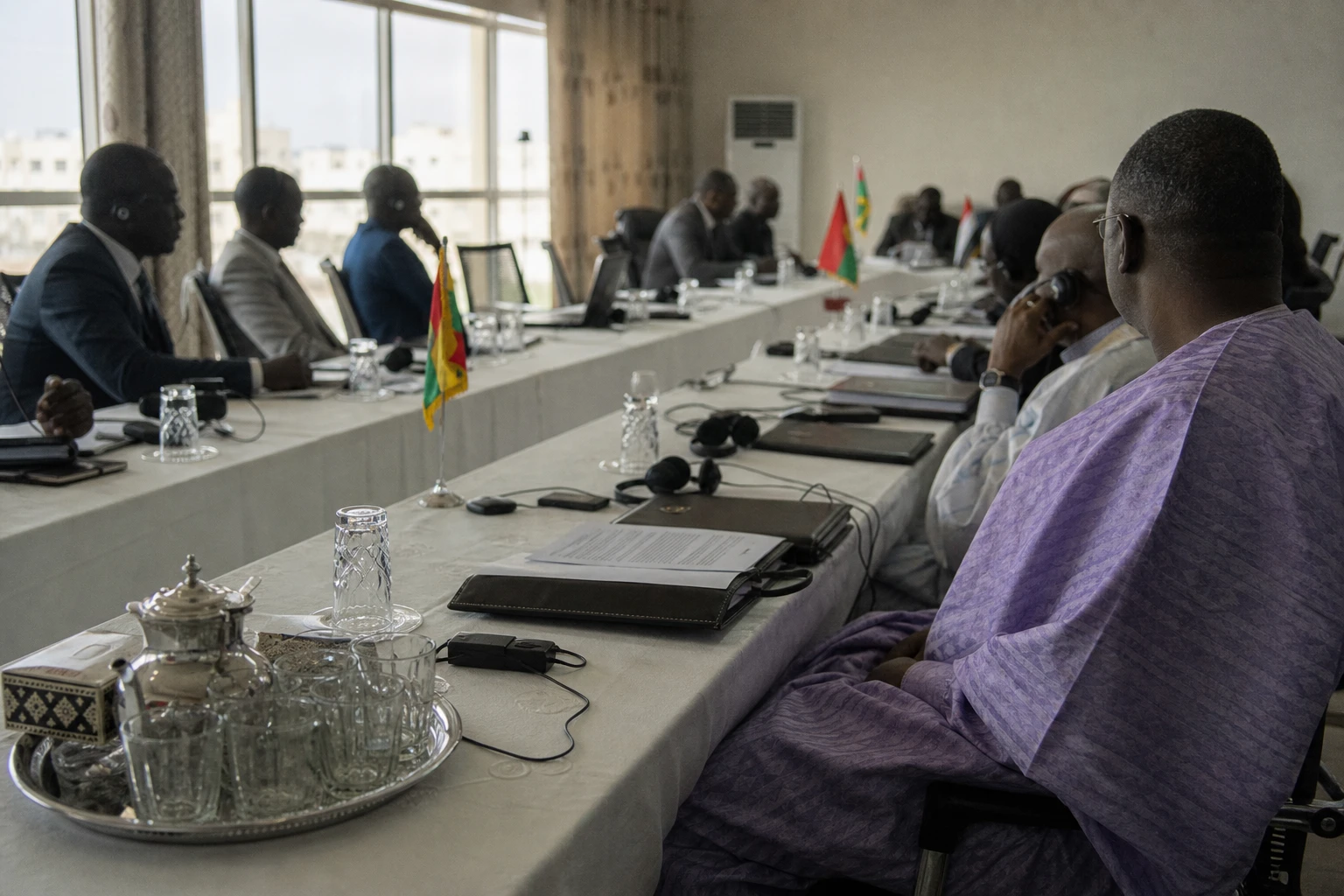
In a Nouakchott home, time is often measured in glasses of tea
In Mauritania, a visitor quickly realises they have not simply entered a living room. They have entered a social rhythm. Tea arrives before serious topics, before apologies, before business. In Nouakchott, as in towns inland, it accompanies visits, discussions, waiting and even shared silence. Its central place is no matter of folklore. It says something about the Mauritanian way of welcoming people, making decisions and living together.
The country is part of a wider cultural space, both Sahelian and Maghrebian. Mauritania belongs to the African Union and the Arab Maghreb Union, alongside Algeria, Libya, Morocco and Tunisia. It is not a member of ECOWAS, even though it shares with West Africa human, commercial and cultural exchanges that go beyond institutional borders. This position also helps explain why Mauritanian tea speaks so much of the desert, travel and urban sociability.
Three glasses, three stages, one social code
The heart of the ritual is known throughout the country: three glasses, served one after another, in an order that prolongs the exchange. The National Tourism Office describes the ceremony as a moment of conviviality and sharing, governed by the three “j”s: jemaa for the gathering, jarr for taking time without rushing, and jmar for good embers. In other words, tea does not exist on its own. It requires people gathered together, a well-tended fire and an embrace of slowness.
This slowness is central to its social value. Several studies on the Sahel show that, over time, green tea became a common consumer good and a vehicle for sociability in the region, particularly through longstanding exchanges between Morocco and Western Sahara, and later towards the Sahel. In Mauritania, this history has become a daily habit. Tea structures breaks, reunions, neighbourhood political discussions and family conversations.
The sequence of three glasses also has symbolic significance. According to descriptions widely repeated in the country, the first is strong, the second more balanced, and the third sweeter. This is not a fixed sacred text. It is more a popular way of saying that conviviality needs time to unfold. The taste becomes more nuanced, and so does the conversation.
A gesture of hospitality that spans homes, offices and roads
Mauritanian tea is not reserved for special occasions. It is served in homes, at work, on journeys and when the heat makes every movement slower. In a country where hospitality remains a cardinal value, offering tea often means recognising the other as a legitimate guest. The country’s tourism authorities also emphasise this hospitality, seen in a Nouakchott villa just as much as in a tent pitched on the outskirts or in the desert.
This practice has a tangible effect: it creates bonds. Tea makes people wait, but above all it gets them talking. It opens up a space for sharing news, negotiating a dispute or preparing a family or professional decision. In a Mauritanian context shaped both by Nouakchott’s rapid urbanisation and the persistence of nomadic traditions, the tea ritual serves as a bridge between different ways of inhabiting the country. It retains a stable form, but adapts to the city, the office, the market and the journey.
Tea also says something about social relations. It brings into view the person welcoming others, the person preparing it and the person waiting. It makes room for conversation, and therefore for mutual recognition. In a society where the spoken word remains important, this shared moment works almost like a code. People do not come together to save time. They come together to create it.
More than a drink, a marker of Mauritanian identity
Mauritanian tea is also a cultural marker. It connects families, generations and social groups. In life stories as in ethnographic descriptions, it appears as an inheritance handed down rather than an everyday consumer product. This transmission matters because it helps maintain continuity between the Arabic-speaking regions of north-west Africa and the Sahelian societies that share similar forms of attaya or atai.
This continuity has a continental dimension. It is a reminder that African food cultures cannot be confined within administrative borders. The same gesture can travel between Mauritania, Mali, Senegal and Niger, then change form without losing its social function. Tea in Mauritania thus shows how a practice that arrived along trade routes was locally reappropriated until it became a social language in its own right.
For Mauritania, a country straddling West Africa and the Maghreb, this symbolic value is no trivial matter. It forms part of an identity that combines urban life, Saharan memory and a sense of welcome. In Nouakchott, a capital often described through its political and economic changes, tea is a reminder that a society can also be understood through its everyday gestures. And in this country, that everyday gesture lasts as long as an entire conversation.