Algeria
 Egypt
 Libya
 Morocco
 Sudan
 Tunisia
 Benin
 Burkina Faso
 Cabo Verde
 Côte d'Ivoire
 Ghana
 Guinea
 Guinea-Bissau
 Liberia
 Mali
 Mauritania
 Niger
 Senegal
 Sierra Leone
 The Gambia
 Togo
 Cameroon
 Central African Republic
 Chad
 DR Congo
 Equatorial Guinea
 Gabon
 Republic of the Congo
 São Tomé and Príncipe
 Burundi
 Comoros
 Djibouti
 Eritrea
 Ethiopia
 Kenya
 Madagascar
 Malawi
 Mauritius
 Mozambique
 Rwanda
 Seychelles
 Somalia
 South Sudan
 Tanzania
 Uganda
 Angola
 Botswana
 Eswatini
 Lesotho
 Namibia
 South Africa
 Zambia
 Zimbabwe
When gas lies underground but does not always reach the plant
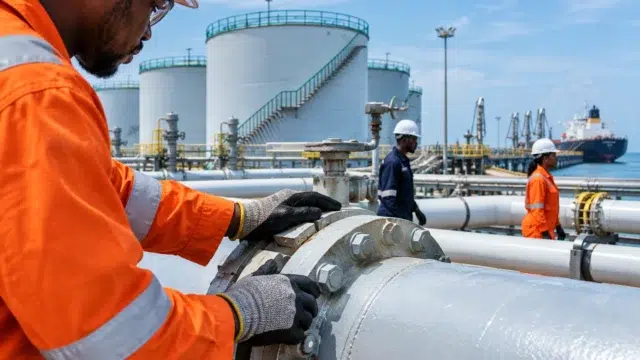
On Bonny Island, in the Niger Delta, the challenge is not simply to produce gas. It must also be delivered without interruption to the liquefaction units. This is where part of Nigeria’s energy future will be decided, as the country seeks to remain a major supplier of liquefied natural gas at a time when buyers are looking for more secure and diversified volumes.
The issue goes beyond Nigeria LNG alone. It affects Nigeria’s place in ECOWAS, the Economic Community of West African States, where energy remains a central lever of economic sovereignty. It also affects public revenues, as gas exports generate foreign exchange, industrial jobs and some of the sector’s investment.
A 30 Mtpa project, but a plant still constrained
At the heart of the matter is Train 7. Nigeria LNG plans to add a new liquefaction line to raise the site’s capacity from 22 to 30 million tonnes a year, an increase of 35%. The project, announced with an investment of $10 billion, is intended to strengthen Nigeria’s position in the global LNG market.
But the plant is already operating below its full potential. Adeleye Falade, managing director of Nigeria LNG, said in Bangkok on the sidelines of the Gastech conference that the company operates six liquefaction trains at a utilisation rate of between 82% and 83%. He also confirmed that the company remains under the force majeure regime introduced in 2022, following supply disruptions linked in particular to severe flooding.
In the oil and gas industry, force majeure is a contractual suspension linked to exceptional circumstances. Here, it says something simple: the plant is ready to produce more, but incoming gas is not yet keeping pace with expectations. Falade said the measure was expected to be lifted when the utilisation rate reached 90%.
The group estimates the gap to be closed at around 15%. In other words, the constraint is less industrial than logistical and upstream. Nigeria LNG says it is working with the state and its partners to increase the volumes directed to the plant.
The real bottleneck: securing gas upstream
This diagnosis highlights a reality familiar to Nigerian energy industry players: the country has substantial gas reserves, but the gathering, processing and transport chain remains fragile. In the Niger Delta, security problems, infrastructure disruptions and maintenance difficulties continue to weigh on flows. The 30 Mtpa target therefore depends first on regular supplies, not just on the completion of Train 7.
This is a strategic issue for Abuja. The Nigerian government presents gas as a transition fuel and a source of revenue capable of supporting economic diversification. NNPC, the national oil company, has also said it wants to help Nigeria LNG reach 30 Mtpa and turn the country into a gas hub.
Nigeria LNG’s shareholders also reflect this long-term structure: NNPC holds 49%, Shell 25.6%, TotalEnergies 15% and Eni 10.4%. This arrangement closely links Nigerian interests and international capital, but it does not resolve the central issue of feed gas, the raw gas needed by the plant.
A commercial opportunity to seize without losing existing customers
The timing comes as the global LNG market remains unsettled. Disruptions to shipping through the Strait of Hormuz, amid tensions in the Middle East, have increased buyers’ interest in additional cargoes and suppliers able to deliver regularly. For Nigeria, this creates a favourable commercial opportunity. But it must first be able to fulfil its contracts.
Nigeria LNG says it is prioritising the fulfilment of its existing commitments, including those affected by force majeure, while maximising available volumes. This is a logical choice. An exporter seeking to expand its international presence must first reassure customers about the reliability of its cargoes. In a competitive market, credibility matters as much as nameplate capacity.
The Train 7 project has already faced several delays, notably because of the Covid-19 pandemic and then the upheaval caused by the war in Ukraine. These setbacks have shown that a gas project does not move forward on the basis of an investment decision alone. It depends on a chain of contracts, supplies, works and authorisations.
What this says about Nigeria and West Africa
For Nigeria, the stakes are twofold. In the short term, it must turn an abundant resource into stable export flows. In the medium term, it must show that the country can hold its place among the major LNG suppliers, as other producers, particularly in the Middle East, North America and southern Africa, also seek to capture global demand.
For West Africa, the issue is a reminder of an often-underestimated truth: the value of an energy project is measured not only by its installed capacity, but by the robustness of the infrastructure supplying it. The region has resources, ports, operators and a growing market. It nevertheless remains exposed to network constraints, competing uses and delays in execution. Nigeria’s case is therefore a test.
The next step will therefore be less symbolic than technical: raise the utilisation rate, stabilise supplies and move permanently beyond the constraints. If Nigeria LNG succeeds, Train 7 will be more than an industrial expansion. It will become a political and economic signal for Abuja and for the West African gas market as a whole.