Algeria
 Egypt
 Libya
 Morocco
 Sudan
 Tunisia
 Burkina Faso
 Cabo Verde
 Côte d'Ivoire
 Ghana
 Guinea
 Guinea-Bissau
 Liberia
 Mali
 Mauritania
 Niger
 Nigeria
 Senegal
 Sierra Leone
 The Gambia
 Togo
 Cameroon
 Central African Republic
 Chad
 DR Congo
 Equatorial Guinea
 Gabon
 Republic of the Congo
 São Tomé and Príncipe
 Burundi
 Comoros
 Djibouti
 Eritrea
 Ethiopia
 Kenya
 Madagascar
 Malawi
 Mauritius
 Mozambique
 Rwanda
 Seychelles
 Somalia
 South Sudan
 Tanzania
 Uganda
 Angola
 Botswana
 Eswatini
 Lesotho
 Namibia
 South Africa
 Zambia
 Zimbabwe
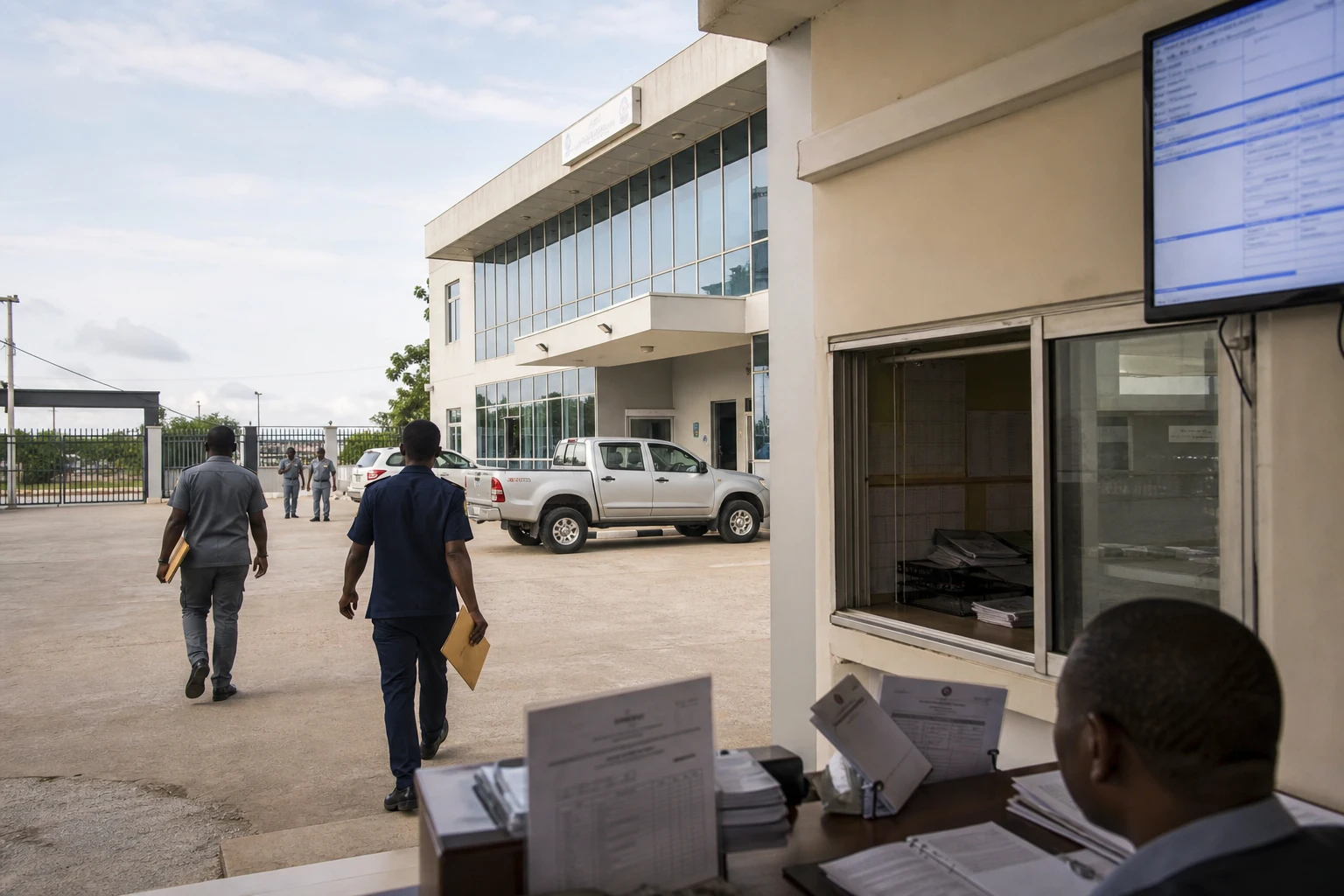
At Sèmè-Kraké, the border is no longer just about the counter
Between Cotonou and Lagos, the real challenge is no longer just getting lorries across the border. It is how quickly two administrations can now communicate, compare their data and avoid entering the same information twice. On a route as busy as the Abidjan-Lagos corridor, every minute saved matters to businesses, transport operators and states seeking to streamline cross-border trade, which remains too costly.
This corridor links five coastal West African countries, from Côte d’Ivoire to Nigeria, via Ghana, Togo and Benin. It accounts for a major share of the sub-region’s trade, and West African authorities regard it as a strategic route for the free movement of goods and people. This is also why ECOWAS has made customs modernisation a priority, with the Interconnected Goods in Transit Management System, or SIGMAT, already launched across the community.
What Benin and Nigeria have launched
On Friday 11 September 2026, the customs administrations of Benin and Nigeria officially launched a pilot project to connect their systems at the Sèmè-Kraké border post. The aim is clear: to enable real-time data exchange between the two administrations, speed up the processing of goods, strengthen targeted checks and reduce duplicate data entry. The system has a technical name: Customs Declaration Exchange System, or CDES.
The mechanism is designed to make a declaration registered in the country of departure accessible in the country of arrival. Manifests, transit information, risk profiles and inspection alerts will also be shared between the two sides. Each administration will nevertheless retain its own powers: calculating duties, assessing risk and making the final release decision. In other words, data exchange does not remove customs sovereignty; above all, it prevents the border from becoming a corridor of administrative duplication.
The project connects two tools already in place. In Benin, the administration uses Customs Webb, while Nigeria relies on its B’Odogwu platform, which Nigerian authorities describe as a system for simplifying, improving the transparency of and modernising procedures. This connection is therefore less an invention than a digital bridge between two national reforms already under way.
Why this reform could change everyday life along the corridor
The customs authorities of the two countries have announced an ambitious target: to cut goods clearance times from 12 to 36 hours to less than three hours, while raising the share of advance electronic processing to more than 80%. Such targets should be seen as an operational guide, not an immediate promise. But they clearly point to the problem: at Sèmè-Kraké, delays are caused not only by the number of lorries, but also by fragmented systems and the separate processing of data.
In practice, the expected benefits are tangible. For transport operators and shippers, less waiting means lower parking costs, less uncertainty and better vehicle turnaround. For customs, the advance sharing of risk profiles should make it possible to focus physical inspections on cargo deemed sensitive. For states, there is a twofold challenge: to secure revenue without slowing trade, and to make borders more predictable in a region where goods often move faster than administrations.
The shared Sèmè-Kraké border had already served as a test site for the digitisation of transit. In May 2025, Benin and Nigeria launched a SIGMAT pilot there under the aegis of ECOWAS, with the aim of tracking goods in transit electronically. CDES goes further: it is not limited to transit, but seeks to connect customs data itself. This is a logical step in a region where trade facilitation now depends as much on servers as on roads.
The border post nevertheless remains constrained by very practical issues: scanners that need to be brought back into service, improved surveillance, better lighting and harmonised bilingual procedures. This is an important reminder. A smart border does not replace infrastructure. It complements it. Without reliable power, functioning equipment and trained staff, interconnection will remain a useful but incomplete tool.
Significance beyond the Cotonou-Lagos route
The choice of Sèmè-Kraké has clear regional significance. The Abidjan-Lagos corridor accounts for a major share of West Africa’s economic flows, and several ECOWAS studies describe it as the sub-region’s most important corridor by trade volume. Its connection with the 1,028-kilometre Abidjan-Lagos motorway project shows that West African integration is advancing on two complementary tracks: physical infrastructure and digital interoperability.
For Benin, a transit and crossroads country, this interconnection could strengthen Cotonou’s role in sub-regional trade. For Nigeria, West Africa’s largest economy, it could ease congestion at an entry point long seen as sensitive in the management of cross-border flows. For ECOWAS, the project is ultimately a test of credibility: if two neighbours can get their systems talking, the idea of a more fluid regional market becomes more tangible. If the project falters, it will also be a reminder that integration cannot simply be decreed; it is built, procedure by procedure.
The next indicator to watch will be simple: the gains measured on the ground. Clearance times, fewer repetitive formalities, reliable data exchanges and the ability to extend the system to other border posts in Benin and Nigeria. That is what will determine the real success of CDES: not the language of modernisation, but the actual flow of traffic along the corridor and restored trust between neighbouring administrations.