Algeria
 Egypt
 Libya
 Morocco
 Sudan
 Tunisia
 Benin
 Burkina Faso
 Cabo Verde
 Ghana
 Guinea
 Guinea-Bissau
 Liberia
 Mali
 Mauritania
 Niger
 Nigeria
 Senegal
 Sierra Leone
 The Gambia
 Togo
 Cameroon
 Central African Republic
 Chad
 DR Congo
 Equatorial Guinea
 Gabon
 Republic of the Congo
 São Tomé and Príncipe
 Burundi
 Comoros
 Djibouti
 Eritrea
 Ethiopia
 Kenya
 Madagascar
 Malawi
 Mauritius
 Mozambique
 Rwanda
 Seychelles
 Somalia
 South Sudan
 Tanzania
 Uganda
 Angola
 Botswana
 Eswatini
 Lesotho
 Namibia
 South Africa
 Zambia
 Zimbabwe
When a song tells more than the story of an era
In Abidjan, some voices never grow old. They return whenever a vinyl record spins, whenever a refrain recalls a ballroom, a television programme or a family living room where music was always playing.
This memory is no mere ornament. It also speaks to the place Côte d’Ivoire held in the cultural life of West Africa, long before digital platforms and viral hits set the pace. Even today, enthusiasts search private collections, old radio archives and forgotten records to keep this heritage from being lost.
Abidjan, a musical crossroads and regional powerhouse
Côte d’Ivoire remains a pivotal country in ECOWAS, the Economic Community of West African States. Yamoussoukro is the political capital, but Abidjan remains the country’s leading economic and cultural stage. For a long time, it was where radio stations, studios, orchestras and performance venues were concentrated.
This central role is not confined to the past. ECOWAS has made culture a tool for regional integration, with events such as MASA, the Abidjan Market for Performing Arts, and ECOFEST, conceived to enable artists, audiences and expertise to circulate across West Africa. In other words, Ivorian music is not just a national heritage: it is part of a vibrant regional space where influences are constantly exchanged.
The country itself has changed scale. Côte d’Ivoire now has a very young population, with nearly three-quarters of its people under the age of 35, according to official figures cited by the country’s economic administration. This generational divide helps explain the challenge: how can an artistic legacy be passed on to young people who grew up with Ivorian rap, coupé-décalé and social media?
From the 1970s to the 1980s, an industry ahead of its time
Between the 1970s and 1980s, Côte d’Ivoire experienced a remarkable musical flourishing. François Lougah, Ernesto Djédjé, Alpha Blondy, Bailly Spinto, Aïcha Koné, Antoinette Konan, Chantal Taïba and Nayanka Bell left their mark on an era when orchestras played live, television served as a springboard, and venues drew audiences from well beyond the country’s borders.
Ernesto Djédjé established ziglibithy, a style born of a dialogue between Bété traditions and modern rhythms such as funk, soul and reggae. Alpha Blondy later gave Ivorian reggae an international reach. His albums put Abidjan on the global popular music map. As for Bailly Spinto, his longevity is a reminder that artists could then spend decades performing on stage, on radio and with major orchestras.
This momentum would not have been possible without a technical ecosystem. ORTI, the national radio and television orchestra, served as a school, a showcase and a gateway for many musicians. The JBZ studio, which opened in the early 1980s, also changed the landscape by providing local recording facilities for artists who had previously had to go to Ghana or Nigeria to make a record.
Copyright eventually provided a more formal framework for this flourishing scene. BURIDA, established in the early 1980s, helped organise the collection and redistribution of royalties. But this framework came late, in a sector still heavily reliant on presidential support, private patronage and personal networks.
The risk of being forgotten and the work of cultural custodians
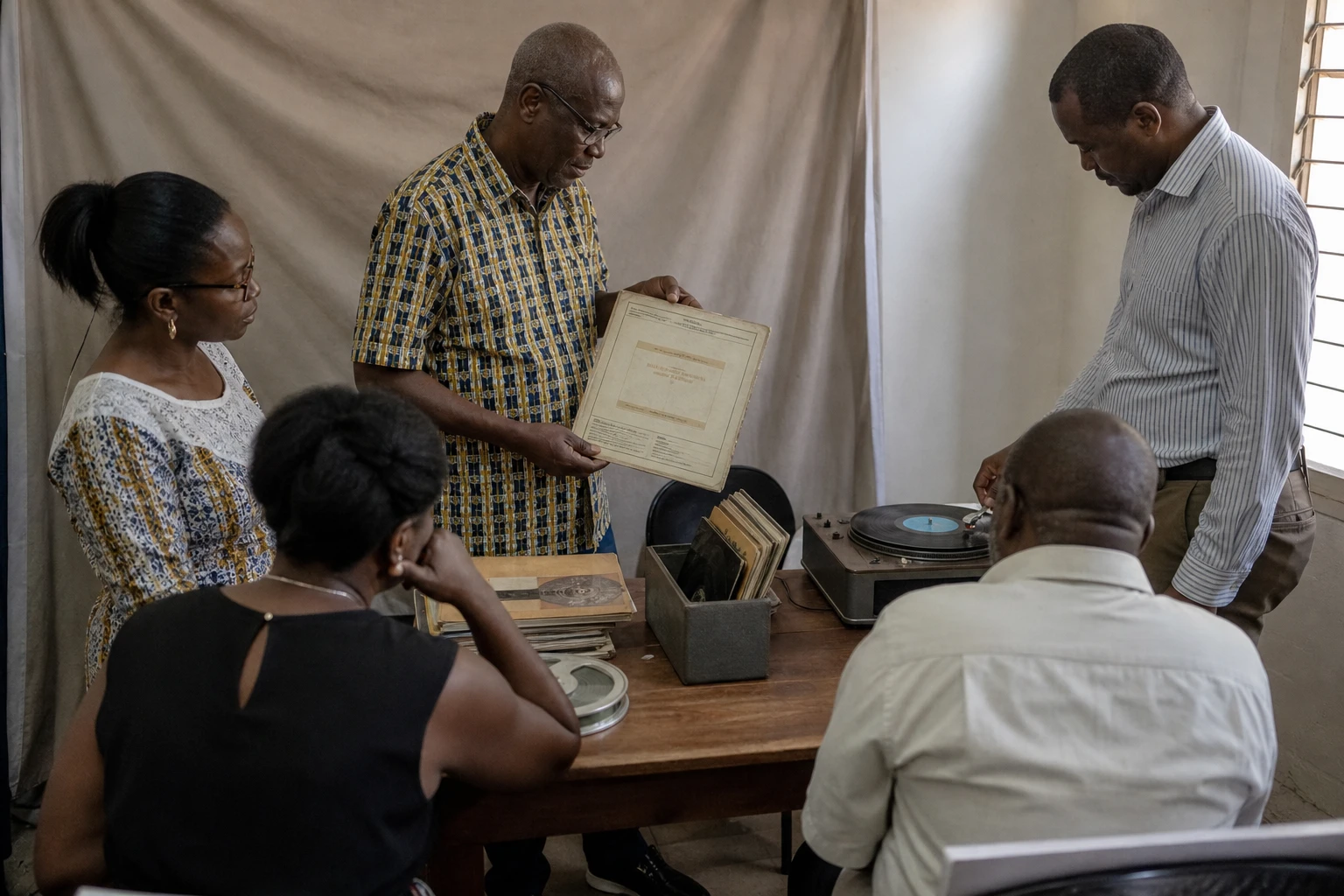
Ivorian musical heritage today depends as much on artists as on those who archive, date, clean and digitise recordings. In Abidjan’s neighbourhoods, some collectors have amassed thousands of vinyl records, cassettes, rare sleeves and live performance photographs. Their work is discreet, but it addresses a very real urgency: recordings deteriorate, witnesses pass away, and institutional archives are not always digitised.
This struggle to preserve memory is also an urban and social issue. In a city such as Abidjan, where modern studios, informal markets, working-class neighbourhoods and new cultural scenes coexist, passing it on takes simple acts: listening to an old 45 rpm record, identifying a recording, or placing a song in its family, social and political history.
The past must also be read without automatic nostalgia. Ivorian music’s golden age coincided with a period of economic expansion and national confidence, before the crises of the 1980s and subsequent political and military tensions weakened the cultural fabric as a whole. When the economy contracts, orchestras break up, tours become less frequent, and artists depend more on individual hits than on a genuine industry.
What this memory says about Côte d’Ivoire today
Renewed interest in the sounds of the 1970s and 1980s is no passing trend. It shows that some young Ivorians are looking for points of reference in a cultural history broader than current urban or political affairs. Recent covers, reissues and tributes to old tracks show that this repertoire continues to feed contemporary creativity.
This movement has continental significance. In a West African space where artists travel from one country to another, regional festivals are multiplying, and institutions are seeking to better protect cultural rights, Côte d’Ivoire has a rare asset: a musical memory that is recognised, popular and exportable. It must, however, be preserved methodically, by digitising collections, documenting catalogues and giving pioneers and new creators an equitable place.
The lesson is simple. Ivorian music belongs not only to the past. It remains a shared language between generations, a marker of regional identity and a field of cultural sovereignty. At a time when Yamoussoukro stands as the political capital and Abidjan continues to shape artistic life, this history is a reminder that a country also tells its story through its orchestras, studios and the way it protects its voices.