Algeria
 Egypt
 Libya
 Morocco
 Sudan
 Tunisia
 Benin
 Burkina Faso
 Cabo Verde
 Côte d'Ivoire
 Ghana
 Guinea
 Guinea-Bissau
 Liberia
 Mali
 Mauritania
 Niger
 Nigeria
 Senegal
 Sierra Leone
 The Gambia
 Togo
 Cameroon
 Central African Republic
 Chad
 DR Congo
 Equatorial Guinea
 Gabon
 Republic of the Congo
 São Tomé and Príncipe
 Burundi
 Comoros
 Djibouti
 Eritrea
 Kenya
 Madagascar
 Malawi
 Mauritius
 Mozambique
 Rwanda
 Seychelles
 Somalia
 South Sudan
 Tanzania
 Uganda
 Angola
 Botswana
 Eswatini
 Lesotho
 Namibia
 South Africa
 Zambia
 Zimbabwe
Power crosses borders, but has yet to reach every home
In Addis Ababa, electricity is no longer just a question of light at the end of a wire. It has become an instrument of economic sovereignty, a lever for regional integration and a source of revenue for the Ethiopian state. But this rapid shift also tells another, less visible story: across much of the country, access remains too unreliable, too partial or too expensive for generation to become a useful everyday service.
This gap captures Ethiopia’s recent trajectory. The Horn of Africa country and IGAD member is seeking to combine major infrastructure projects, local distribution and cross-border trade. The Grand Ethiopian Renaissance Dam, or GERD, in the Benishangul-Gumuz region, has brought the national electricity system to a new scale. At the same time, the government has included universal energy access in its National Energy Compact, backed by Mission 300, the joint initiative of the World Bank and the African Development Bank to connect 300 million people in sub-Saharan Africa by 2030.
More exports, yes—but only if the domestic grid is strengthened
On 16 September 2026, Ethiopian Electric Power announced that the country was preparing to double its deliveries to Kenya, from 200 to 400 MW, from December 2026. The company also said that a pilot supply of 100 MW to Tanzania was continuing via the Kenyan corridor, pending work to strengthen regional interconnectors. This expansion is part of a broader framework: Ethiopia already exports to Kenya, Djibouti and Sudan, and more recently to Tanzania, according to the official ENA news agency.
The figures point to an electricity system producing far more than before. Ethiopian Electric Power says it generated 29.5 TWh in 2024/25, a year-on-year increase of 43.1%. The country also has installed capacity of about 9,761 MW, with the GERD alone accounting for around 5,150 MW. According to ENA, the dam has accounted for 52% of the country’s electricity export revenues and helped push those revenues above half a billion dollars.
But the picture at home remains mixed. The national compact published by the World Bank says that in January 2025, 65% of households had at least one source of electricity, while only 44% received Tier 1 service or higher—that is, a minimally useful level of access under the World Bank’s framework. In other words, millions of Ethiopians remain on the threshold of electrification, even as national generation rises rapidly.
The problem is not just the availability of kilowatt-hours. It also concerns lines, substations, technical losses and distribution capacity. The World Bank document envisages extending the transmission network from 20,390 km to 30,000 km by 2030, and the distribution network from 179,000 km to 456,000 km. It also aims to reduce distribution losses from 22% to 13% and commercial losses from 10% to 4.5%. The message is clear: generating more is not enough if electricity does not reach the right place at the right time and at an acceptable level of quality.
What these exports change—and for whom
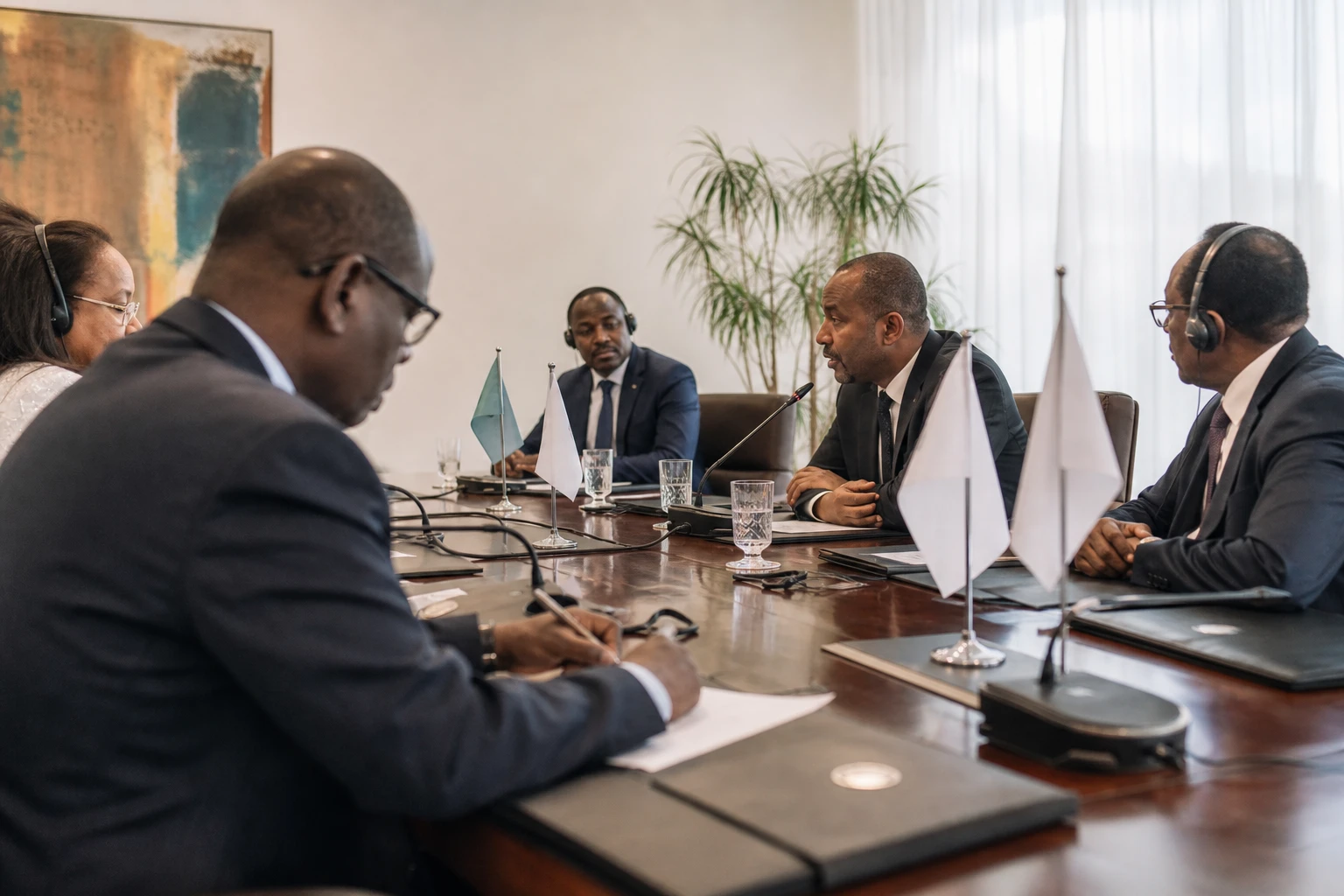
For the Ethiopian state, exports provide a twofold boost. They earn foreign currency and make use of generation capacity already built. They also strengthen Addis Ababa’s position as an energy player in East Africa, within the Eastern Africa Power Pool, the regional electricity market. This matters because it places Ethiopia in a broader pattern of interdependence with Kenya and Tanzania, two markets where demand is rising and grid integration is advancing in stages.
For households, however, the question remains more immediate. High generation capacity guarantees neither more reliable power nor connections in rural areas, nor acceptable voltage quality in the outskirts of cities. The national compact sets a target of 75% basic access by 2030, combining 70% grid-based solutions with 30% off-grid. It also pledges to connect more than 9.23 million additional households, showing that the heart of the challenge still lies in distribution—the final stretch between major investment and the home.
The country’s geography compounds the challenge. Ethiopia is vast and mountainous, and the gap remains wide between Addis Ababa and the main industrial corridors, on the one hand, and many rural areas, where stand-alone solar solutions still predominate, on the other. The compact notes that in rural areas, a large share of electrified households still rely on solar lanterns or individual systems, underscoring the fragility of access. In cities, the issue is less a total lack of electricity than its reliability and cost. In the countryside, it is often a matter of a first connection or a basic solution.
The regional message is just as important. The Horn of Africa is seeking practical forms of cooperation in an environment marked by water tensions, rapidly growing industrial needs and public finances under pressure. Electricity here is more than a service: it is diplomatic infrastructure. If Addis Ababa can stabilise its surpluses, secure its lines and meet its deadlines, it will be able to exert greater influence over energy exchanges within IGAD and the EAPP. If domestic distribution remains behind, however, exports risk looking like a macroeconomic success that does too little, too slowly, to ease daily life.
The next steps will therefore follow a precise timetable: the announced increase in deliveries to Kenya in December 2026, progress on grid works by 2030 and, in the background, the Ethiopian government’s ability to make the GERD not just a regional showcase but also a tool for fairer connections across the country. That is where the true reach of Ethiopia’s electricity transition will be measured, beyond generation figures.