
 Algeria
 Egypt
 Libya
 Morocco
 Sudan
 Tunisia
 Benin
 Burkina Faso
 Cabo Verde
 Côte d'Ivoire
 Ghana
 Guinea
 Guinea-Bissau
 Liberia
 Mali
 Mauritania
 Niger
 Nigeria
 Senegal
 Sierra Leone
 The Gambia
 Togo
 Cameroon
 Central African Republic
 Chad
 DR Congo
 Equatorial Guinea
 Gabon
 Republic of the Congo
 São Tomé and Príncipe
 Burundi
 Comoros
 Djibouti
 Eritrea
 Ethiopia
 Kenya
 Madagascar
 Malawi
 Mauritius
 Mozambique
 Rwanda
 Seychelles
 Somalia
 South Sudan
 Tanzania
 Uganda
 Angola
 Botswana
 Eswatini
 Lesotho
 Namibia
 Zambia
 Zimbabwe
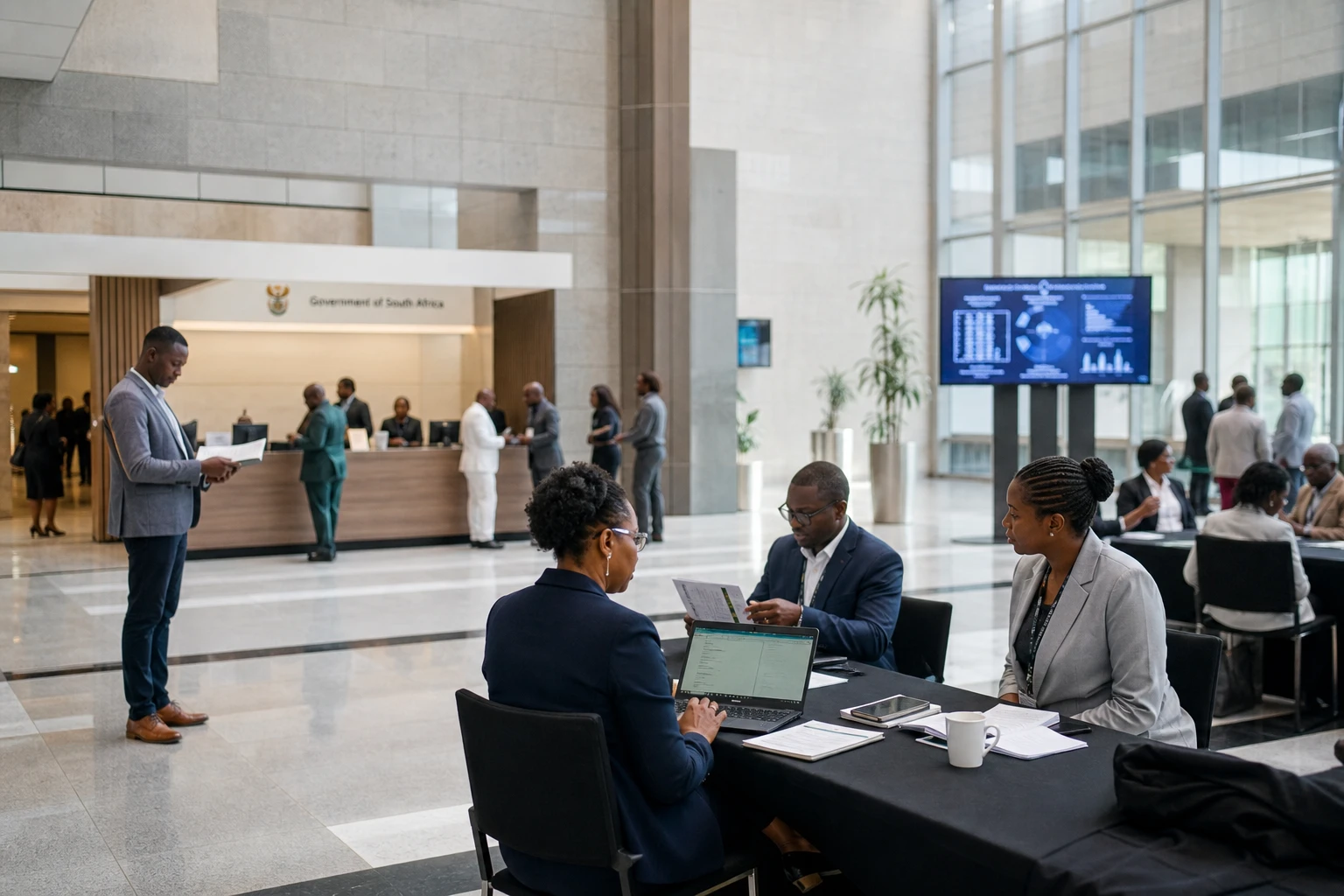
In Pretoria, AI is no longer a distant issue
In South Africa, the debate about artificial intelligence has moved beyond laboratories and major conferences. It now affects everyday work, digital security and trust in information. In a country where services, call centres, finance and public administration already rely heavily on digital technology, the question is no longer simply what AI can do. It is also necessary to ask who controls it, under what rules and for what purposes. UNESCO also stresses that AI must remain grounded in human rights, transparency, fairness and human oversight.
This debate comes as Pretoria seeks to organise its response. The South African government has launched a National AI Stakeholder Forum, presented as a space for coordination between the state, academics, civil society and the private sector. In March 2026, the Presidency also confirmed that a draft national policy on artificial intelligence aimed to strengthen regulation, support local innovation and develop skills.
An African framework already in place
South Africa’s case is not playing out in isolation. Since 2024, the African Union has had a Continental Artificial Intelligence Strategy. It calls on member states to adopt coherent national approaches, tailored to African realities, to support development while reducing technology-related risks. The strategy forms part of the Digital Transformation Strategy for Africa 2020-2030 and Agenda 2063.
South Africa has already positioned itself within this movement. The country says it wants to make AI a lever for digital sovereignty, industrial competitiveness and inclusion. The authorities have even described the country as one of the continent’s most developed technology ecosystems, with digital infrastructure, an advanced financial sector and a relatively dense network of start-ups. Pretoria also wants to align its efforts with SADC, the Southern African Development Community, where the movement of data, skills and digital services is becoming a regional issue.
The facts: useful technology, but not a neutral one
AI is advancing rapidly, and its effects now go beyond the simple automation of tasks. The ILO observes that generative AI can transform the quality of work, job structures and employment conditions. The World Economic Forum, for its part, estimates that the period 2025-2030 could see job creation and job losses occurring together, with strong demand for roles related to data, AI and cybersecurity. These trends do not mean that a country will mechanically lose jobs. Rather, they show that the value of work is shifting towards skills, adaptability and the ability to supervise machines.
In South Africa, this shift is arriving in an economy already marked by sharp inequalities in access to digital technology. The IMF has noted that South African workers’ exposure to AI varies considerably across sectors and levels of qualification. In this context, the most vulnerable jobs are not only those that can be automated. They also include jobs based on repetitive, poorly protected tasks that can easily be outsourced.
Jobs, surveillance and security: the most tangible risks
The main concern for households remains jobs. This is understandable in a country where unemployment remains a central social issue. Call centres, administrative support, some data-entry roles and customer service are exposed to rapid automation. But reducing the debate to fears of replacement would be incomplete. AI can also boost productivity, support education, improve healthcare and help public services, provided it is deployed within a framework and people have genuine access to the necessary skills.
The second risk is security. South African authorities have already warned that the country is living in an era of AI-powered attacks, deepfakes and data manipulation. The Cybercrimes Act of 2020 provides a criminal-law framework for some of these offences, but police and justice services continue to point to limitations in technical capacity. In a sensitive political environment, the spread of doctored images, fake recordings or automated messages can undermine public trust far faster than conventional fraud.
The third risk concerns surveillance. AI makes it easier to sift through vast quantities of data, identify patterns and analyse behaviour. Without safeguards, these tools can serve legitimate purposes, but they can also encroach on privacy, reinforce biases or intensify existing inequalities in monitoring. South Africa therefore faces a dual challenge: protecting the public against abusive uses while avoiding curbs on local innovation.
What Pretoria can influence beyond its borders
South Africa occupies a particular position in Southern Africa. It has a strong scientific base, an active private sector and an administration capable of developing standards. If Pretoria manages to establish a stable AI policy, the country could serve as a regulatory testing ground for SADC and, more broadly, the continent. Conversely, a muddled framework would send a cautionary signal to other African capitals seeking to balance innovation and digital sovereignty.
The debate also extends beyond Africa because it is part of a global discussion on AI governance. UNESCO has established an international ethical framework, and the African Union has set out its own continental roadmap. Between the two, states must now turn principles into concrete rules on data access, worker protection, tackling bias, cybersecurity and legal liability. That is where the real battle lies: not between humans and machines, but between a technology imposed on people and one that is governed.
For South Africa, the immediate challenge is clear: to make Pretoria a credible place of decision-making, not merely a stage for debate. The country already has policy tools, a multi-stakeholder forum and a draft national framework. What remains to be seen is whether this architecture will produce clear rules, real protections and tangible opportunities for South Africans, from the capital to the provinces.



