Algeria
 Egypt
 Libya
 Morocco
 Sudan
 Tunisia
 Benin
 Burkina Faso
 Cabo Verde
 Ghana
 Guinea
 Guinea-Bissau
 Liberia
 Mali
 Mauritania
 Niger
 Nigeria
 Senegal
 Sierra Leone
 The Gambia
 Togo
 Cameroon
 Central African Republic
 Chad
 DR Congo
 Equatorial Guinea
 Gabon
 Republic of the Congo
 São Tomé and Príncipe
 Burundi
 Comoros
 Djibouti
 Eritrea
 Ethiopia
 Kenya
 Madagascar
 Malawi
 Mauritius
 Mozambique
 Rwanda
 Seychelles
 Somalia
 South Sudan
 Tanzania
 Uganda
 Angola
 Botswana
 Eswatini
 Lesotho
 Namibia
 South Africa
 Zambia
 Zimbabwe
When agricultural data become a tool of sovereignty
In Côte d’Ivoire, agriculture is about more than fields. It affects household incomes, exports, rural employment and, more broadly, the state’s ability to steer economic growth. In a country seeking to feed its domestic market better while remaining a heavyweight in cocoa, cashew and rubber, the quality of the figures matters almost as much as the quantity produced. That is the purpose of the new agricultural survey, launched across the country from 10 September 2026.
The issue goes beyond statistics. It concerns how Abidjan, the country’s economic capital, balances modernisation, food security, local processing and farm financing. It also affects rural areas, where agricultural households are concentrated and where disparities in access to irrigation, agricultural advice and credit remain decisive.
What the 2026 survey covers
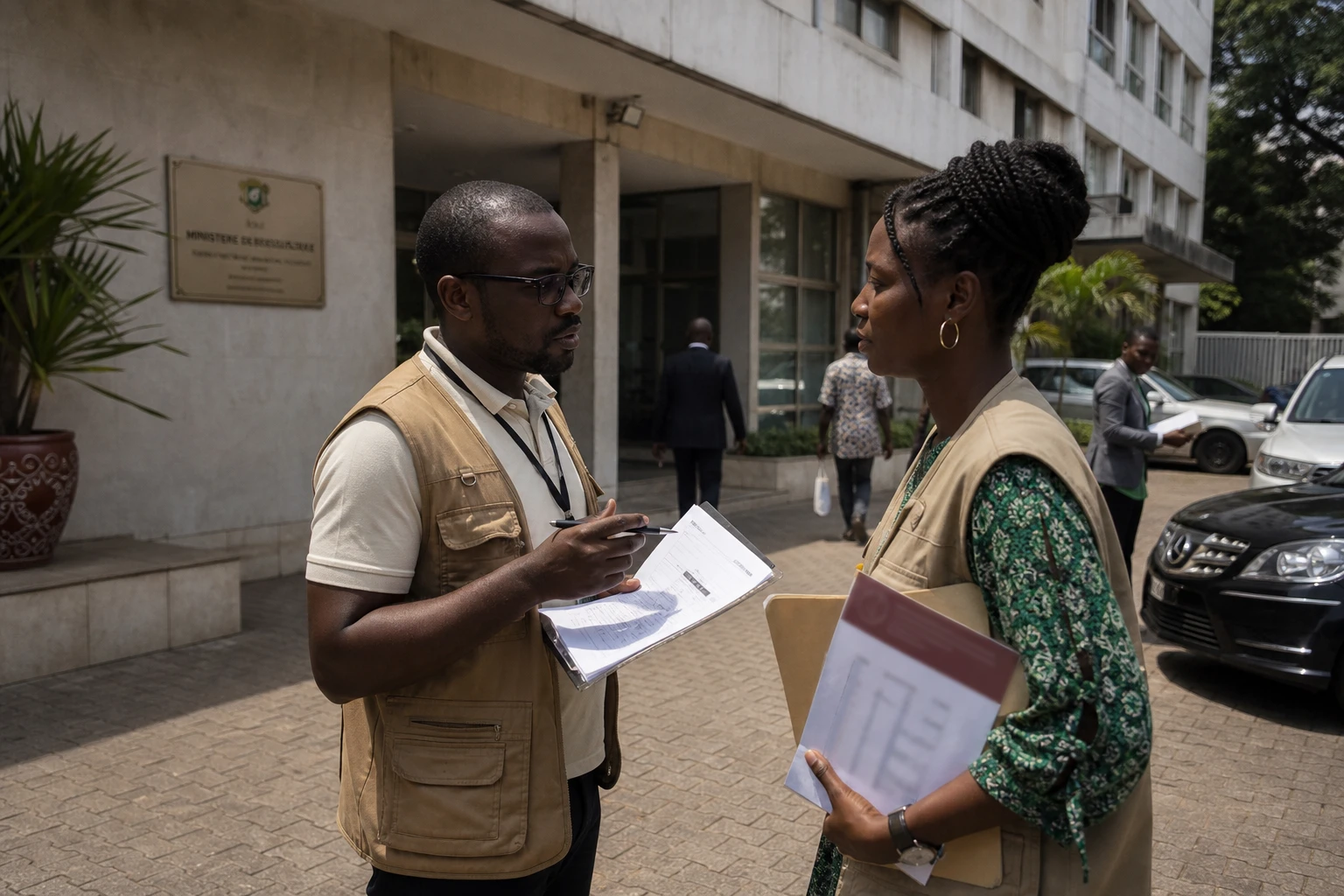
The ministry responsible for agriculture described the operation as a three-month project to collect data on food and cash crops from agricultural households. Its stated aim is straightforward: to obtain reliable information to better understand the sector’s constraints and improve public policy planning. An official publication dated 13 September 2026 confirms the launch and places it within the ongoing national data-collection programme.
The initiative is part of a broader process. Since 2023, Côte d’Ivoire has taken part in the AGRISurvey programme, led with technical support from the FAO. The framework aims to establish an integrated annual data-collection system covering crops, livestock, fisheries and forestry. The rationale is clear: move beyond an occasional snapshot of farming seasons towards more regular monitoring of farms and yields.
The country is not starting from scratch. The results of the 2024-2025 Annual Agricultural Survey, published by ANStat in April 2026, have already provided a baseline. They report 1,734,942 agricultural households, an average area of 3.4 hectares per household, and a structure dominated by family farms. The survey also highlighted heavy reliance on rainfall: 97% of plots had no irrigation.
In other words, the 2026 data collection is not starting from nothing. It builds on an already useful baseline, but one that is still incomplete for the needs of an agriculture that is more mechanised, better irrigated and more closely connected to markets. Methodological robustness also matters: ANStat’s data catalogue notes that some variables are released only at an aggregated level to preserve statistical reliability.
Why the Ivorian state is emphasising these figures
Côte d’Ivoire is entering a more ambitious phase of planning. The 2026-2030 National Development Plan places agriculture, food security and local processing among its structural pillars. The official document refers to a “modern and inclusive” agricultural sector, with agrifood systems that are more resilient to shocks. At the same time, the government has approved a total budget of 114,838.5 billion CFA francs for the NDP.
In this context, agricultural statistics are not just for counting tonnes. They inform budgetary decisions, helping determine where to invest in rural roads, irrigation, mechanisation, seeds, storage or processing. They also help distinguish the constraints facing cash-crop sectors geared towards exports from those affecting food crops, which are vital to local markets and price stability.
Data published in 2026 already shed light on several vulnerabilities. An average farm of 3.4 hectares remains small for rapid upgrading, especially without irrigation. An agriculture still heavily dependent on rainfall is highly exposed to climate variability. In the most exposed regions, this affects incomes and, in turn, local consumption. In cities, the consequences take a different form: fluctuations in food prices, pressure on household budgets and the need for more regular supplies.
ANADER’s 2026-2030 strategic plan points in the same direction. The rural development support agency has announced a budget of 167.42 billion CFA francs for 51 major projects, with the aim of increasing productivity and modernising farms. This is no minor detail: the statistical survey provides the map; ANADER must help change what happens on the ground.
An Ivorian challenge, but also a West African one
The survey’s significance extends beyond Côte d’Ivoire’s borders. Côte d’Ivoire is a central player in ECOWAS, both because of the size of its economy and its role in regional agricultural trade. Ivorian authorities also point out that the country remains a driving force in WAEMU, making a substantial contribution to GDP and regional exports. In a sub-region where climate shocks, security tensions and dependence on food imports remain major concerns, reliable agricultural data are becoming a tool for resilience.
The continental dimension is just as clear. The FAO links Côte d’Ivoire’s programme to the 50×2030 Initiative, designed to reduce the agricultural data gap in Africa and better track the Sustainable Development Goals. This is not merely a matter for statisticians. It is a way to make agricultural policies comparable, traceable and fundable across Africa.
The precedent matters. When agriculture still accounts for a decisive share of GDP, exports and employment, public policy without precise data risks being too broad or too late. By contrast, a regular data-collection system makes it possible to forecast yields, identify areas of vulnerability and better target support to producers. That is what the Ivorian authorities are seeking to do at a time when food sovereignty, local processing and rural employment have become national priorities.
What happens next will depend on the ability to turn data into action. The 2026 survey results will need to be put to use quickly to inform the implementation of the 2026-2030 NDP, ANADER programmes and upcoming sectoral decisions. For Côte d’Ivoire, the challenge is no longer simply to produce. It is now to know precisely where, how and for whom to produce better.