
 Algeria
 Egypt
 Libya
 Morocco
 Sudan
 Tunisia
 Benin
 Burkina Faso
 Cabo Verde
 Côte d'Ivoire
 Ghana
 Guinea
 Guinea-Bissau
 Liberia
 Mali
 Mauritania
 Niger
 Nigeria
 Senegal
 Sierra Leone
 The Gambia
 Togo
 Cameroon
 Central African Republic
 Chad
 DR Congo
 Equatorial Guinea
 Gabon
 Republic of the Congo
 São Tomé and Príncipe
 Burundi
 Comoros
 Djibouti
 Eritrea
 Kenya
 Madagascar
 Malawi
 Mauritius
 Mozambique
 Rwanda
 Seychelles
 Somalia
 South Sudan
 Tanzania
 Uganda
 Angola
 Botswana
 Eswatini
 Lesotho
 Namibia
 South Africa
 Zambia
 Zimbabwe
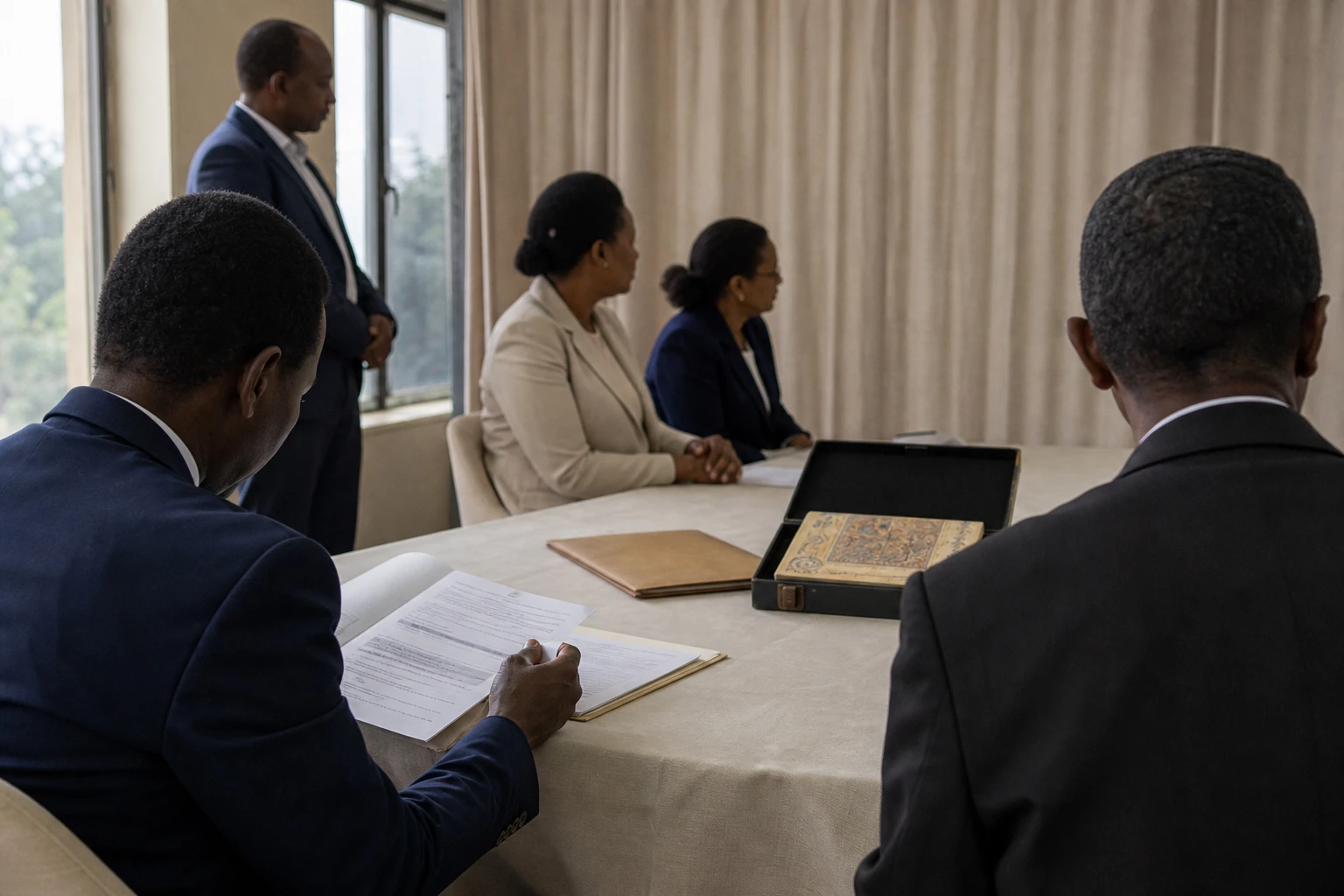
An ancient manuscript, and a very current debate
In Addis Ababa, the return of heritage is not a museum issue reserved for specialists. It is a question of memory, cultural sovereignty and, for many Ethiopians, historical justice. When a manuscript linked to Tewodros II reappears on the international market with a price tag, it is a reminder that the objects from Maqdala are not merely ancient works: they still bear the mark of a military conquest and organised dispersal.
The regional context also matters. Ethiopia is at the heart of East Africa and carries weight in IGAD and African Union forums, as well as in African debates on restitution. In Addis Ababa, heritage authorities have recently stepped up their calls for the return of dispersed cultural property, while UNESCO points out that the 1970 Convention does not apply retroactively, without thereby “legitimising” earlier transactions.
What is known about the manuscript and its journey
The document in question is an 18th-century Ethiopian Gospel book, written in Ge’ez on vellum and dated to around 1730–1740. It contains the Gospels of Luke and John and is the companion volume to another held by the Bavarian State Library in Munich, which contains Matthew and Mark. The catalogue of the dealer presenting it in Abu Dhabi lists an asking price of €250,000.
The Abu Dhabi International Book Fair, whose 35th edition runs from 13 to 18 September 2026, thus provides a showcase for an item of genuine bibliophilic value, but one whose history is inseparable from the 1868 British expedition against Maqdala. The British Museum itself describes the looting of the fortress, the auctioning of the spoils on 20 and 21 April 1868 on the plain of Delanta, and the purchase of manuscripts for the museum by Richard Holmes.
This provenance lies at the heart of the case. The British Museum’s collections acknowledge that Holmes, an assistant in the Department of Manuscripts, accompanied the expedition as an “archaeologist” and took part in both purchases and the removal of objects on site. The museum even notes that this was an exceptional case of a member of staff being sent on a military campaign in Africa. In this context, the manuscript’s subsequent circulation on the market does not erase the origins of its initial transfer.
Why the question of restitution remains open
The legal point is often raised, but it does not settle everything on its own. UNESCO points out that the 1970 Convention governs the illicit trafficking of cultural property, has no retroactive effect and that, in some cases, return can take other routes: negotiation, mediation, gifts, purchases or diplomatic agreements. In other words, the absence of an automatic obligation to return an object does not make its sale morally unproblematic.
In Ethiopia, the argument is no longer theoretical. The Ethiopian Heritage Authority says it has stepped up efforts to trace objects taken out of the country, and states that more than 72 items have returned in recent years through voluntary restitution, international cooperation or diplomatic negotiation. Among recent returns, a Maqdala shield was repatriated in 2024 after a campaign involving institutions and researchers, before being displayed at the National Museum of Addis Ababa.
This movement also reflects a change in approach. Ethiopia is no longer limiting itself to symbolic claims. It is documenting, negotiating, presenting provenance evidence and drawing on public, academic and civil society networks. The stakes for the country are concrete: enriching national collections, supporting research, promoting heritage tourism and bringing objects long absent from Ethiopia’s public narrative back into view. In Addis Ababa, heritage has become a cultural policy issue in its own right.
A landmark case for Africa and the rare-book market
This case, however, goes beyond Ethiopia alone. It is part of a continental debate about African objects held in Europe, North America or private collections, often as a result of colonial expeditions, wars or unequal transfers. The African Union, UNESCO and several national institutions have made restitution a matter of law, memory and cultural cooperation, not an isolated heritage dispute.
For the market, the message is clear. Bibliophilic rarity is no longer enough to neutralise questions about an object’s origins. When a manuscript from Maqdala returns to the market with provenance pointing to a documented military operation, its sale becomes a public test of transparency. For Ethiopia, by contrast, each such reappearance strengthens the case for a wider inventory of dispersed treasures, from manuscripts to liturgical objects and imperial regalia.
The calendar will soon bring the debate to a head. With the Abu Dhabi Book Fair taking place and Ethiopia’s repatriation efforts continuing, the question is not whether the Maqdala case will fade away. It is rather which objects will surface next, and how Ethiopia, in Addis Ababa, will continue to turn a memory of dispossession into a strategy for restitution.



