Algeria
 Egypt
 Libya
 Morocco
 Sudan
 Tunisia
 Benin
 Burkina Faso
 Cabo Verde
 Côte d'Ivoire
 Ghana
 Guinea
 Guinea-Bissau
 Liberia
 Mali
 Mauritania
 Niger
 Nigeria
 Senegal
 Sierra Leone
 The Gambia
 Togo
 Cameroon
 Central African Republic
 Chad
 DR Congo
 Equatorial Guinea
 Gabon
 Republic of the Congo
 São Tomé and Príncipe
 Burundi
 Comoros
 Djibouti
 Eritrea
 Ethiopia
 Kenya
 Malawi
 Mauritius
 Mozambique
 Rwanda
 Seychelles
 Somalia
 South Sudan
 Tanzania
 Uganda
 Angola
 Botswana
 Eswatini
 Lesotho
 Namibia
 South Africa
 Zambia
 Zimbabwe
When rain is scarce or excessive, villages, ports and dams bear the brunt
In Madagascar, El Niño is never merely a distant weather phenomenon. On the Big Island, excess heat in the Pacific can translate very concretely into more vulnerable harvests, longer water cuts and coastal ecosystems under strain. Its effects are not visible only in climate assessments. They can be seen in markets, schools, health centres and fishing grounds.
The context makes the threat all the more serious. Madagascar is an island state in the Indian Ocean and a member of SADC, the Southern African Development Community, which comprises 16 countries. Antananarivo must therefore contend with shocks that extend beyond the national level and also affect regional supply chains, food security and population movements.
Contrasting forecasts from north to south, with a country already highly exposed
The outlook announced for 2023 was clear: a strong El Niño was expected to intensify climate contrasts across Madagascar. Humanitarian projections pointed to rainfall often below average in the centre and south, while the north faced a risk of torrential rain and flooding. This was no isolated surprise. By 4 July 2023, the WMO had already confirmed the onset of El Niño conditions and warned that at least a moderate event was expected to continue through the second half of the year, with the potential for significant climate disruption. In October 2023, the organisation even spoke of a strong likelihood that the event would persist through the boreal winter.
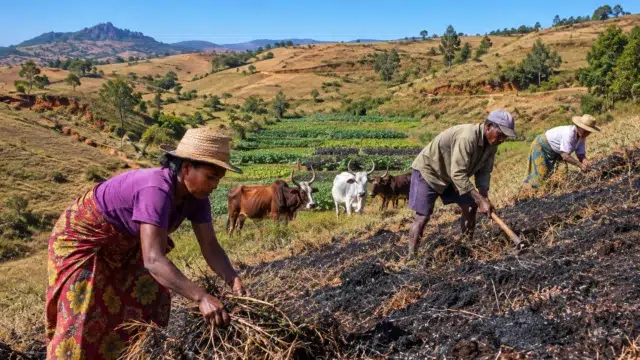
On the ground, the expected effects overlapped with long-standing vulnerabilities. FEWS NET said in August 2023 that El Niño conditions would probably reduce rainfall in southern Madagascar, delay the start of the rainy season and weigh on the incomes of poor households that rely mainly on seasonal agricultural work. The same assessment described harvests and stocks in the Grand South as already under pressure.
This vulnerability is not abstract. In the south and south-east, repeated climate shocks have already affected millions of people. Analyses by the IMF and UNICEF noted that the country faced chronic food insecurity, exacerbated by droughts, cyclones and episodes of extreme rainfall. The IMF report on climate shocks and food insecurity in Madagascar recalled that several million people were already highly vulnerable in 2022.
Coastal ecosystems and Antananarivo’s power supply: two front lines
In Madagascar, El Niño threatens more than crops. It also puts ecosystems under strain that play an essential economic and protective role. Mangroves and coral reefs absorb some of the force of storms, protect coastlines against rising waters and serve as nurseries for marine species important to small-scale fisheries. WWF Madagascar has for several years stressed that these environments are central to the livelihoods of coastal communities, as well as to ecotourism and climate resilience.
This matters because it connects the weather to everyday economic life. When mangroves are degraded, fishers lose breeding grounds for crabs and several fish species. When reefs bleach or deteriorate, natural coastal protection is reduced. In coastal villages, the loss of an ecosystem quickly translates into lower incomes, a less varied diet and greater reliance on external aid.
There is also an energy risk. The Andekaleka hydroelectric dam, in the Alaotra-Mangoro region, supplies a significant share of Antananarivo’s interconnected grid. JIRAMA itself has acknowledged that incidents at the facility caused alternating power cuts in the capital. In a context of potentially dwindling water resources, a longer low-water period could therefore weigh on Antananarivo’s electricity supply, with direct effects on households, small businesses and public services.
Humanitarian response still too limited for the scale of needs
As the El Niño threat intensified, the United Nations announced a disbursement of $6 million for the Grand South to prepare for a severe drought. This emergency funding was added to a situation already strained by food insecurity. WFP has more recently said that at least 1.7 million people in Madagascar are facing acute food insecurity, while its projections for the 2026-2027 lean season anticipate a further deterioration in the Grand South if climate shocks recur.
For the population, the issue is not only emergency aid. It is also the continuity of water, electricity, schooling and food production. For the authorities, the challenge is to better align national measures with regional forecasting and response mechanisms, particularly within SADC, where Madagascar shares exposure to extreme climate shocks with Mozambique, Malawi and Zimbabwe. Preparedness budgets established by UNICEF and WFP show that taking anticipatory action costs less than repairing the damage afterwards, but such funding remains insufficient given the scale of needs.
The case of Madagascar ultimately highlights a pan-African reality: climate never strikes alone. It affects agriculture, health, energy, ports, roads and social safety nets. Across the continent, Madagascar illustrates what many coastal and island countries in the Indian Ocean are already observing: the urgent task is no longer to discover these risks, but to incorporate them into public planning, local investment and regional resilience policies. The next rainy season, dam levels and the state of the coast will show whether this preparation has been adequate.