Algeria
 Egypt
 Libya
 Morocco
 Sudan
 Tunisia
 Benin
 Burkina Faso
 Cabo Verde
 Côte d'Ivoire
 Ghana
 Guinea
 Guinea-Bissau
 Liberia
 Mali
 Mauritania
 Niger
 Nigeria
 Senegal
 Sierra Leone
 The Gambia
 Togo
 Cameroon
 Central African Republic
 Chad
 DR Congo
 Equatorial Guinea
 Gabon
 Republic of the Congo
 São Tomé and Príncipe
 Burundi
 Comoros
 Djibouti
 Eritrea
 Ethiopia
 Madagascar
 Malawi
 Mauritius
 Mozambique
 Rwanda
 Seychelles
 Somalia
 South Sudan
 Tanzania
 Uganda
 Angola
 Botswana
 Eswatini
 Lesotho
 Namibia
 South Africa
 Zambia
 Zimbabwe
When borders, prices and public services come under pressure at the same time
In North Africa, as in West and Central Africa, early warning signs often say a great deal about a country’s condition. A border coming under strain, households taking to the streets to protest the cost of living, a train returning to service after years out of action: these events tell the story of more than a turbulent week. They also speak to mounting pressure on states, amid social expectations, mobility, security and public credibility.
The thread running through this sequence is clear: governments are being urged to respond quickly, but not to rely on communications alone. In Morocco, migration became entangled with relations with Spain. In Kenya, a presidential statement rekindled fears among foreign workers and Burundian refugees. In the Democratic Republic of the Congo, Kinshasa is trying to ease gridlock with the return of an urban train. In Senegal and Tunisia, events also show that social issues and civil liberties remain closely linked.
Ceuta, Rabat and Madrid: a migration crisis becomes a political issue
Morocco on Thursday 10 September rejected any official involvement in the mass influx of migrants into Ceuta on 30 and 31 July. The Moroccan foreign ministry said that no data, facts or reports established any responsibility on the part of the Moroccan authorities. The statement responded to suspicions raised by a Spanish police report and the political debate in Madrid.
The episode matters for one simple reason: it goes beyond migration alone. It affects relations between neighbours Rabat and Madrid, shaped by security cooperation, trade and recurring disagreements. Since the diplomatic normalisation of 2022, the two capitals have sought to stabilise the issue, but the Ceuta crisis is a reminder that a Mediterranean border can become a domestic issue in several countries at once within a matter of hours.
The impact on those involved is tangible. In Spain, the pressure fell on reception facilities. In Morocco, the controversy has put the management of migration flows and police cooperation back at the centre of debate. And for North Africa as a whole, the episode confirms that a border is no longer just a line of control. It is also a space of power politics, imagery and political exploitation.
Kenya: presidential remarks trigger shock among Burundian migrants
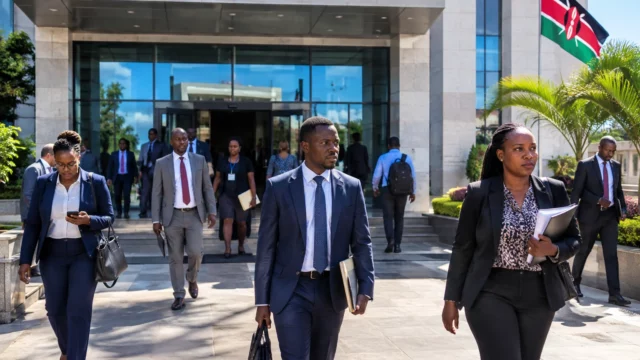
In Nairobi, President William Ruto’s statements sparked panic among many foreigners living in the country, particularly Burundians. According to the UN refugee agency, about 16,000 Burundian refugees and asylum seekers live in Kenya. After the government announced plans to formalise foreign commercial activities, several hundred of them went to the Burundian embassy to obtain documents, while some considered leaving quickly.
The issue goes beyond the Burundian community. Kenya is an economic powerhouse in East Africa, as well as a market that attracts small traders, informal-sector workers and investors from across the region. When a head of state puts pressure on foreign business activities, the shock is felt immediately by families who make their living from small-scale work, often without a robust social safety net. In a regional space where labour mobility has become a reality, political rhetoric alone can create a crisis of confidence.
The affair is also a reminder of a familiar lesson in East Africa: migration or trade regulations are never merely administrative. They affect regional integration, the place of the informal sector and attitudes towards foreigners. Governments may talk about bringing order. Those affected often hear an immediate threat.
Kinshasa tries to regain control of the city
In the Democratic Republic of the Congo, the urban train linking the Central Station to N’Djili International Airport has resumed service after nearly 15 years out of operation. The Congolese presidency presented the relaunch as a way to improve mobility in Kinshasa, the capital, where traffic jams paralyse major roads every day. The ACP, for its part, confirmed that services had resumed after the ONATRA, the public transport operator, carried out drainage works and repairs to the railway line.
The symbolism is powerful, but the stakes are very practical. In a metropolis of more than 15 million people, traffic is not merely an inconvenience. It slows economic activity, makes travel more expensive and penalises above all those who live far from employment centres. A functioning urban train can help, provided the service is regular, safe and integrated with other modes of transport. Without that, its impact will remain limited.
The relaunch also comes amid a broader effort to rehabilitate public infrastructure in the DRC. It shows that a service abandoned for years can once again become a tool of urban policy. For Kinshasa, the issue is not merely technical. It concerns the state’s ability to make a promise of modernisation visible in people’s daily lives.
Tunisia, Senegal: press freedom and the cost of living remain under pressure
In Tunisia, the arrest of journalist Mohamed Yousfi prompted a response from the profession. According to the TAP news agency and the CPJ, he was detained on 4 September while on his way to a programme about the water crisis. He is accused of suspected illicit enrichment and money laundering, and a detention order was issued on 8 September. Press freedom organisations see the case as another sensitive episode for Tunisia’s media landscape.
In Senegal, people took to the streets over another central issue: the cost of living. In Dakar, a protest dubbed the “empty baskets march” denounced rising food prices and the growing difficulty of filling the household basket. The mobilisation was covered by Senegalese public media, which described a march starting at the Jet d’eau roundabout, with pots and empty baskets as symbols.
These two cases point to something broader across the continent: social concerns have not disappeared behind major geopolitical issues. When prices rise and water or food bills become too heavy, governments are judged less on their rhetoric than on their ability to protect the most vulnerable incomes. And when the press or critical voices come under pressure, the space to document this reality shrinks.
Beyond the week: mobility, stability and the image of African states
This week also served as a reminder that major pan-African events and everyday crises often unfold in parallel. In Athens, the flame for the Dakar 2026 Youth Olympic Games was lit ahead of its arrival in Senegal, a sign that the continent is also preparing to host events capable of producing more than stories of crisis. Africa is not only a space of tensions. It is also a space of organisation, infrastructure and symbolic ambition.
What this sequence of events across Africa ultimately highlights is fairly simple: states are being tested on three fronts at once. They must secure their borders without damaging regional relations. They must respond to the cost of living without denying the scale of social discontent. And they must make public services visible, useful and sustainable. From Ceuta to Nairobi, Kinshasa, Tunis and Dakar, this was less a succession of isolated events than a single test of governance.