Algeria
 Egypt
 Libya
 Morocco
 Sudan
 Tunisia
 Benin
 Burkina Faso
 Cabo Verde
 Côte d'Ivoire
 Ghana
 Guinea
 Guinea-Bissau
 Liberia
 Mali
 Mauritania
 Niger
 Nigeria
 Senegal
 Sierra Leone
 The Gambia
 Togo
 Cameroon
 Central African Republic
 Chad
 DR Congo
 Equatorial Guinea
 Gabon
 Republic of the Congo
 São Tomé and Príncipe
 Burundi
 Comoros
 Djibouti
 Eritrea
 Ethiopia
 Kenya
 Madagascar
 Malawi
 Mauritius
 Mozambique
 Rwanda
 Seychelles
 Somalia
 South Sudan
 Tanzania
 Uganda
 Botswana
 Eswatini
 Lesotho
 Namibia
 South Africa
 Zambia
 Zimbabwe

When two borders face similar challenges, security becomes a matter of coordination
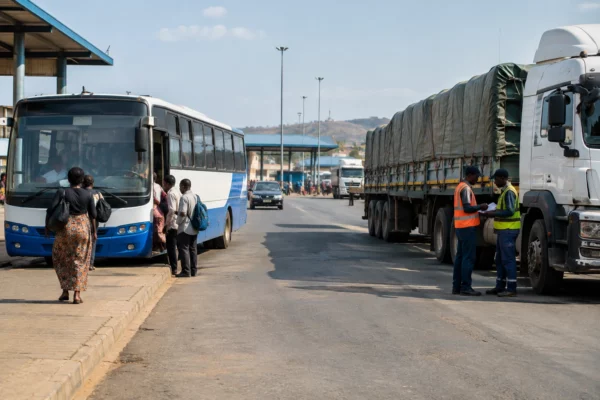
Between southern Angola and northern Botswana, the map does not tell the whole story. The same roads can carry livestock, goods and tourists—or illicit networks that exploit long distances, sparsely populated areas and lengthy borders. Against this backdrop, Gaborone and Luanda have chosen to strengthen their security cooperation, with a clear focus on border controls and the fight against cross-border crime.
The issue goes beyond bilateral relations. In the Southern African Development Community (SADC), member states have faced networks moving from one country to another for several years: livestock theft, stolen vehicles, drug trafficking, wildlife smuggling, the movement of precious stones and human trafficking. Police forces in the region have already stepped up exchanges on these issues, including at a meeting in Kasane, Botswana, in February 2026.
Political and security agreements signed in Luanda
The process gathered pace in Luanda during a state visit by Botswana’s President Duma Boko, who was invited by his Angolan counterpart, João Lourenço. According to information published by Botswana’s authorities, several agreements were signed, including one on defence and security. The two capitals also declared their intention to work together on law enforcement, border controls and cross-border crime.
The rapprochement did not come out of nowhere. In April 2026, Botswana’s ministry responsible for defence and security had already hosted Angola’s ambassador to Gaborone for talks on conservation, tourism, natural resources and defence. At the time, the two sides were already discussing broader cooperation in the spirit of SADC. This diplomatic continuity gives the Luanda meeting added weight: it is not an isolated gesture, but another step in a relationship that is becoming more structured.
Botswana’s authorities have also recalled that this dynamic is part of a longstanding relationship. Political and diplomatic ties between the two countries were formalised in 1976, against the backdrop of southern Africa’s liberation struggles. Botswana and Angola have since maintained regular political relations, marked by high-level exchanges, including a visit by the Angolan president to Gaborone in 2023 and a series of preparatory consultations in 2026.
Why the border also matters to the real economy
Security cooperation is not a standalone issue. It has a direct impact on economic activity that depends on borders. For Botswana, the authorities and INTERPOL cite several priorities: vehicle theft, drug trafficking, wildlife crime and human trafficking. For Angola, INTERPOL says the trafficking of precious stones is a growing concern. In other words, border security protects public revenue as well as legitimate transport, livestock, trade and tourism activities.
This matters for local economies. In rural areas, livestock theft and smuggling first affect households, small-scale farmers and local markets. In cities and logistics corridors, trafficking disrupts supply chains, raises the cost of enforcement and encourages clandestine networks that are more mobile than public services. Closer cooperation between police, customs, armed forces and intelligence services can therefore close gaps without obstructing the legitimate movement of people and goods. In practice, that is the balance the two capitals are seeking.
The Botswana government says it already conducts border patrols with its police and defence forces. Angola, for its part, says it has stepped up surveillance of its land borders. The new agreement formalises this operational reality and provides a basis for sharing experience, institutional coordination and information exchange. Effectiveness often depends on this: less on high-profile announcements than on the ability to quickly pass useful information between neighbouring services.
A bilateral response to a regional problem
Gaborone and Luanda’s approach is also part of a broader trend in southern Africa. In February 2026, senior police officials from Angola, Botswana, Namibia, South Africa, Zambia and Zimbabwe met in Kasane to examine cross-border crime and coordinate joint responses. Botswana highlighted the results of joint patrols, including disrupted drug networks, recovered vehicles, intercepted poached wildlife products and tighter border controls.
This regional approach matters because trafficking networks do not respect administrative borders. They exploit differences in states’ capacity, the length of border lines and the variety of control systems. Governments, in turn, are seeking more flexible tools: bilateral agreements, standing commissions, coordinated patrols, intelligence-sharing and, at regional level, cooperation frameworks supported by SADC. The agreement between Angola and Botswana is therefore part of a broader architecture in which each national accord can strengthen the wider whole.
The question now is implementation. The agreements signed in Luanda also cover other areas, including mining, energy, agriculture, livestock, tourism and transport. This shows that the two governments do not separate security from development. Instead, they share a diagnosis: without safer borders, economic projects struggle to advance; without economic cooperation, security alone cannot address the root causes of trafficking. That is where the issue’s continental significance lies: in an increasingly interconnected Africa, states make progress when they address mobility, security and growth together.
What happens next will depend on the practical implementation of the agreements, follow-up mechanisms between ministries and the ability of the services involved to share actionable information. In the short term, the Luanda meeting confirms one thing above all: in southern Africa, border security has become a pillar of economic diplomacy as much as a law-enforcement tool.