
 Algeria
 Libya
 Morocco
 Sudan
 Tunisia
 Benin
 Burkina Faso
 Cabo Verde
 Côte d'Ivoire
 Ghana
 Guinea
 Guinea-Bissau
 Liberia
 Mali
 Mauritania
 Niger
 Nigeria
 Senegal
 Sierra Leone
 The Gambia
 Togo
 Cameroon
 Central African Republic
 Chad
 DR Congo
 Equatorial Guinea
 Gabon
 Republic of the Congo
 São Tomé and Príncipe
 Burundi
 Comoros
 Djibouti
 Eritrea
 Ethiopia
 Kenya
 Madagascar
 Malawi
 Mauritius
 Mozambique
 Rwanda
 Seychelles
 Somalia
 South Sudan
 Tanzania
 Uganda
 Angola
 Botswana
 Eswatini
 Lesotho
 Namibia
 South Africa
 Zambia
 Zimbabwe
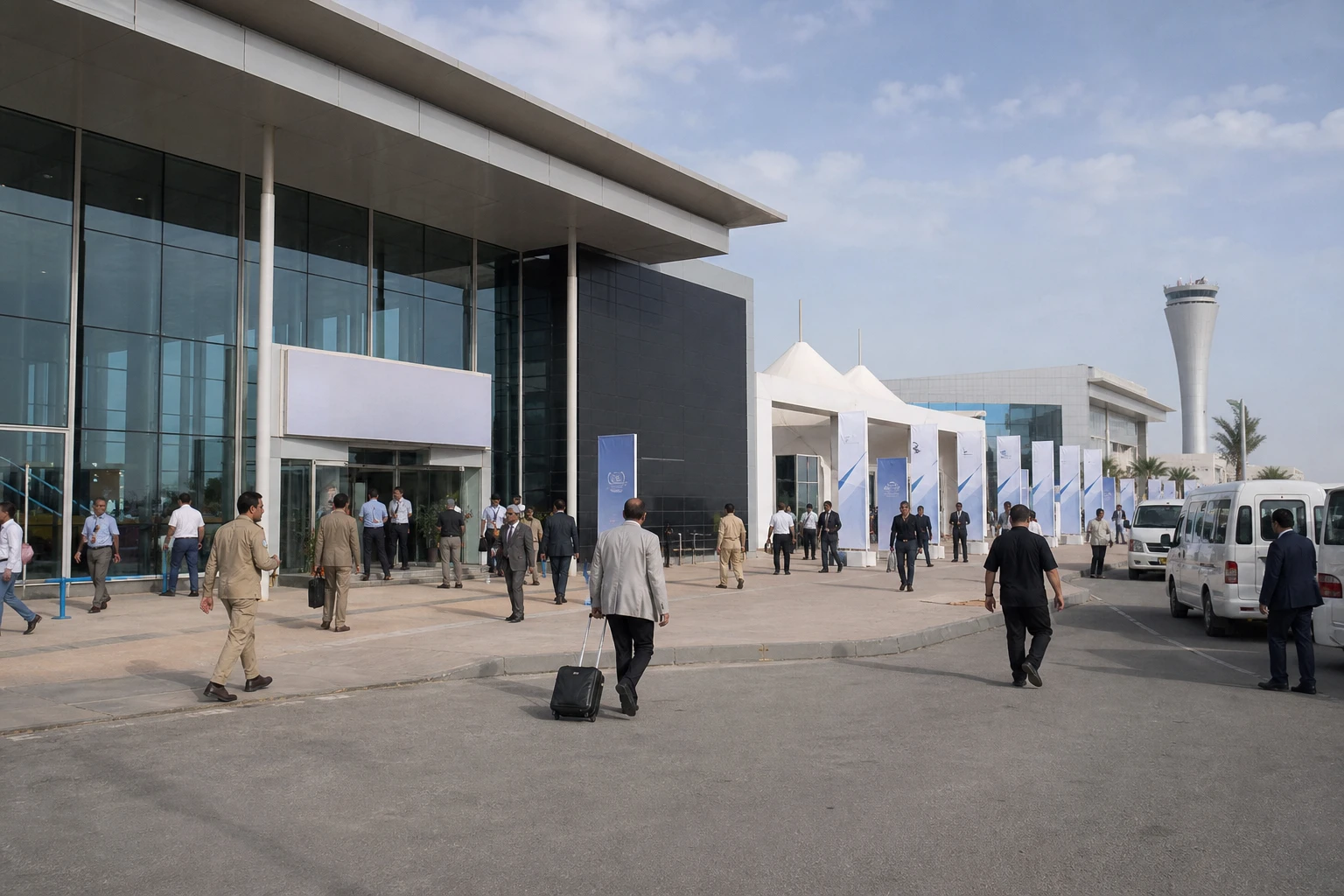
A showcase that goes beyond aerial displays
On Egypt’s Mediterranean coast, Al-Alamein is more than a backdrop for flying displays. During the 2026 International Air Show, the city has become a meeting point for industry, diplomacy and military power. Egypt’s goal is clear: to show that it can attract participants from several continents and position itself as a regional hub for aerospace and defence.
The event is part of a broader sequence. The country hosted a first edition in 2024, then prepared this second edition with the support of the Ministry of Defence, the civil aviation authorities and the Egyptian Space Agency. Organisers had announced more than 250 exhibitors from 50 countries, over 50 flying displays and more than 100 aircraft ahead of the event, while early US communications and local coverage now refer to participation by more than 80 countries.
Egypt’s strategic weight in regional aerospace
This move upmarket is no coincidence. Egypt has turned its major defence events into a tool for international visibility. The country wants to attract contracts, industrial partnerships and technology transfers. In a region where military markets remain highly competitive, a successful show is also a political message: Cairo wants to count in procurement, maintenance and co-production.
The diplomatic dimension is just as important. The US presence, with a dedicated pavilion and several aircraft on display, is accompanied by an explicit message about bilateral cooperation. Washington presents its participation as a way to strengthen its strategic partnership with Egypt in military, commercial and private aviation, as well as aerospace technologies. On the ground, this is reflected in C-130J Super Hercules, A-10 Thunderbolt II, F-16 Fighting Falcon and F-15E Strike Eagle aircraft on display in El Alamein.
What US participation shows
The US Air Force presence is more than a sideshow. It is a reminder that Egypt remains one of the United States’ key military partners in the Middle East and North Africa. Cairo, for its part, is seeking to keep ties open with several suppliers and equipment blocs. This diversification strategy gives Egypt greater room for manoeuvre, even if it entails more complex maintenance logistics.
Egypt’s air fleet reflects this approach. The country’s air force operates US, French and Russian aircraft. Among the most prominent models are French Rafales, US F-16s and Russian MiG-29M/M2s. These are joined by older aircraft inherited from the Cold War, which remain in service with some units. This mix illustrates a pragmatic doctrine: buy from several partners, preserve multiple channels of cooperation and avoid exclusive dependence.
For industry, the impact is immediate. A show of this size is not just about displaying aircraft. It opens discussions on assembly lines, maintenance, onboard electronics, simulators and training. Companies taking part are seeking to establish a foothold in Cairo, while also reaching Arab and African markets from Egypt, which has infrastructure, a large domestic market and a strategic location between Africa, the Middle East and the Mediterranean.
A signal that reaches beyond Egypt
At continental level, the event represents more than a display of power. It shows that an African country can host a major international aviation gathering, attract large delegations and become a meeting point for manufacturers, armed forces and civil authorities. On a continent where needs in transport, aerial surveillance, border security and industrial development remain substantial, this capacity to host matters as much as the aircraft on display.
It also highlights the competition running through North Africa and the Mediterranean region. Defence shows, joint exercises and aircraft orders are now shaping a form of technical diplomacy. Egypt is defending its position, with Cairo as its political and administrative centre, while Al-Alamein is becoming an increasingly useful showcase for its economic and military ambitions. For neighbouring countries, the message is simple: Africa’s aerospace industry can take shape around hubs capable of attracting regional demand, rather than relying solely on major centres outside the continent.
The next steps will play out on two fronts. First, the show’s ability to turn displays into contracts and lasting cooperation. Second, how Egypt will use this visibility to strengthen its position in the defence and aerospace industries, at a time when several African capitals are also seeking to move up the value chain in these sectors.



